


Photo provided by Alaska Department of Transportation & Public Facilities
n April 29, 1974, work crews began building the Haul Road— a gravel highway from the Yukon River to Prudhoe Bay where the largest oil field in the United States had recently been discovered.
In a rush to accommodate construction of the Trans Alaska Pipeline System, or TAPS, the road was completed in just five months and served as a vital corridor for delivering equipment to the North Slope. Known today as the Dalton Highway, this invaluable roadway provides the only gateway to the Arctic and continues to support ever-expanding work on the North Slope.
“Two years ago, we formed the Alaska Oil and Gas Historical Society to begin collecting artifacts to preserve and share the history of the oil and gas industry in Alaska,” says Rebecca Logan, CEO of the Alaska Support Industry Alliance and one of the society’s founders.
Edna Arend Witcher, an engineer who worked on the project, wrote the book Alaska’s Last Great Gold Rush: 1974 Haul Road Diary—Alaska’s Arctic Road documenting the five months it took to build the North Slope Haul Road where no roads previously existed.
“The exhibit was born out of that, and we began discussing what we could do to share that information and honor the anniversary event,” Logan says. “We used the ‘Diary of the Haul Road’ as the theme and began compiling pictures, newspaper articles, artifacts, and stories from individuals who have worked on and driven the Dalton Highway.”
Among the artifacts is a 1974 Chevrolet Suburban, the first vehicle to traverse the entire length of the North Slope Haul Road.
A monumental achievement in the history of Alaska’s infrastructure, the Dalton Highway today stretches 414 miles from Livengood to Deadhorse, on the shores of the Arctic Ocean. The historic exhibit honors the visionary leadership and commitment of Nate Bauer and the individuals who worked alongside him to complete the extraordinary engineering feat, which continues to be the lifeline of the North Slope.
The traveling exhibit concluded at Fairbank’s Westmark Hotel in late October.
“One of the things we are working towards is having an Alaska Oil and Gas Museum where we can permanently display these artifacts and others,” says Logan.
Santos has the tremendous Pikka project on state and Alaska Native Corporation lands; ConocoPhillips has the Willow project; and there are a number of other explorations and pilot projects going on that are expected to boost Alaska oil production.
The success of these projects depends heavily on the state of the Dalton Highway. Moving goods and equipment up to the slope in a timely, efficient, and safe manner is a priority for all projects on the North Slope.
When contractors and transportation providers express concerns about the condition of the Dalton Highway, the Alaska Department of Transportation & Public Facilities is obligated to respond as quickly as possible to keep the road passable and safe for trucks to travel at a reasonable speed.
Santos’ Pikka project requires thousands of round trips on the Dalton Highway. Slow rates of travel and congestion caused by poor road conditions impact the timeliness and efficiency of delivery to the project area.
The company has maximized efficiency by using prefabricated modules that travel up the Dalton Highway to the slope. The modules can contain sensitive equipment and electronics that are vulnerable to adverse vibrations and movement. Rough road conditions can impact Santos’ ability to integrate and connect the modules, forcing the company to rebuild or repair them on site. Slow delivery times also increase costs, and the time required to complete construction.
In safety meetings with contractors, transportation service providers have raised concerns about conditions and inexperienced or unprepared drivers on the road. These concerns, combined with the need for their modules to arrive intact, caught the attention of company management. Although Santos has no direct role in maintaining the highway, the company has been able to help rally support focused on these issues and on the importance of the highway and its maintenance.

Photo provided by Alyeska Pipeline Service Company/McCutcheon Collection

Photo provided by Alaska Support Industry Alliance
“During the project, we were able to widen the footprint of the road by 16 feet and raise the grade in key areas,” says Cruz Construction project manager Taylor Lueck. “The grade raises will reduce embankment settlement and provide a section of road for maintenance crews to easily maintain during the winter months.”
From funding issues to multiple design changes to marginal material sources, the project was not without challenges.
“The pit we were able to utilize for the 2.3 million tons of material we needed was at one end of the project, which resulted in long hauls,” Lueck says. “The material source provided a marginal material due to high saturation, making compaction difficult.”
Additional sites with good potential for quality material were identified in more ideal locations within the project boundaries. Unfortunately, due to the extensive permitting process required to open material sites on federal land, Cruz worked solely out of the material site at the far end of the project. “It’s never an ideal situation, especially for a quantity of material with this magnitude,” Lueck says. This ultimately resulted in additional costs associated with equipment maintenance, road maintenance, and material trucking.
Another AGC member, Great Northwest, Inc., has also been working on the Dalton Highway with a focus on sub-standard road geometry and failing embankment sections of the roadway between Mileposts 18 and 37. The project scope included embankment stability improvements, highway realignments where deficient roadway geometry did not meet the 50 mile-per-hour speed standards, updated signing and guardrails, and replacement of the Hess Creek Bridge at Milepost 24.
Great Northwest signed on for a three-year project, but had some luck.
“We were able to complete the project in two years,” says project superintendent Tyler Quakenbush. “The first year, we had over 100 workers on the job and in year two, just over 70.” The Great Northwest team worked a twelve days on, two days off schedule. “Basically, we took off every other weekend,” said Quakenbush. “We built an RV camp for the workers with power, water, and sewer.”
The first year of the project involved blasting at materials sites.
“The project required the drilling and blasting of several rock quarries located within the corridor in order to produce the 2.5 million tons of borrow required for the project’s completion,” explains Quakenbush. “In addition, our work effort included 800,000 cubic yards of excavation, both rock and frozen earth; the installation of over 20,000 lineal feet of culvert; and the construction of a new Hess Creek bridge.”

Photo provided by Alaska Support Industry Alliance

Photo provided by Alyeska Pipeline Service Company/McCutcheon Collection
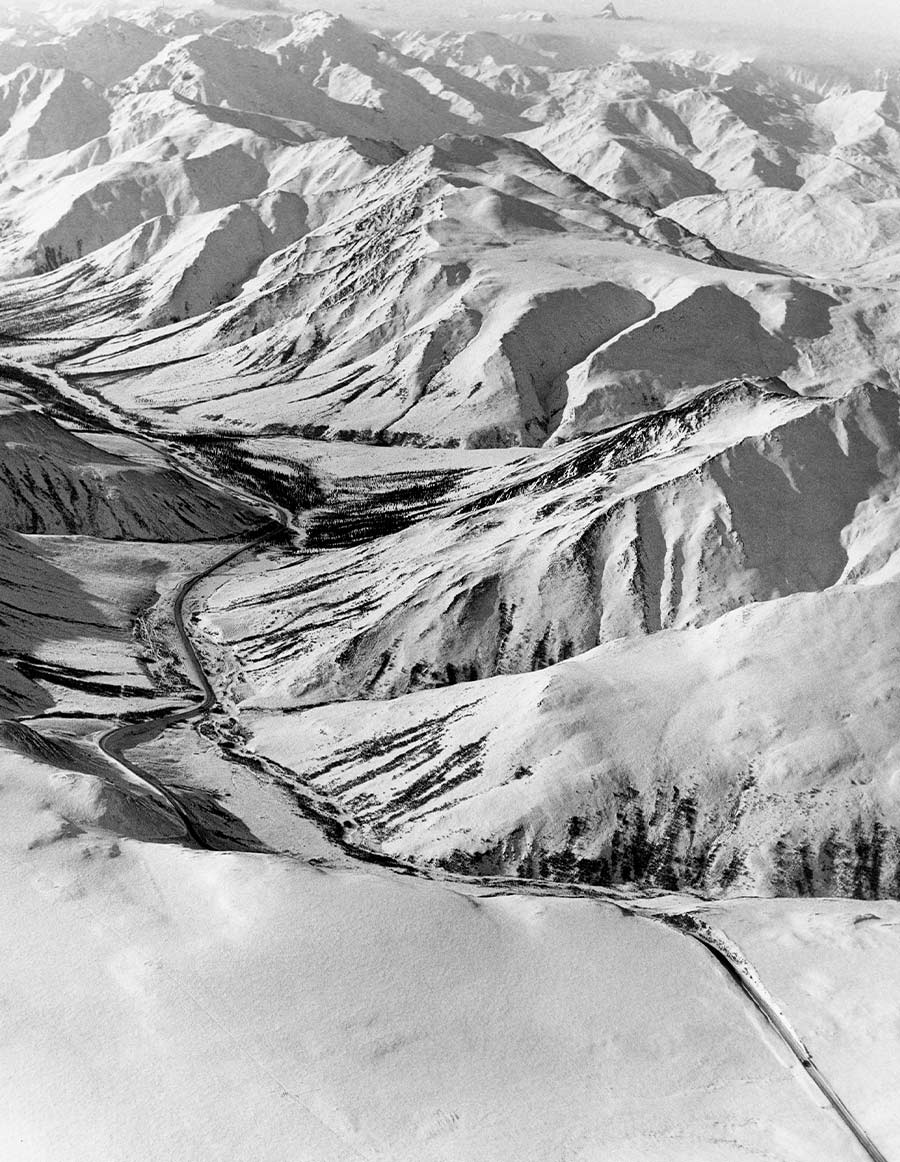
Photo provided by Alyeska Pipeline Service Company/McCutcheon Collection
DOT&PF is using various engineering techniques while working to improve the road. One example is north of Atigun Pass.
“We’ve raised the roadway at least five feet in some areas, and now the road is scoured by the wind, which removes some of the snow buildup for us,” says Perreault. “Considering feedback from drivers and our maintenance staff, we continue to deploy technology to the highway. We now have cell towers in many of the stations, and we have some remote weather installations and are looking to add more, as this gives us real-time conditions for our maintenance staff and operators on the roadway. The state continues to look at how we can improve things for the people we are working for by harnessing innovative technology.”
When highway conditions are unfavorable, the road’s efficiency decreases. Some operators have indicated they are working at about 50 percent efficiency, which means road users were able to complete about half the trips in the summer that they would in a normal year.
“We are hearing from operators that the conditions are beating up the trucks or slowing them down,” explains Perreault. “We’re working to resolve this by bolstering the maintenance staff numbers. We’re continually recruiting for these positions and are currently offering a schedule set up as two weeks on and two weeks off to be more attractive to people. Workers from other districts are able to volunteer to take a turn working on the Dalton Highway on their two weeks off.”
Increasing the workforce necessary to complete the repairs to the Dalton Highway requires more funding, however.
“We make that argument with the state legislature. One of my maintenance supervisors says there’s no top end for how much money we could use,” says Perreault. “We have managed to stay within our budget, as given to us by the legislature, and we have been able to get supplemental funding. But there’s a lot of work to be done—and we need hands to do it.”
Having access to the materials necessary to complete the work required for resurfacing and rehabilitating the Dalton Highway presents additional challenges.
Much of the land on the North Slope is controlled by the US Bureau of Land Management, or BLM. BLM has a permitting process for developing material sites, with distinct protocols and priorities. As a result, gaining access to the gravel and materials on BLM sites is often difficult and costly.
“We’ve run into this problem around milepost 404 of the Dalton. In order to keep this section of the road from washing out, we had to bring in a lot of loads of the materials from 200 miles away,” explains Perreault. “This is not an efficient use of our resources, energy, or our carbon emissions budget. But experiences like that provide an opportunity to really be able to explain to our partner agencies the importance of finding a way to get those places developed.”
“The Dalton Highway is a vital artery to the Arctic Ocean that needs to remain open, stable and resilient.”
Work on the Dalton Highway will continue into the future. Contracts for upcoming Haul Road work on the Dalton Highway Milepost 245 through 274 resurfacing and the Dalton Highway Milepost 247 through 289 and Milepost 305 through 362 delineator replacement projects will go to bid early this year.