


hen visitors step into the University of Alaska Fairbanks’ new planetarium, they will be greeted by more than just a high-tech projection system and a state-of-the-art dome. They will be entering a space that was decades in the making—a dream for scientists, educators, and students.
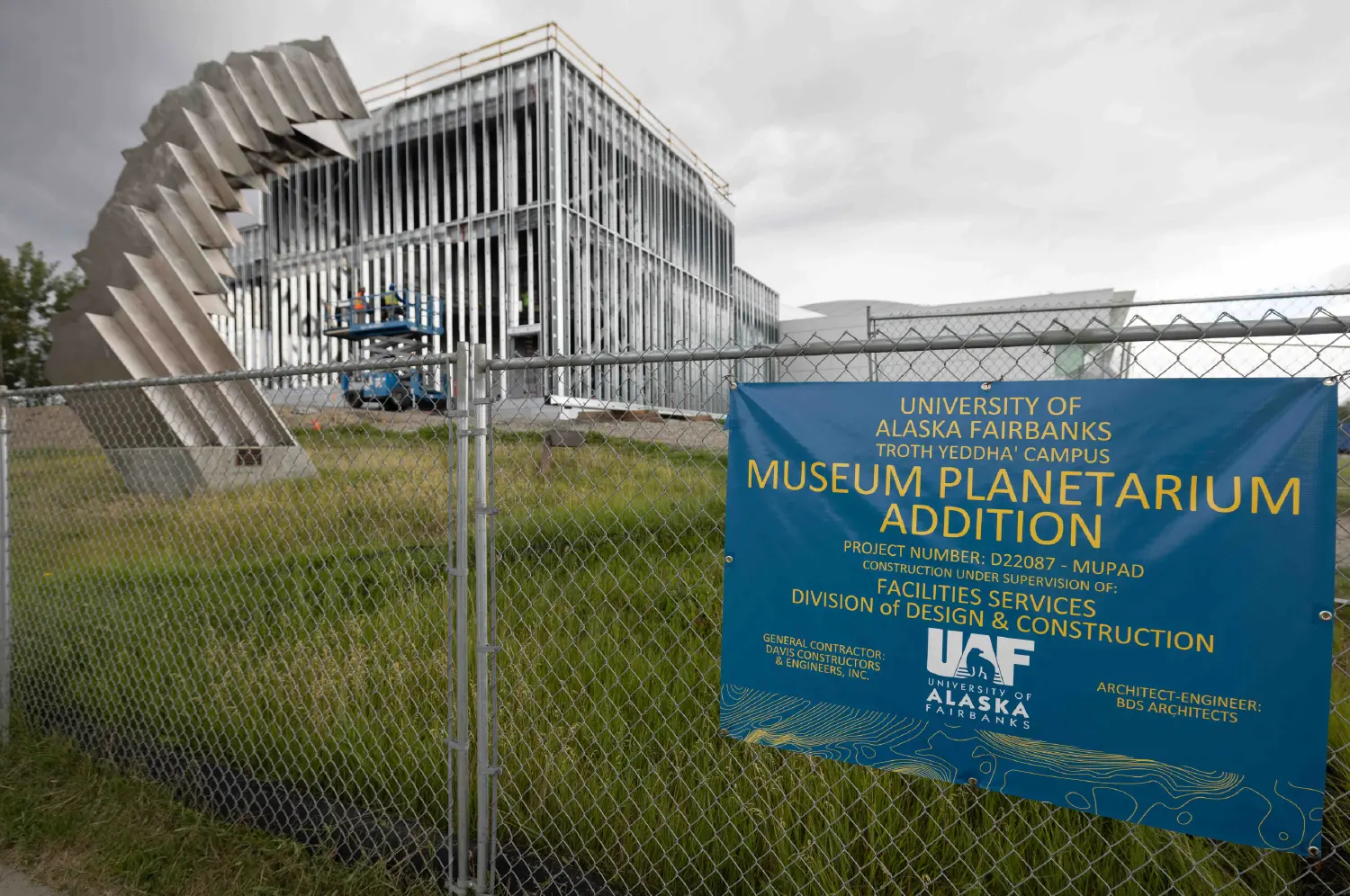
The Fairbanks community has long wanted a permanent place to bring the wonders of the Arctic sky, the aurora borealis, and the universe indoors. This $9 million, 5,700-square foot facility, which is expected to open to the public in February, will be the northernmost planetarium in North America.
Located on the west side of the University of Alaska Museum of the North, the theater will feature an 11-meter dome, two projectors, four image-generation computers, theater-quality surround sound, and specialized lighting systems. The sixty-five-seat venue will host astronomy classes, public programs, and immersive experiences that go beyond stargazing.
“Every summer, tourists wander into the Geophysical Institute and ask, ‘Where’s the aurora?’” says McCoy. “In winter, we can point them to the real thing, but in summer, with the 24-hour daylight, they’re out of luck. A planetarium means we can show them the aurora, along with the science, culture, and beauty behind it any time of year.”
This idea wasn’t new. Fairbanks residents have advocated for a planetarium for at least four decades, says McCoy. Former UAF Chancellor Brian Rogers pushed for funding when he was a state legislator more than forty years ago. Multiple feasibility studies came and went without a green light.
What finally brought the planetarium to life was an anonymous donor’s commitment to fund the brick-and-mortar portion of the project. Additional contributions soon followed. The MJ Murdock Charitable Trust pledged nearly $500,000 for the projection and sound system. In addition, longtime UAF donors Sarah and Cary Keller committed $125,000 to fund the planetarium manager position.
McCoy says he sees the project as a tool for both outreach and research. Beyond serving tourists and the local community, the facility will be used for K-12 field trips, university courses, and scientific presentations.

With the software and technology that’s being installed, the planetarium can entertain and educate visitors about astronomy as well as chemistry, biology, glaciology, and volcanology.
“We can pull up a molecule, spin it around on the dome, and make science come alive,” says McCoy.
Preliminary demolition began in late 2024, including the relocation of an Alaska Native totem pole from the construction site to a protected location inside the museum. Official groundbreaking took place in April 2025 and completion is targeted for late December 2025.
“A planetarium is a specialized facility,” says Lindsey. “They require unique equipment that requires technical installation. Keeping all [stakeholders] included on the schedule and the planning process to have the construction side complete for dome installation has been very important.”
Lindsey says consistent collaboration has kept the project on track.
“This project was very much a team approach,” says Lindsey. “We’ve worked hard on value engineering and design to fit within the designated budget. Everyone involved worked hard to make the pieces come together.”
The construction brought together a wide range of skilled subcontractors, each contributing specialized expertise to the project.
Aaron Plumbing & Heating Company tackled the mechanical systems, the electrical work was completed by Fullford Electric Inc., and Swanson Steel Erectors Inc. and JD Steel Co., Inc. took care of the structure steel, meaning the building represents coordinated effort across multiple trades.
Great Northwest, Inc. handled site work, while Rady Concrete Construction and Gundersen Painting, Inc. were hired to add finishing touches inside and out. A&A Roofing Company, Inc. is working to ensure the building is weather tight, and Commercial Contractors, Inc., Elite Acoustics, and GMW Fire Protection are taking charge of interior systems and safety. BEK of Alaska, Inc. and Siemens Industry, Inc. are also providing support.
For Lindsey, these partnerships are essential.
“We can bring all that into the dome,” says McCoy.
It’s not just a place to look at the stars. It’s a place to tell Alaska’s stories. Programs will include astronomy shows, cultural presentations, and immersive science films. One highlight is Cultural Connections, a collection of films produced by UAF featuring interviews with Alaska Native elders about the aurora, along with song, dance, and animation.
Classroom integration will be another major focus. For years, UAF has been operating portable planetariums around Alaska. The inflatable domes are popular, says McCoy, but they wear out and can only reach so many schools.
“This fixed facility means we can welcome everyone in, year-round,” says McCoy.
Through it all, Davis Constructors & Engineers have maintained a strong partnership with UAF.
“Working with Davis has been great,” says McCoy. “They’re doing a fantastic job.”
For Lindsey and the Davis team, the reward will be seeing a project that was years in the making reach completion.
“The collaborative teamwork that has occurred to bring this project together will undoubtedly make a positive impact on the Fairbanks community,” says Lindsey. “Davis Constructors and all of our subcontractors are excited to see this project come to life.”

- Aaron Plumbing & Heating Company
- Fullford Electric Inc.
- JD Steel Co., Inc.
- Great Northwest, Inc.
- Gundersen Painting, Inc.
- Commercial Contractors, Inc.
- GMW Fire Protection, Inc.
- Siemens Industry, Inc.