


A
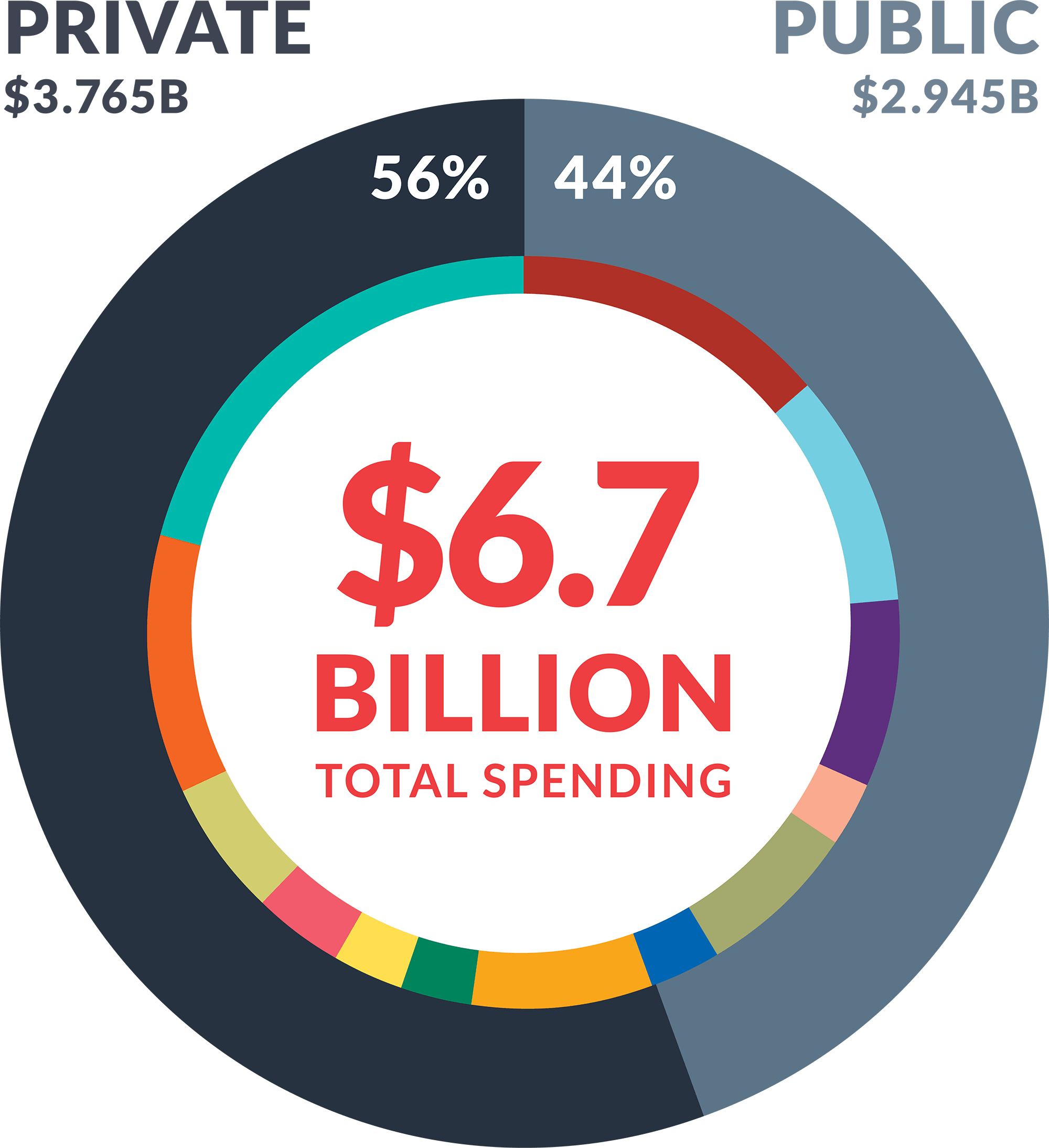
n anticipated increase in private sector projects is expected to outweigh decline in public sector infrastructure spending. Forecasted public sector spending will be significantly influenced by the availability of State of Alaska funding to unlock federal transportation construction dollars.
One of two large North Slope development projects will move into production this year, reducing overall oil and gas construction spending. Healthcare-related spending reflects several large projects, notably pursued by Alaska’s Tribal Health Organizations, and a wide range of utility infrastructure work is planned for the coming year (broadband, water/sanitation, electrical).

Private Sector
Construction Outlook
Oil and Gas
$1.4 billion

Work is coming to a close on Santos’ Pikka project, one of two large developments driving oil and gas spending over the last several years. ConocoPhillips will continue development on the Willow Project through 2029, when first oil is expected. Hilcorp will develop infrastructure in support of its Point Thomson operations, and site work for Alyeschem’s new methanol plant on the North Slope will facilitate module tie-in by midyear. A final investment decision is expected soon on the Alaska Liquified Natural Gas pipeline, a project with renewed planning following significant investment in 2025.
Utilities
$750 million

Utility spending on construction is expected to increase in 2026 as broadband and water/sanitation infrastructure projects continue. The Alaska Native Tribal Health Consortium (ANTHC) will continue rural water/sanitation construction including first service water and sewer in Tetlin, Tununak, and Venetie. Some utility projects are on pause following cancellation of federal grants. However, power providers still plan to contract projects across the state. Examples include Golden Valley Electric Association substation upgrades and new builds in the Interior, as well as Sweetheart Lake and Thayer Creek hydro projects in Southeast Alaska.
Residential
$430 million
Private residential construction increased in 2025 and recent interest rate cuts are likely to ease pressure on the residential sector. Regional housing authorities have development planned across the state including residential construction by Taġiuġmiullu Nunamiullu in Nuiqsut and Wainwright, site prep by Baranof Island for residential development in Sitka, and ten new units in and around Fairbanks by Interior Regional Housing Authority.
Hospitals and HealthCare
$280 million
Tribal health organizations continue to invest in health infrastructure across Alaska. Work continues in Anchorage on the Alaska Native Medical Center expansion and skilled nursing facility. SouthEast Alaska Regional Health Consortium (SEARHC) plans to expand service in Haines and develop employee housing in Haines and Wrangell. Completion of the Providence Crisis Stabilization Center in Anchorage is targeted for the end of 2026. Southcentral Foundation’s Benteh Nuutah Valley Native Primary Care Center is undergoing significant expansion through 2027. Construction of the Nenana Health and Wellness Complex, a health clinic and fire station, will begin in the City of Nenana.
Mining
$190 million
Construction spending in support of mine development is expected to total $190 million in 2026. Favorable commodity prices and policy support are driving significant mineral exploration work in Alaska. Infrastructure development is often necessary to facilitate exploration. For example, Contango plans to develop infrastructure in support of the Lucky Shot and Johnson Tract projects in Southcentral Alaska. Alaska’s seven large producing mines continue to spend in support of mine development. Examples include Kensington, which will continue its Tailings Treatment Facility expansion outside of Juneau.
Other Basic Industry
$215 million
For several years, cruise dock developments have been among the highest-value projects in this category. In 2026, project owners in Juneau will continue to pursue two major developments, Àak’w Landing and Goldbelt Aaní on Douglas Island. In Southcentral, work continues on the $135 million Seward dock and terminal replacement. In Fairbanks, the Fountainhead Transportation Museum will be relocated to the old Kmart building while the existing museum space will be repurposed as a large conference and event center. Seaweed processing facility development is expected in Kodiak, and routine maintenance will continue at modest levels across Alaska’s seafood processing plants.
Other Industrial/Commercial
$500 million
Businesses across Alaska will continue to invest in new facilities, upgrades, and expansions. Anchorage downtown redevelopment work continues, while long planned air cargo and logistics projects at Ted Stevens International are likely to extend into 2026.
Public Sector
Construction Outlook
Airports, Ports/Harbors, Railroad
$900 million
Two major port projects will increase spending in this category in 2026. The Port of Nome project was rebid in 2025, and construction is expected in 2026. Work will begin on Anchorage’s Port of Alaska Terminal 1 replacement. An EPA grant and private funding will bring shore power to Seward’s port; ships will be able to plug in by 2027. Port MacKenzie is planning several projects including security upgrades and demolition of existing structures in 2026. About $300 million in statewide Department of Transportation airport projects are subject to state match requirements to receive federal funding.
Highways and Roads
$690 million

The Alaska Department of Transportation and Public Facilities (DOT&PF) directs the majority of Alaska’s highway and road construction funding. Reconstruction of the Parks and Richardson Highways, landslide repairs to Haines roadways, rehabilitation of Skagway’s state-owned roads, and the Wasilla Main Street Rehabilitation project are among projects planned by the three DOT&PF regions. Funding of these projects is highly contingent upon state match funding to access federal transportation grants, and spending in this category may fall short of this forecast if the full state match funding is not appropriated in 2026.
National Defense
$515 million
National Defense spending will decrease following completion of large US Army Corps of Engineers projects in 2025. In 2026, military construction projects will include Joint Base Elemdorf-Richardson’s comprehensive flight training facility, Fort Wainwright’s fieldhouse, and pier repair on Shemya Island. The US Coast Guard will focus on housing and water/sanitation infrastructure in Kodiak, repairs and maintenance in Ketchikan, and new homeport facilities in Sitka ahead of the arrival of Coast Guard Cutter Douglas Denman from Ketchikan.
Education
$200 million
Major maintenance, expansion, or renovation projects will account for the majority of education-related construction work in 2026. K-12 facility projects are anticipated in Anvik, Rampart, Nome, and many other communities. The Matanuska-Susitna Borough School District will expand three charter schools. University projects include UAA’s Alaska Leaders Archives, a childcare facility at UAF, and updates at UAS facilities in Sitka and Ketchikan.
Other State and Local Government
$440 million
State and local government projects not captured in other categories are expected to total $440 million in 2026. Projects include cemetery upgrades in Ketchikan, a new animal control facility in Bethel, and the Seward Harbor Boardwalk Replacement project, among others.
Other Federal Government
$200 million
Projects receiving federal funding that do not fall into other categories are expected to total $200 million in 2026. Projects include wildland fire crew housing in Denali, Petersburg Forest Service office renovations, and continued work on public use cabins in the Chugach and Tongass National Forests.
Prepared by McKinley Research Group for the Associated General Contractors of Alaska/Construction Industry Progress Fund.

The full report and additional resources are available online at agcak.org/news-publications