


Photo provided by Great Land Trust.
Photo provided by Great Land Trust.
ust beyond Valdez’s downtown and ferry terminal, a forested hill that once sat quietly in private ownership has been transformed into one of the city’s newest public assets.
Known today as Nayurluku Park at Meals Hill, the 184-acre site is now a four-season recreation area shaped by years of planning, layered funding sources, and a construction phase that required flexibility. The name, agreed on through discussions with Alaska Native groups who live in the area, is pronounced “neigh-og-lou-goo”. The name is from the Sugpiag people, who fished and traded on the land for centuries. Nayurluku means to “guard” or “keep safe.”
Completed in September 2025, Phase 1 of the park is designed to serve both the Valdez community and the growing number of visitors arriving by cruise ship just steps from the park’s entrance.
That changed in November 2019 when Great Land Trust purchased the property using Exxon Valdez Oil Spill (EVOS) settlement funds and placed it under a conservation easement. The agreement preserved the land and set aside funding for a future master plan.
Valdez City Manager Nathan Duval, who previously served as the city’s capital projects and facilities director, said conservation alone was not the goal.
“It had been a recreation area, kind of an informal recreation,” Duval said. “Putting in the conservation, the intent was not to just be a nice thing to look at but also something that we could actually use and enjoy.”
The master planning process began in 2020, during the height of the COVID-19 pandemic, and focused on opening the land to public use while respecting ecological constraints and long-term stewardship. Great Land Trust led the effort, working with partners including The Port Valdez Company, Exxon Valdez Oil Spill Trustee Council, and multiple federal, state, and local agencies.

Photo provided by Great Land Trust.

Photo provided by Great Land Trust.
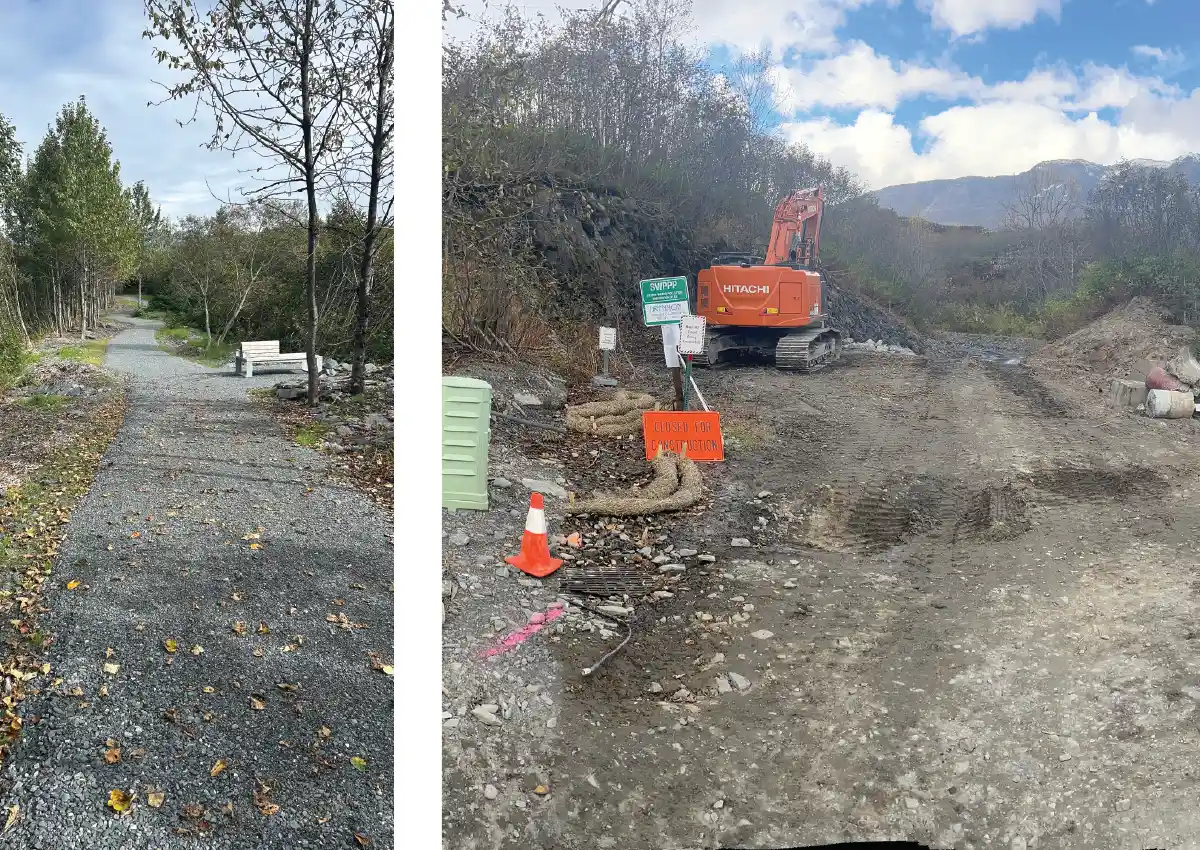
Photo provided by City of Valdez
“Community input made it clear that people wanted to experience Meals Hill regardless of age, ability, or confidence level,” said Lucy Baranko, who worked on construction administration for the project.
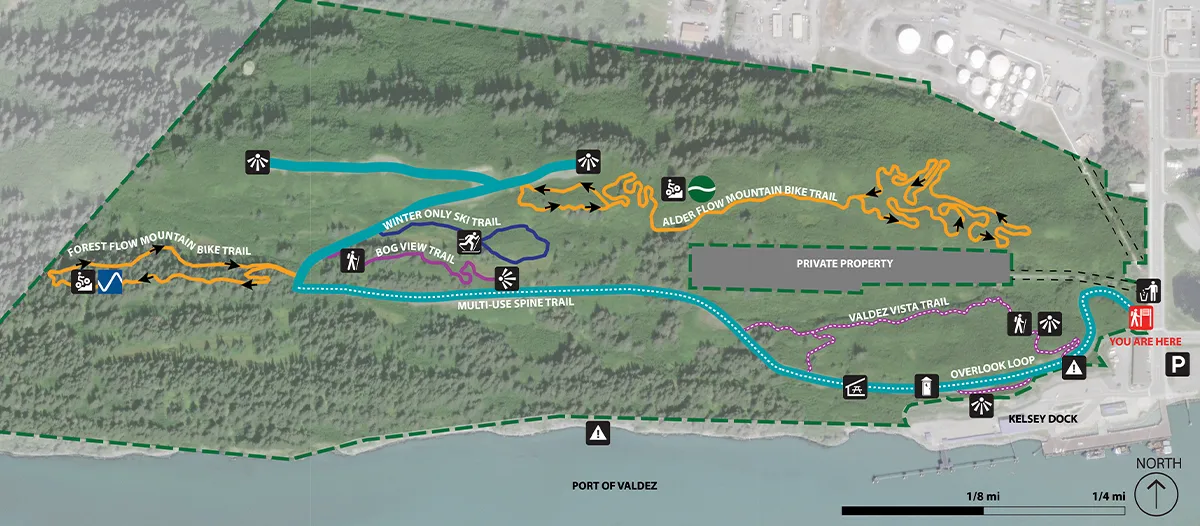
To address that, the master plan centered on a regraded, multi-use spine trail that follows an existing road alignment originally intended for subdivision access. The first quarter mile meets universal design standards, says Baranko, creating a consistent and manageable grade for a wide range of users.
“This decision influenced everything from trail widths to surfacing and even where viewpoints were located,” Baranko said. “Key experiences, like harbor overlooks and forest canopy views, were intentionally placed along accessible routes so that users don’t have to choose between ease of access and meaningful scenery.”
From the spine trail, narrower routes branch out to serve more specific uses, including purpose-built mountain bike singletrack, hiking trails, and winter ski and snowshoe routes. The layered system allows users to choose their experience while minimizing conflicts.
As the primary contractor, Drennon was responsible for both trail design-build work and the physical construction of Phase 1, including trails, bridges, park amenities, and hard-surfacing components.
The work required careful trail layout to fit proposed routes within tight corridors, all handled “in a safe and aesthetic way,” says Drennon president Roy Drennon. It was a challenge to maintain access on the ridgeline where crews were often working in multiple areas with a single access point in and out.
Trail construction required advance planning to keep materials moving while preserving access throughout the site, says Drennon. Crews worked with specialized materials, including yellow cedar for fences, rail caps, and posts, and performed rock excavation into solid bedrock by hand to build stair access to key viewpoints.
“Working in Valdez added another layer of complexity,” says Drennon, “with long lead times to fly or truck in materials and narrow weather windows due to heavy precipitation.”
With a fixed grant budget, not every element of the master plan could be built at once.
“From the beginning, Phase 1 needed to do two things well: establish access and set the tone for the park’s long-term identity,” says Baranko. “That meant prioritizing the primary access route, early trail connections and visible improvements that help people understand how the park works.”
That also meant making some decisions on the fly, such as routing mountain bike trails.
“We didn’t have a lot of subsurface or geotech information,” says Duval. “They had to be kind of creative with the layouts and the routing of the trails.”
Natural springs and drainage issues led to real-time decisions in the field, including removing roughly a quarter-mile of trail to avoid costly structures, such as bridges.
“The design team worked closely with Drennon and city staff to problem-solve in the field,” says Baranko.
Drennon says the collaborative approach with the City of Valdez and the design team was one of the most rewarding aspects of the project, pointing to the finished trails and overall beauty of the site as a source of pride from a construction standpoint.
“Every time I went up there for a site visit,” says Duval, “I had to kick people off, saying, ‘Hey, we’re still running a loader up here.’ People were chomping at the bit.”
The official ribbon cutting took place September 11, 2025, in conjunction with a state parks conference in Valdez. The ceremony included the unveiling of an entry plaza artwork honoring the Meals and Hazelet families, Alaska Native history, and the Exxon Valdez oil spill restoration funding that helped make the project possible.
Once opened, the park saw immediate use.
“The next weekend was beautiful,” says Duval. “It was mountain bikes up and down the hill all day. The cross-country teams from the middle and high schools were running up there doing their laps.”
For Cole Beck, Valdez’s Park Maintenance Supervisor, Phase 1 marked the transition from construction to daily operations.
“We are just getting into our management and maintenance of the property,” says Beck. “It’s been fun to use the snow to create new winter recreation opportunities.”
Valdez’s heavy snowfall has allowed the city to lean into winter recreation. The main spine trail is groomed with a PistenBully, while the Alder Flow mountain bike trail is groomed with a snowmachine and rollerpacker and remains open to non-motorized use.
“The view stations have worked well and are the focal point of the park, with a beautiful cedar fence and high-quality informational signs,” he says.
The park’s proximity to downtown, the ferry terminal, and cruise ship docks will influence city operations.
“I’m interested in seeing how the summer tourist season impacts the park,” says Beck. “With such beautiful views and easy-access trails so close to the dock, I’m expecting it will be highly used.”
Without EDA and EVOS funding pieces, a project like this would probably never happen, Duval says. Coordinating the funding added complexity, but he says the result was worth it.
“It’s going to have a return on investment from a tourism and community perspective,” he says.
With Phase 1 complete and future phases identified, Nayurluku Park at Meals Hill stands as a working example of how organizations can come together to deliver long-term public value just steps from the heart of Valdez.