

Chenega Regional Development Group

Chenega Regional Development Group combines local knowledge and skill
nhancing the lives of shareholders. Investing in community and culture. Increasing economic development. Chenega Regional Development Group (CRDG) LLC is hoping to achieve all that and more for Chenega Corporation shareholders and Native Village of Chenega residents.
Formed in 2023 as a subsidiary of Chenega Corporation, CRDG operations largely take place in Prince William Sound. There, the company maintains and improves the infrastructure and quality of life in the village by providing construction, land management, and maritime services. It also contributes to the education and preservation of the traditional culture of the Chenega people. In addition to serving both the Native Village of Chenega and corporate-owned properties of the Chenega Corporation, CRDG also serves multiple native communities through its cultural and subsistence educational programs.
“We are in an ideal position with both marine transportation and construction capacity and a deep history and knowledge of Prince William Sound to grow development opportunities in the sound and to support contractors and others working in the area,” explains Project Manager Douglas Lipinski, adding that CRDG also owns a number of housing units and lodging facilities in western Prince William Sound to accommodate those working in or visiting there. “I don’t know of another company that offers the array of services that we provide under one umbrella.”
This synergistic, team-focused approach was demonstrated particularly well this past fall, Lipinski says, when Chenega was notified of the discovery of an old dug-out canoe on Montague Island.
“Our team was able to join our cultural, marine logistics, and construction expertise for a complicated and successful recovery of this important artifact,” he says.
Resiliency and Resourcefulness
While the Chenega Corporation consistently ranks among the top ten most successful Alaskan-owned businesses in the state, it has had to overcome numerous obstacles to thrive. The village of Chenega was devastated by the 1964 earthquake, in which 26 residents—one-third the community’s population—died. It was the largest loss of any community in Alaska. After rebuilding the village in a new location twenty years later, the Exxon Valdez oil spill occurred, creating more devastation to the ecosystem and severely impacting the subsistence lifestyle of the people in Prince William Sound and within the spill area.
“The people of Chenega have lived and subsisted in Prince William Sound for thousands of years, requiring innovation and resiliency through challenging times,” says Lipinski. “It is important in everything we do to always be respectful of our culture and the history of the indigenous people of our region. Resiliency and resourcefulness is what has kept the village and the Chenega people strong—and we exemplify those values in the work we do every day.”

The Chenega Regional Development Group construction crew is finishing up the fourth of six full-home renovations in the village, taking the buildings down to the studs to allow for the addition of energy-efficient improvements and providing access for necessary repairs.

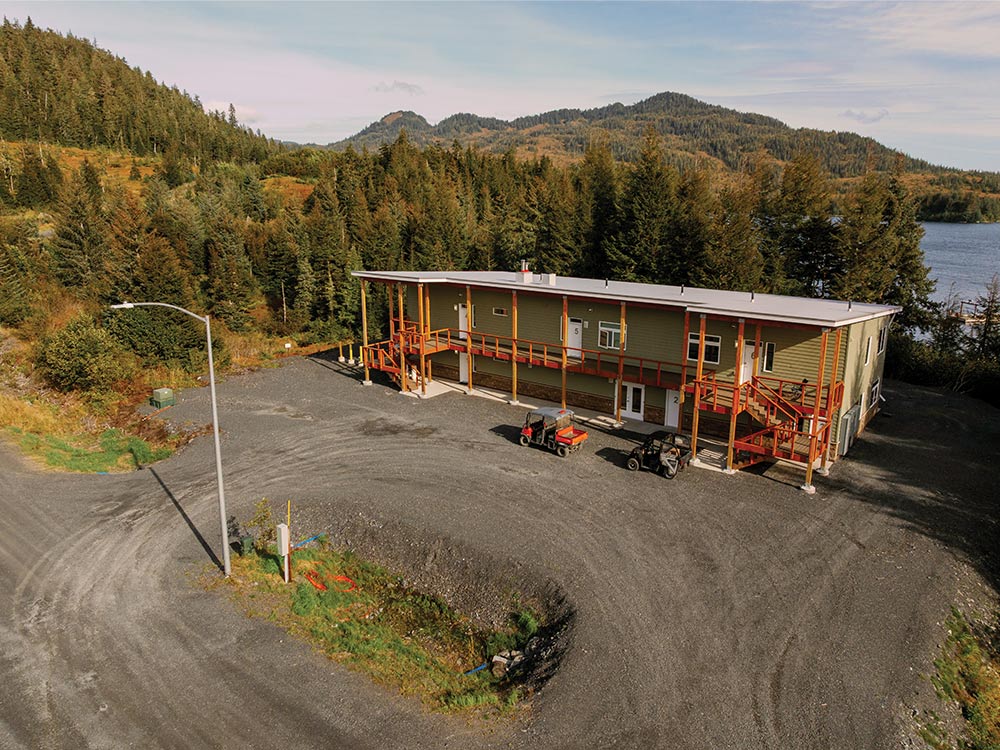
The six-plex Multipurpose Lodging Facility has capacity for 12 people in three different room layouts and a multiuse common area. Associated General Contractors (AGC) of Alaska member F&W Construction Company, Inc. completed the project. Lipinski notes F&W staff communicated consistently throughout the project and finished ahead of schedule. The building doubles the available overnight capacity in the village, allowing support personnel, contractors, and medical professionals to comfortably provide essential services.
“CRDG was our client on this design-build project, and their collaborative approach streamlined decision-making, which minimized change orders and ensured clear communication from conception through completion,” says Saigen Harris, project manager for F&W Construction. “We appreciated their professionalism and would enjoy an opportunity to work with them again in the future.”
According to Lipinski, the project with F&W Construction is a good example of the benefits that being an AGC member provides, in addition to access to educational opportunities and industry support.
“Coming out of the residential construction industry, and as a board member and president with the Anchorage Home Builders Association, I was very familiar with AGC,” says Lipinski. “In my new role with CRDG, they were an excellent fit to establish relationships that could benefit the development of Chenega and the surrounding area. They are a very professional and organized association with a great reputation.”
Projects in Motion
“The housing stock in the village was largely constructed in the mid-1980s and was showing its age in this tough marine environment,” says Lipinski. “The completed homes have allowed improved housing access for both existing and returning residents.”
Other projects CRDG has in motion include work at the Chenega Village bulk fuel tank farm, Eshamy Bay Lodge and Sawmill Bay Lodge improvements and tourism development, continued housing renovations, and a new housing subdivision development. The company is also providing support on Alaska Department of Transportation and Public Facilities ferry dock improvements, as well as the Beatson Mine reclamation project, a cleanup effort of the copper mine once owned by J.P. Morgan and the Guggenheim family and later sold to the Kennecott Utah Copper Corporation. The mine operated on Latouche Island between 1904 and 1930. The state learned of potential contamination in 2013 and Rio Tinto has been investigating the extent of the contamination since 2016. Rio Tinto and the Alaska Department of Environmental Conservation are working to develop a cleanup plan to address the contamination, which includes both surface and submerged tailings.