


n the heart of Prince William Sound, the remote village of Chenega stands out as a place known for its stunning beauty, enduring resilience, and persistent challenges. Accessible only by air or water, this isolated community dreamed of reaching a major milestone in its efforts to accommodate the people who play a vital role in its sustainability. With the completion of the Chenega Multipurpose Housing Facility, the community’s vision is now a reality.
Led by F&W Construction Company, Inc. and guided closely by Chenega Regional Development Group, LLC, the $6 million design-build project is a direct response to the community’s severe housing shortages that came into focus during the COVID-19 pandemic. But its purpose will go well beyond pandemic recovery.
The facility will serve as a home away from home for visiting teachers, healthcare professionals, emergency responders, and construction workers who are essential to the region’s continued growth.
“Chenega has long faced a shortage of housing to accommodate essential personnel who come to support the community,” says Doug Lipinski, project manager for Chenega Regional Development Group. “This project marks the most significant expansion of housing in Chenega since the community resettled on Evans Island in 1984, following the devastating impact of the 1964 Good Friday earthquake and tsunami on the original village site on Chenega Island.”

With walls up and windows installed, the Chenega Multipurpose Housing Facility nears completion in its remote coastal setting.
Urgent and Lasting Needs
The new facility provides the infrastructure to support visiting professionals and frees up housing within the village, allowing for more long-term residential growth, says Lipinski. It represents a turning point in Chenega’s post-resettlement development and provides critical flexibility for hosting educational, medical, and infrastructure teams.
The building is designed with flexibility and functionality in mind, Lipinski says, featuring six separate living units and a shared common area that can be used as a meeting or gathering space. The layout includes two efficiency units, two two-bedroom units, and two three-bedroom units.
Each space is equipped with a full kitchen, providing comfort and independence for short- and long-term guests. In total, the facility can house up to twelve people.
Chenega Regional Development Group selected the site for the facility to capitalize on the stunning views of Crab Bay, located in southwestern Prince William Sound—west of long, narrow Montague Island and east of Seward. This intentional design decision not only enhances the quality of life for those staying in the units but also highlights the natural beauty that defines Chenega, says Lipinski.
Though the building was not yet ready for occupancy in early May, the community already began to respond positively.
“People like the layout of the units and the views,” says Lipinski, noting that initial walkthroughs have generated enthusiasm about the thoughtful design and comfort of the facility, which opened in June.
“We had to ensure constant delivery of food and materials to the site—something that’s incredibly difficult in winter,” says Saigen Harris, project manager for F&W Construction and Associated General Contractors, or AGC, of Alaska president. “There were two different periods where we couldn’t get materials or food for over two weeks. But because of our planning and forecasting, there were no safety issues or schedule impacts.”
Anchorage-based F&W has more than six decades of experience delivering infrastructure in Alaska’s most challenging environments. A third-generation, family-owned firm, F&W has built its reputation on integrity, safety, and innovation. Its teams are skilled in a variety of construction disciplines, from structural steel and modular construction to timber framing and pre-engineered buildings.
The company has a deep understanding of rural Alaska’s seasonal and logistical challenges, says Harris. F&W’s crews are highly experienced in transporting materials by barge, plane, and helicopter to isolated job sites. The team’s logistical planning and field expertise helped ensure this project was equipped with the right people, tools, and materials to succeed safely and efficiently.
Project Manager, F&W Construction Company, Inc.
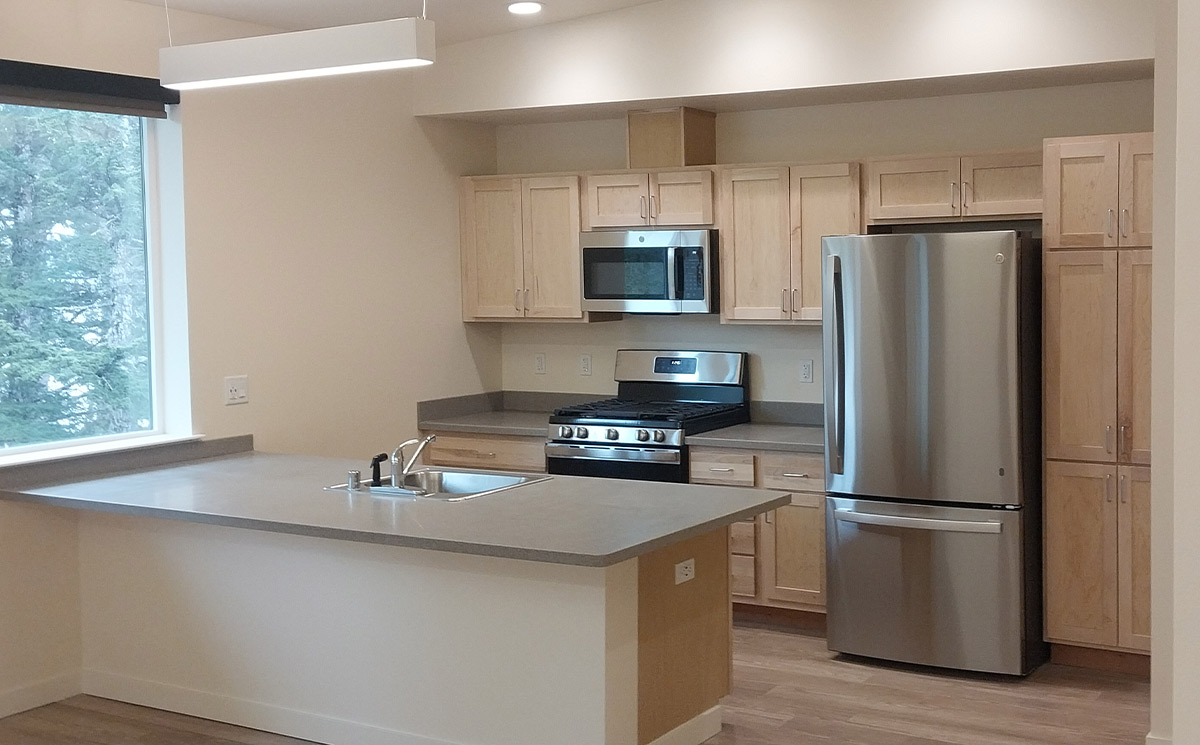
A fully equipped kitchen in one of the units of the new Chenega Multipurpose Housing Facility is ready for use.
More than a Building
Local input played a crucial role in shaping the project. Village-based Chenega staff shared institutional knowledge that informed key decisions—from landing sites for materials to site preparations for winter.
“Their involvement helped ensure that this project was grounded in local realities and responsive to the village’s needs,” says Lipinski.
A collaborative network of highly skilled subcontractors and consultants ensured the success of the Chenega Multipurpose Housing Facility. AK Underground’s civil work enabled rapid mobilization, expediting the construction schedule. Samson Electric and Slayden Plumbing & Heating Inc. also played major roles, providing in-depth design reviews that prevented change orders later in the process. AGC member companies working on the project included project architect KPB Architects; Malone Construction LLC, which performed concrete placement and finishing; and roof installer Rain Proof Roofing.
Their early participation in the design phase allowed F&W to spot potential issues long before they impacted the job site, says Harris. That kind of foresight is what made the difference in sticking to the schedule and avoiding costly changes.
While the Chenega Multipurpose Housing Facility may be a single structure, its impacts are broad and deeply felt. Overall, it strengthens the community’s infrastructure, honors local knowledge, and provides a much-needed lifeline to those who come to support the village.
And as Chenega continues to grow and rebuild in the wake of its relocation, Lipinski says this project represents progress and possibility, proving that, even in the most remote corners of Alaska, development rooted in responsiveness and respect can be successful.