


ining and construction are not merely adjacent industries in Alaska, they are fundamentally intertwined. From permitting and design to logistics and infrastructure to reclamation at the end of a mine’s life, construction contractors are present at every stage.
“We could not do what we do without the construction industry,” says Deantha Skibinski, executive director of Alaska Miners Association. “Mines have people with specific skill sets, but especially in Alaska’s unique conditions, we rely on construction companies to bring the expertise needed to build and maintain operations. We have a reliance and a partnership with the construction industry that is really special.”
The permitting process for any large mine in Alaska requires a level of design detail that only experienced contractors can provide. Mine operators submit detailed plans describing how roads will be built, where mill buildings will be placed, how maintenance shops will operate, and how tailings, water, and waste rock will be managed safely.
That means construction contractors factor into permitting from the very beginning.
“Companies identify the contractors with the right expertise—road builders experienced in arctic conditions, underground contractors who create the portals, engineers familiar with pit-wall design,” Skibinski explains. “Their input shapes the mine plan that regulators review.”
“When you’re doing an investment like that, you have to have a lot of caution, and navigating that space doesn’t happen quickly,” she says.
These long lead times mean that contractors don’t just execute the work, they serve as long-term partners and subject-matter experts. Their involvement ensures the plans that go to state and federal agencies are realistic, buildable, and compliant.
It also means they are poised to mobilize quickly when permits are approved.
Construction doesn’t end when the mine is commissioned. Contractors are there for the life of the mine, providing trucking services and reclamation, working on facility upgrades, and doing infrastructure repairs.
The presence of a mine can boost the local economy, says Meadow Riedel, external affairs manager for Kinross Gold Corporation.
Contractors continue to play leading roles as mines expand. After Coeur Alaska amended its plan of operation to expand tailings-waste storage at Kensington Mine, companies such as Alaska Aggregate Products (AAP) and AGGPRO, Alaska’s largest commercial gravel mining operation, were tapped to perform a dam raise and build a treatment facility.
Coeur’s External Affairs Manager Rochelle Lindley says Coeur called on these trusted Alaska contractors not just because they’re local but because they’re specialized, experienced, and used to working in remote terrain.
Since its founding in 2009, Associated General Contractors (AGC) of Alaska member AAP has specialized in remote earthworks: roads, dams, leach pads, lined ponds, and high-density polyethylene (HDPE) piping systems. The contractor has completed mine reclamation, including pit closure and soil treatment, large earthmoving rehabilitation projects, and building demolition. AAP’s expertise has supported mines across Alaska, performing a dam raise and bridge replacement for Kensington Mine and reclamation and heap leach construction for Fort Knox.
This year, the Alaska Industrial Development and Export Authority (AIDEA) Board of Directors committed $50 million for permitting, geotechnical work, and construction-planning activities, with plans to begin geotechnical work soon.
Representatives of Ambler Metals, the company leading exploration of the Ambler Mining District, say if the project goes ahead, the company will need to find ways to deal with the effects of permafrost along Ambler Road. Ambler Metals may lean on local expertise to preserve frozen ground and engineer the road for thaw settlement, lateral movement, and drainage changes.
For many in the construction industry, Ambler Road represents not just a project but a generational opportunity. If built, the road would create significant contracting opportunities—not just for road building but for gravel pits, maintenance hubs, river crossings, and long-term infrastructure. A fact sheet produced by the White House following President Donald Trump’s October 6 decision directing his administration to authorize the Ambler Road Project estimates the construction project will support 2,730 jobs and that Alaska will receive more than $1.1 billion in revenue linked to mining in that area.
Every project, no matter how similar, brings its own challenges, says AAP President Kirk Zerkel. “Although the purpose is the same for all heap leaches, this does not mean that all footprints are the same, nor their terrain.”
Reclamation, in particular, is a continuous process, and it’s often handed over to contractors. As one portion of a mine is exhausted, contractors carry out the reclamation plan, resurfacing and returning the disturbed area back to a pre-mine condition, ensuring the site meets regulatory closure criteria.
When the mine closes, contractors are brought in for final reclamation: reshaping terrain and replanting vegetation. It’s not just cleanup; it’s restoration.
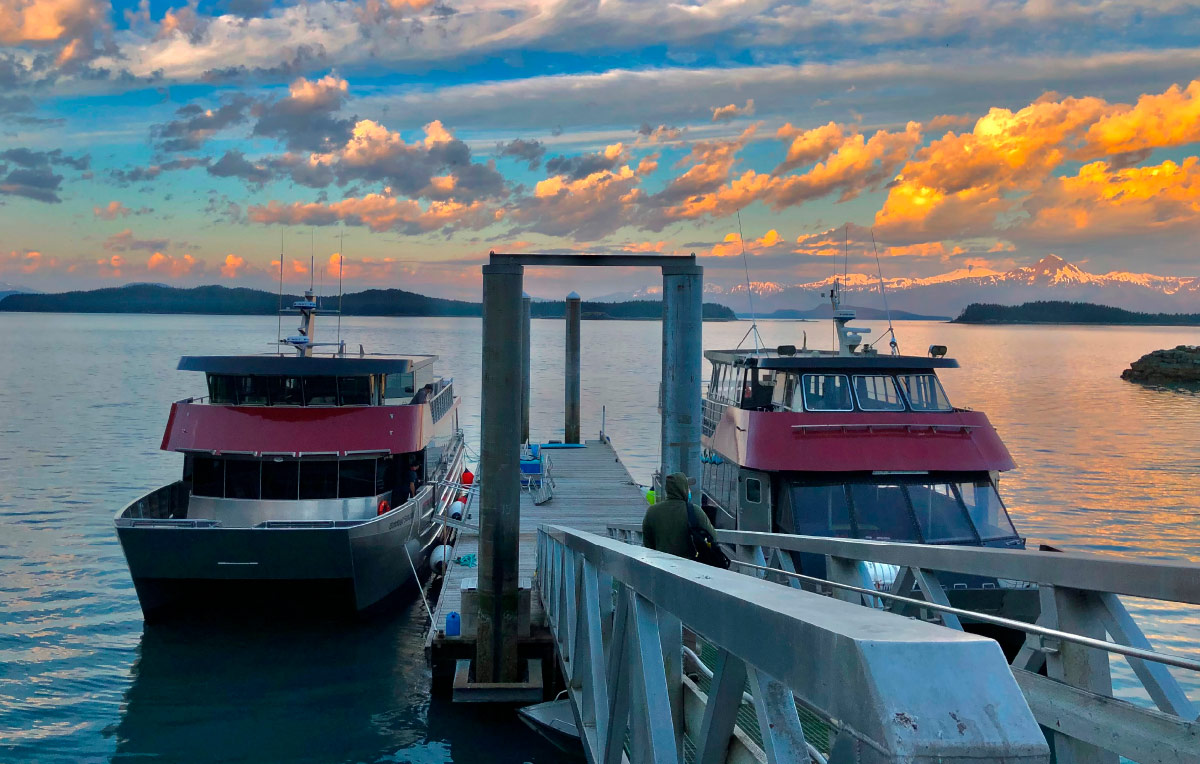
Coeur Alaska’s Kensington Mine is located 45 miles north-northwest of Juneau in the Berners Bay Mining District—off the road system and accessible only by air or water. That means Kensington employees are transported to the site twice daily by bus and boat, a task handled by Goldbelt Transportation, a subsidiary of Alaska Native Corporation Goldbelt, Inc. Meanwhile, AGC of Alaska member company Alaska Marine Lines provides barge services between the mine site and other ports, transporting food, equipment, supplies, and gold concentrate. It’s a critical supply chain, managed via contracts with companies with deep understanding of Alaska’s remote logistics.
At the Manh Choh project near Tok, Kinross Gold Corporation relies on Black Gold Transport, a division of AGC of Alaska member company Black Gold Express, Inc. created specifically to provide service for the mine. Black Gold Transport hauls ore about 240 miles to Fort Knox’s mill.
“We collaborated closely with [Black Gold Express] and the Alaska Department of Transportation to build the safety program and operation plan from day one,” explains Riedel.
Black Gold’s trucks travel 24 hours a day, seven days a week—logging 8 million miles in 2024, its first year of operations—bringing mine traffic onto public highways and into public view.

The remoteness of the Red Dog Mine, though, means “ore hauling hasn’t been right in front of our faces,” Skibinski points out. The Manh Choh project, on the other hand, “has shined a light on moving ore that we hadn’t seen before.”
With the Man Choh project, 90 percent of the route Black Gold Transport’s truckers take is on public highways, increasing interaction between the truck drivers hauling ore and the general public. The heightened contact has had surprising effects: Skibinski describes truckers pulling over for cars in distress along their route and taking time to jump batteries or radio for help.
“The drivers have the basic safety training to be able to assist until paramedics arrive when there’s an accident,” she says. “Black Gold Transport has been a wonderful contractor to work with and has really gotten very involved in the communities along that route.”
“When you get an AGC member that goes in there and says, ‘Look, I’m an Alaska construction company, I have seventy-eight employees and my entire business portfolio is doing services for mining industries,’ it means something,” Skibinski says. “AGC as an organization is constantly shining a light on the Alaska construction businesses that might be harmed or helped by decisions [around mining]. It’s made a huge difference.”
AGC and Alaska Miners Association have long collaborated, including partnering in the spring to host a networking event in Juneau that’s part of the AGC Legislative Fly-In.
Their voices illuminate an often-overlooked truth: when policy slows mining activity, it impacts not only mining companies but hundreds of construction jobs across dozens of Alaska businesses. In Alaska, partnership between the two industries isn’t optional; it’s the foundation on which the future of mining rests.