



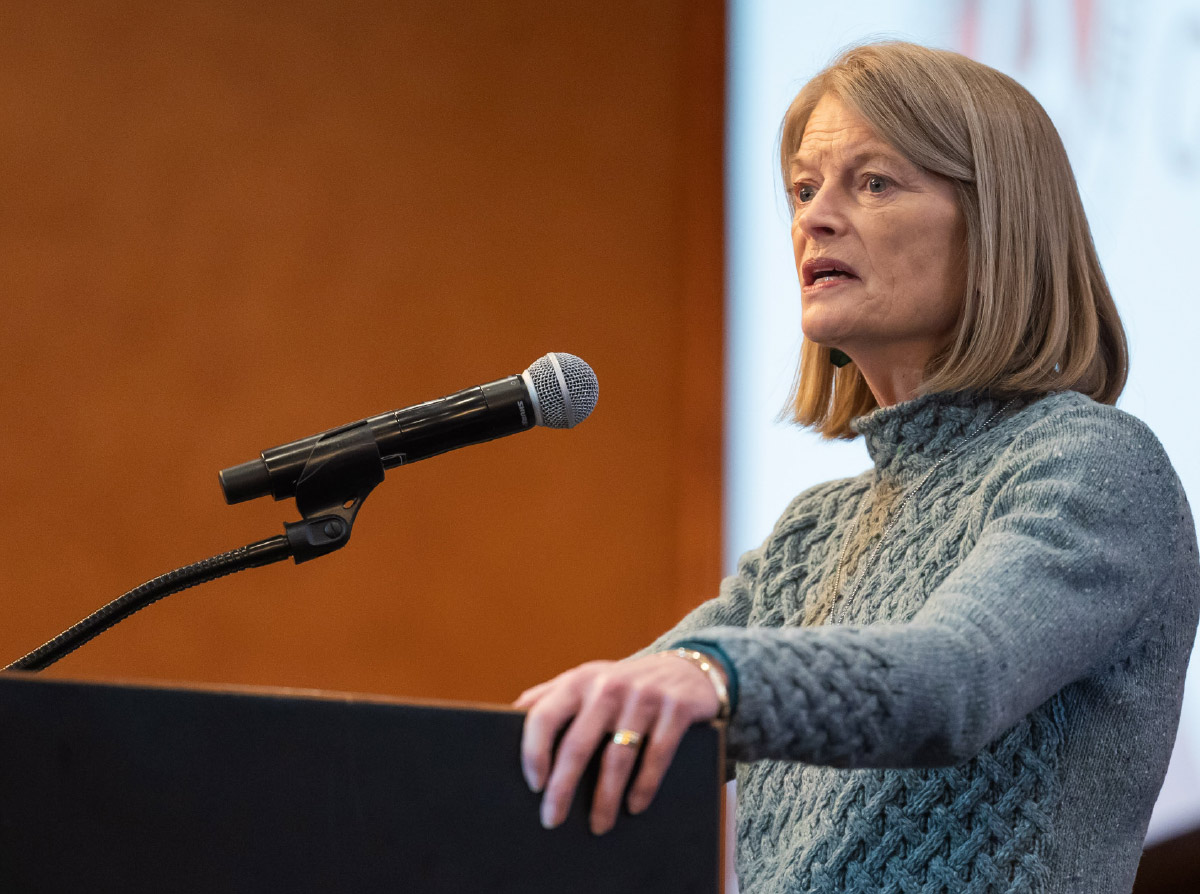
ssociated General Contractors (AGC) of America President Todd Roberts commended the Alaska contractors gathered at the November 14 luncheon at the Hotel Captain Cook, where the winners of the IMA Excellence in Construction awards were announced. Roberts, the president of a successful heavy and civil construction company based in Jackson, Mississippi, said he was impressed by Alaska contractors’ ability to surmount challenges that aren’t generally seen elsewhere in the nation.
“Congratulations to all the Excellence in Construction award winners that are going to be announced today. The projects you build up here are inspiring—especially when you think about the many logistical and weather challenges you face. I know it’s a different kind of construction up here, and it’s very rewarding to see what you all do and how you do it,” Roberts said.
Davis won two awards in the Vertical Construction category: Vertical Construction Under $5 million for its Providence Kodiak Medical Center Magnetic Resonance Imaging (MRI) Module project, and Vertical Construction Between $5 and $15 million for its Providence Medical Group Eagle River Walk-In Clinic project. The company also won the Sustainability in Construction award for its Fort Greely Communications Center project.
“One of our favorite aspects of receiving these awards is that they showcase the hard work of our project teams, acknowledge a job well done, and provide them with a source of pride when the project is done,” Davis officials say. “Winning the AGC Excellence in Construction awards highlights the skill, dedication, and collaboration of our onsite field teams as well as our office-based project management staff. These awards highlight our reputation among future clients, employees, and community partners.”


It wasn’t smooth sailing once the MRI unit had reached Kodiak, however. Midway through installation, a valve failure caused the MRI’s magnet to lose a majority of its helium gas due to a sudden “quench” event. If the magnet warmed, it would ruin the multi-million-dollar system. Davis crews learned of the quench at 7 a.m. and procured helium from various locations on the island—fish processing plants, refrigeration contractors, and the unused amount that was going to be shipped on the Matson steamship, which was in the process of casting off for its Seattle voyage.
“The team’s resourcefulness provided just enough helium to stabilize the system, avert catastrophe, and keep the project on track. Without immediate action by the Davis team, the multi-million-dollar unit would have been a total loss,” Davis officials wrote.
The renovation added fourteen exam rooms, five bathrooms, two offices, a blood draw room, a lab room, and a conference and team area and was completed under a compressed schedule, with completion scheduled in seven months from the start and a requirement by the client that the space be usable before completion.
“Even though our team was on track to finish within the tight deadline, our crews made even more of a push to open up a selection of the building early. Opening up the building while construction was still going on meant our teams’ safety protocols were tightened, along with working after work hours to ensure there were no disruptions to the staff or patients,” Davis officials wrote in the award application.
Although additional information was provided to judges for their consideration for this award, due to concerns about national security, more information about the project is not able to be published at this time.
The health center is a 26,000-square-foot new construction medical facility, built to provide care for Chugachmiut, an Alaska Native nonprofit agency serving the seven tribes in the Chugach region. The facility is Leadership in Energy and Environmental Design (LEED) Silver-certified and includes space for primary care, behavioral health, visiting psychiatry, dental and vision, community health aides, pharmacy, and lab services.
“It’s an incredible honor for RHC to be awarded with the Excellence in Construction award for Chugachmiut Regional Health Center,” says RHC President Sean Hickel. “This recognition affirms the exceptional workmanship, collaboration, and attention to detail our team brought to this project. Delivering this facility for the Seward community was a meaningful accomplishment on its own, and being acknowledged by our peers makes it even more rewarding. Most importantly, it reflects the dedication of our employees and partners, and it will continue to inspire our team as we look ahead to the work still to come.”
The project presented significant challenges, including a three-month delay caused by early design changes, but the team rallied to deliver it on schedule—and even returned over $1 million in unused contingency to the owner. Being a LEED Silver-certified facility meant many materials used to build the facility were special-order projects that require more lead time and careful handling to ensure compliance with sustainability standards.
“Despite these complexities, the team’s commitment to meticulous planning, collaboration, and innovative problem-solving allowed the project to be completed on time, meeting strict federal funding deadlines and allowing staff to begin operations as planned. The result is not just a building but a landmark facility that demonstrates what can be achieved when vision, skill, and dedication are combined with a trusted contractor like Roger Hickel Contracting,” Hickel says.
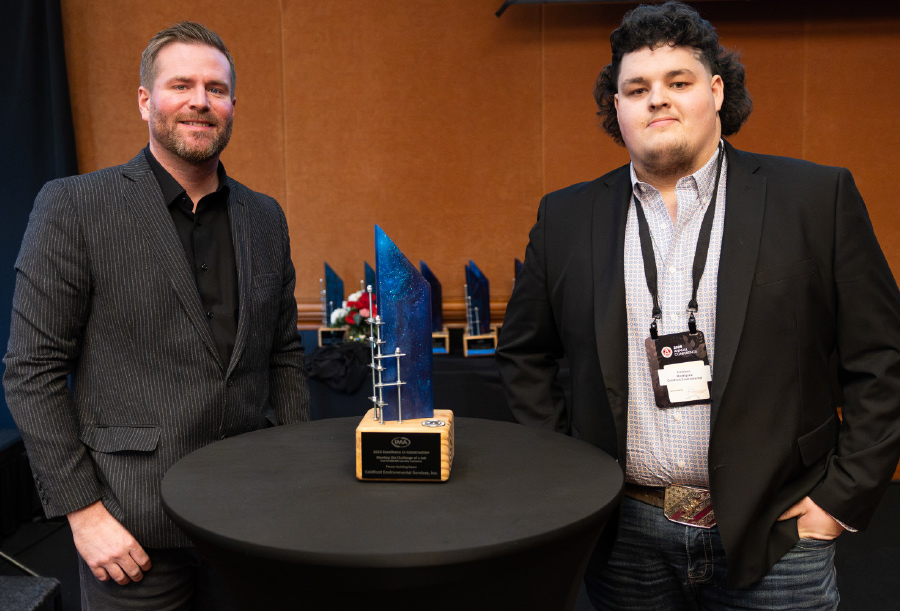
Coldfoot Environmental is a demolition, remediation, and hazardous materials removal company with work experience across Alaska. The company began work demolishing the Polaris Building, the Golden Heart City’s tallest building, in 2023. After twenty years standing vacant, it was an attractive nuisance in the city, not to mention that it contained asbestos, lead, mold, and other dangerous materials.
“Today, with the Polaris Tower coming down, Fairbanks has gained more than a cleared site—it has gained renewed hope. What was once the city’s tallest eyesore is now an opportunity for growth, safety, and revitalization. The demolition has not only eliminated a long-standing hazard but has also opened the door to reimagining the heart of downtown Fairbanks,” Coldfoot officials wrote in the award application.
The demolition was a step-by-step process; first Coldfoot demolished the Annex restaurant attached to the building, then came abatement, when material containing asbestos and other harmful or hazardous material was removed. Finally, the company brought in the largest high-reach demolition excavator in Alaska, a Volvo EC700CHR, to bring down the building itself—with plenty of local and media attention while it happened.
And Emiliano Rodriguez, on his first big job with Coldfoot, was at the controls of the excavator. He says it was a little stressful.
“At the start, it was definitely a learning curve,” he says.
Through it all, Coldfoot crews focused on safety. Three daily safety meetings were held to reinforce safe work methods, allow for immediate hazard identification, and give workers a chance to raise concerns or suggest improvements. The work was completed with zero accidents or injuries.
“There’s definitely a lot of hard work on projects like these; it’s nice to get an award for it,” Rodriguez says.
“Winning this award reinforces the quality of the work our teams deliver every day. It’s a recognition of the craftsmanship, planning, and problem-solving that our crews bring to every project. It also helps us communicate that commitment to future clients, partners, and employees. Awards like this validate our methods, strengthen our reputation, and open the door to new opportunities,” says Matt Jones, north slope operations manager for Cruz.



“The move required tight coordination, including the use of three tugboats and a spud barge to stabilize the vessel as the self-propelled rig advanced at roughly 1 mph onto the 630-foot barge before traveling 60 nautical miles to Point Thomson,” Jones says. “Extensive pre-planning, daily meetings, and staged backup crews and equipment allowed us to navigate weather and logistical challenges while maintaining efficiency. The project was completed with zero incidents, and all temporary materials were removed afterward, leaving no environmental footprint.”
“We’re extremely proud of our team and grateful for the recognition. Awards like this highlight the dedication of everyone involved—from our field crews to our project managers to our support staff. We appreciate the partnership and trust of our clients, and we look forward to continuing to deliver work that reflects the values of Cruz Construction,” Jones says.
But as with many projects in Alaska, it wasn’t as straightforward as it appeared on paper. The challenges STG, Inc. overcame to build the tower on time and on budget despite the obstacles it faced netted the company a clear win for Excellence in Construction—Specialty Job Under $1 million.
“STG’s client for this project is in the early stages of implementing their network. Because they are still fine tuning the needs of each tower site, it is a challenge for STG to be in tune with how their needs might be changing and to offer solutions as things develop,” says project manager Wesley Burgess.
“A major logistical challenge arose when the Wrangell barge landing’s reduced load capacity prevented offloading the crane needed for tower erection,” STG, Inc. officials wrote in the award application. “With the tower too tall for local boom trucks, STG pivoted to a helicopter-assisted construction strategy, employing an A-Star B3 helicopter to lift preassembled tower sections into place.”
Pivoting was relatively easy, Burgess says, because STG has done the groundwork.
“My team and I had to rely on our past experience and strong industry partnerships to execute the solution on very short notice. Being very familiar with the helicopter work being performed, and with trusted pilots and tower crews, we were able to pivot so quickly to an entirely new workplan and avoid any schedule delays,” Burgess says.
Burgess adds that he and his team are honored to be recognized by AGC.
The flooding, caused by several days of warm weather and increased water flow due to glacial melt, had caused the road to be closed for nearly two miles near Maud Road, stranding residents. Water rose roughly six inches every half hour. Residents had filled hundreds of sand bags to try to create barricades to protect property in the area, and Governor Mike Dunleavy declared the flooding a state disaster.
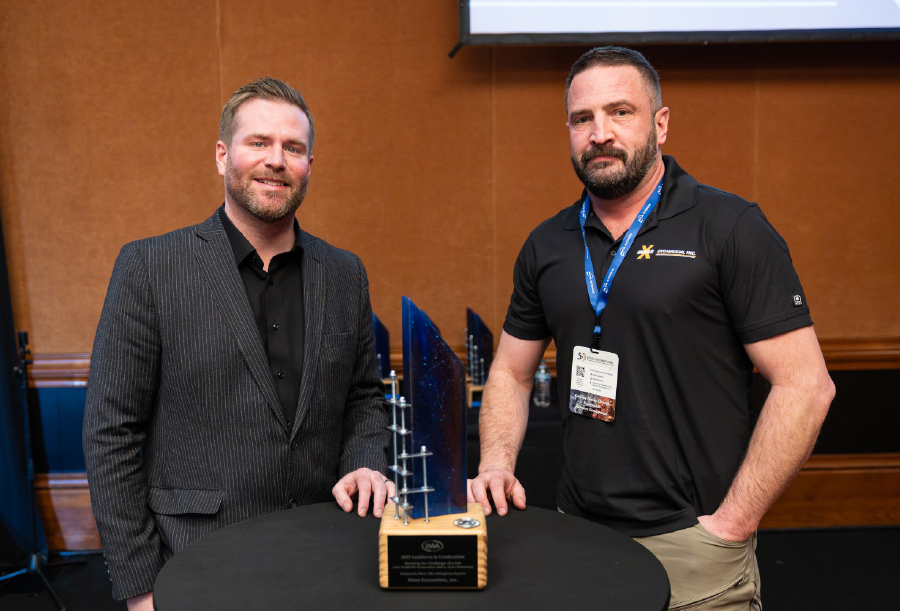
“There were several utility poles that had been compromised and were falling over. They were really depending on us to get out there and get it under control so they could get the power back on,” says Mass X General Manager Justin Shields.
Mass X, already working in the area, responded immediately, creating an access road and placing riprap to stabilize and rebuild the bank. Crews worked around the clock, returning multiple times as the currents of the braided river shifted, ultimately stopping the erosion and protecting the road and nearby properties.
“Within three days we had it back where the utility companies were able to get back in there and get the power and utilities on, and we continued to improve it for the next three weeks,” Shields says.
He adds that the crew appreciated being able to help residents have power and access restored.
“For us, to win the award, it’s huge—we not only work in these communities but we live in them as well, so for us to be able to step in and help our neighbors is important to us,” Shields says.

“Doing night work plus tide work is a really challenging project,” Thurman says.
“It involved a lot of tide work, rock work, dyke shift, because it’s during the summertime when you can’t restrict traffic on the Seward Highway other than nighttime, so there were a lot of challenging situations,” he adds.
More than 73,000 tons of borrow was used to widen the shoreline and build the parking lot and 38,000 cubic yards of riprap in layers along the shoreline and parking area to protect and stabilize them.
Despite the technical, high-risk, and high-exposure nature of the project, Granite completed all major scopes of work a year ahead of schedule. Thurman says winning the award for this job is meaningful.
“We were very thankful and appreciative of being selected for the award. It’s been quite some time since Granite has won an award like this from the AGC, and it’s just great to be back winning the award again,” Thurman says.
The project was to rehabilitate the 121 and 135 aprons and add a Remain Over Night (RON) hardstand area east of the terminal building for airplanes staying at the field. In the course of the project, SECON officials realized there were a number of ponds or puddles on the aprons, which don’t drain properly and make it more difficult to maintain. SECON management discussed the issue with stakeholders and all agreed to use a new form of pavement cold planing based on 3D design models. The asphalt mill communicates with two total stations, or high-precision surveying instruments, to change the depth of the cold planing while in motion, resulting in a consistently smooth surface. The company also used a similar grade control for the grader and dozer used on the project.
In addition to the technical tools used to achieve a better end result, SECON used innovative phasing and logistics to minimize airport disruption, meet Federal Aviation Administration regulations, and bring the project to a close early.
“We are proud to receive this award. It wouldn’t have been possible without our skilled team and stakeholders. It reflects our dedication and skill in the industry,” says SECON Project Engineer Jared Mackey. “Winning this award affirms our team’s commitment to quality and innovation. It strengthens SECON’s reputation and helps us build trust for future projects throughout Southeast Alaska.”
AGC would like to acknowledge some oversights in this year’s Excellence in Construction Awards review process. Two Cornerstone General Contractors submissions were unintentionally left out of the judging packets, and one Cruz Construction project was reviewed in the incorrect category. We sincerely regret these errors. AGC is taking added steps to strengthen our review process and ensure accuracy moving forward.