


Photo by Rod Cummings
Photo by Rod Cummings
fter years of rapid growth across the Matanuska-Susitna Borough, the two-lane Seward Meridian Parkway could no longer keep pace.
Traffic volumes climbed. Medical offices filled in along the route. Parents jockeyed for space at school drop-off zones. Left turns from side streets grew risky. Fenders met. Sirens followed.
What had once been a quiet road now felt like a bottleneck in the heart of Alaska’s fastest growing region. Phase 2 of the Seward Meridian Parkway project—the final stretch of a two-phase plan—aims to fix that.
Led by the Alaska Department of Transportation and Public Facilities (DOT&PF), with Mass Excavation, Inc. as general contractor, the $44 million project will fully connect the corridor, widen the majority of it to four lanes, join the last gaps between three primary east-west routes, and layer in safety features that reduce crash risk while improving day-to-day reliability for students, parents, patients, and other drivers.
At roughly two miles long, the Seward Meridian corridor runs north-south though a densely developed part of the Mat-Su. The growth along the corridor has been striking, says Tague. A medical plaza has sprung up with clinics, various medical providers, a surgery center, and a 67-bed skilled nursing facility. Hundreds of families use the road daily to reach one of the four schools along the corridor. Recreation traffic on the weekend can also include paddlers who head for the area’s chain of lakes.
More than 13,000 vehicles travel the corridor per day, according to state traffic data. Before Phase 2, a missing link between east-west connectors Bogard and Seldon roads forced drivers heading from Wasilla to Mat-Su Career and Technical High School or Teeland Middle School to detour along a previously quiet residential street.
As volumes increased, Tague says side-street turns became riskier.
“People start taking chances,” says Tague. “That’s when you see crashes.”
A separated multi-use path now runs the length of the project on the west side of the corridor, a deliberate choice because three out of four schools along the route are located on that side of the road. Students walking or biking will now have a protected route that stretches from Seldon south to Walmart at the Parks Highway.

Photo by Rod Cummings
In the past, boaters had to either portage across Seward Meridian Parkway or take their chances paddling through the narrow culvert.
“There were a couple things that led to building the bridge,” Tague says. “We raised the elevation of the road by about 14 feet in that location, so if we had gone back with a culvert, the fill would have been much wider and impacted much more stream channel. Also, from the Fish and Game side, a bridge is far more desirable for salmon passage.”
DOT&PF salvaged natural streambed material to keep the channel looking and functioning like a creek. Beneath the top layer sits a stable base of riprap that’s designed to hold firm during flood events.
Cody Troseth, project manager for Mass X, says the transformation at Cottonwood Creek was dramatic.
“The old crossing was just a 10-foot culvert, half-buried, clogged with rocks, timbers, and even trees,” he says. “We cleared everything out and replaced it with an open channel under a 120-foot long, 90-foot-wide bridge. Now it looks and functions like a real stream.”
“We cut through the hill and punched the corridor all the way to Seldon,” Troseth says.
The dirt, however, didn’t always cooperate.
“We hit hardpan in the cut, which wasn’t anticipated,” Troseth says. “You couldn’t just excavate it up.”
Mass X switched to ripping it with a claw, then excavating. At Cottonwood Creek, crews encountered a fine, silty material that turns to goo when wet. Operators had to over-excavate to reach firm ground, dewater constantly, and backfill in a controlled way while working up to 30 feet deep in some places.
“It was a big challenge,” Troseth says.
Throughout the project, the corridor had to remain usable. Aside from two weekend closures to set temporary culverts and do critical creek work, Seward Meridian has stayed open.
Managing traffic on a corridor carrying more than 13,000 vehicles a day was a logistical puzzle. Mass X and DOT&PF coordinated closely with subcontractor and AGC member Jolt Construction & Traffic Maintenance, Inc. to keep traffic moving safely.
“The most challenging part of the job is dealing with traffic and the public,” Troseth says. “You’re building one side of the highway, moving traffic onto it, then building the other side. We ran day- and night-shifts. It’s the only way to stage a project like this without shutting down the corridor.”
Flaggers managed traffic at busy driveways and intersections throughout the corridor, particularly near medical offices and Cottonwood Elementary School, where side-road approaches were stripped to gravel before being rebuilt.
Despite the complexity, Troseth credits the teamwork with DOT&PF and Jolt Construction for keeping the project on track.
“It’s not easy keeping that much traffic moving,” says Troseth.
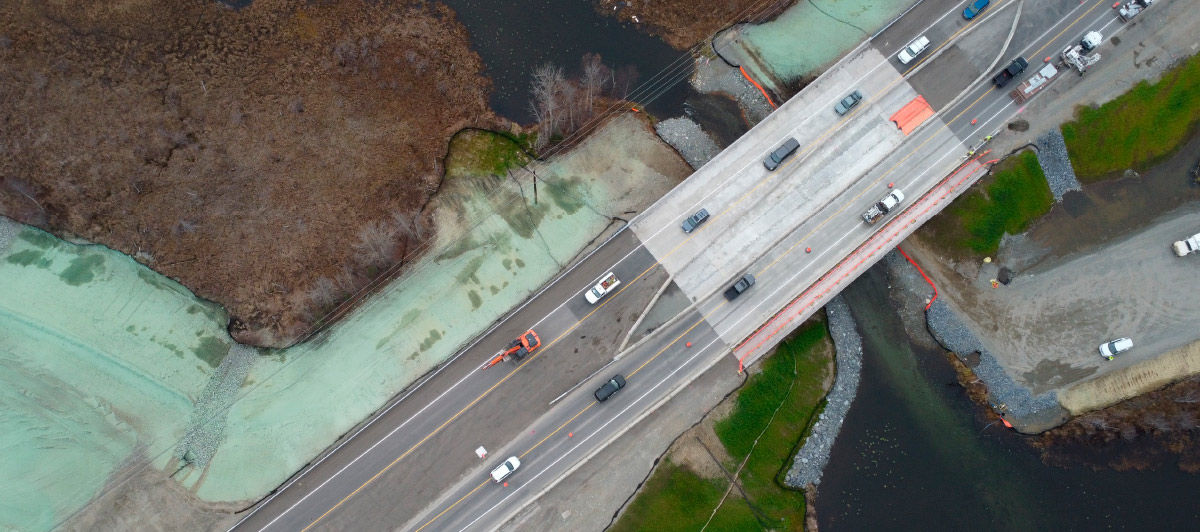
Photo provided by Mass Excavation Inc.
DOT&PF widened sight distance at intersections and used the median to manage turns in and out of driveways. Sidewalks and the new multi-use path unclutter the shoulders and offer predictable spaces for people who bike, walk and run.
The work is already paying off.
“We’ve already seen a drop in the number of accidents,” says Tague. “These are the kind of crashes that tend to happen on a congested two-lane road.”
Seward Meridian Phase 2 also came with a web of utilities to adjust. The project required extensive relocations for fiber and powerlines. Coordination with Enstar allowed for the installation of a high-pressure gas main within the project boundaries. This upgrade has helped alleviate low-pressure issues in the Hatcher Pass area, says Tague.
“Because of this new corridor being linked through, we were able to take advantage of some opportunities,” says Tague.
“This is our seventh bridge with Swalling,” says Troseth. “We’ve got a very good working relationship with them.”
Meanwhile, AGC of Alaska members Sturgeon Electric led the signal and lighting system and ASRC Earthworks, LLC handled the paving. Specialty striping and guardrail crews cycled in as phases opened. On a typical day, Troseth estimates, fifty people from Mass X, Swalling, and Sturgeon were active on site, with bigger surges during paving.
“We worked closely with our subs on everything,” says Troseth. “The collaboration has been good.”
Construction on Phase 2 kicked off in spring 2024, with crews taking advantage of winter work windows wherever possible, especially around the creek diversion and bridge.
“We thought colder ground might help,” says Troseth. “Last winter didn’t really cooperate, but the extra push still helped the schedule.”
Even though the project’s contract completion date is set for August 2026, both DOT&PF and Mass X expect to finish ahead of schedule. The remaining civil work centers on the Bogard Road intersection and the final electrical installations needed to complete the corridor’s new signal and lighting systems.
“Fall in Alaska isn’t the time to bite off more than you can chew,” says Tague. “We were right on the bubble for paving this year and made the call to hold Bogard for next season.”
In the meantime, the widened north and south ends of the corridor already deliver a vast improvement, says Tague.
When construction wraps up, ownership of the upgraded corridor will transfer to the Matanuska-Susitna Borough. And when the last barricades come down and the final signal flashes green, Seward Meridian Parkway will feel like what it has quietly become—a true north-south spine through a growing community that will be safer, steadier, and ready for the future.