

here’s a saying about safety: “Working safely may get old, but so do those who practice it.” It takes a little extra time for preparation, gear maintenance, thinking or talking through plans before acting, and even going through checklists, but a zero-incident rate is a green flag to prospective clients and potential employees.
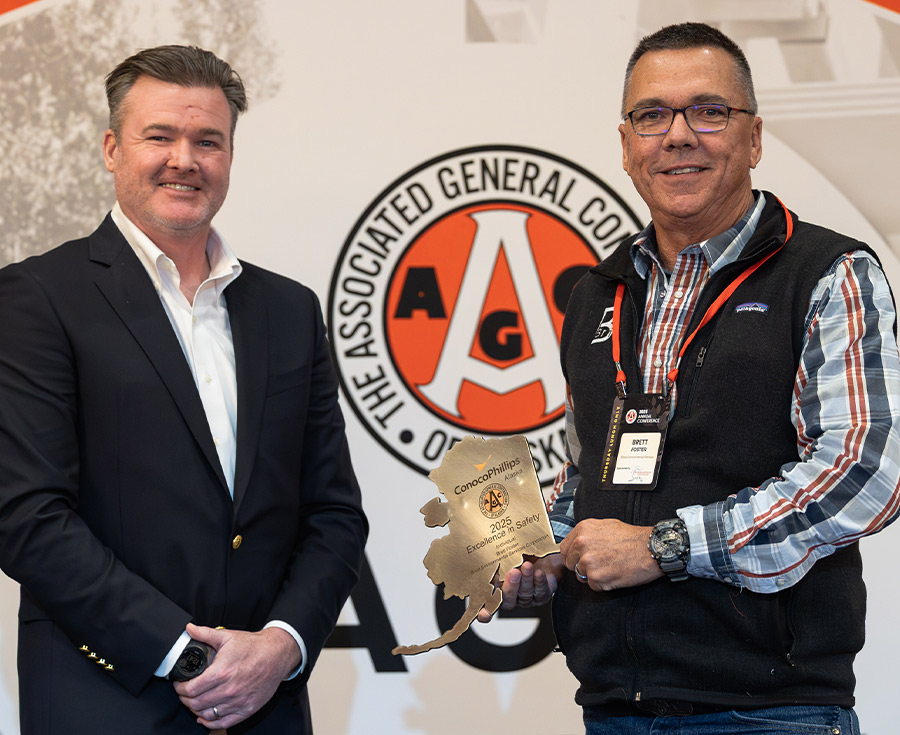
Just ask the staff at the three companies and one individual who were selected as winners of the 2025 ConocoPhillips Excellence in Safety awards. Winners were announced at the November 13 luncheon presentation at Hotel Captain Cook as part of the Associated General Contractors (AGC) of Alaska annual convention. This year’s company winners are American Marine Corporation, Mass Excavation, and Cornerstone General Contractors. Brett Foster, construction manager with Brice Environmental Services, Inc., won the individual award.
American Marine Corporation operates at the intersection of commercial diving and marine construction, navigating some of the most hazardous environments on the planet. Divers contend with near-zero visibility below the surface, thirty-foot tidal fluctuations, and powerful currents and cross-currents—conditions that demand precision and discipline.
“This company has achieved something truly extraordinary: more than fifteen years of operation without a single OSHA [Occupational Safety and Health Administration] reported incident, without a single diving-related injury, and without a single lost-time accident. Fifteen years—and this, in one of the world’s most dangerous industries,” said Jason Charton, ConocoPhillips Alaska vice president of health, safety, and environment, when announcing that American Marine had won the 2025 Excellence in Safety—Specialty award.
For José Owens, Alaska operations manager, trust and leadership are central to sustaining this record. With two decades of experience, he emphasizes a philosophy that guides every dive: “There’s urgency involved, but it’s urgency in making sure that we’re doing things the right way.”
Every dive begins long before anyone enters the water. The process starts in the office with a job safety analysis. In the field, crews revisit the plan and adapt it to real-time conditions such as weather, site complications, or project changes. A dive supervisor reviews the plan once more, and then the team rehearses the dive step by step.
Sometimes divers even practice blindfolded, ensuring tools are positioned correctly, and motions are almost second nature. As Owens explains: “The reason we do that is to further ingrain in them what their motions are going to be, so when they get in the water, it’s been rehearsed, and the topside crew knows what to expect. We also discuss contingencies and emergency response if things do not go as planned.” In an environment where visibility is often nonexistent, details like body positioning, tool placement, and the line connecting diver to boat can make all the difference.
After each dive, divers log their experience in a notepad, noting whether everything went according to plan and documenting any irregularities. Issues are analyzed, discussed, and addressed openly. Owens stresses that every team member has the freedom to raise concerns—and the confidence that those concerns will be heard.
He reflects on the pride he takes in his crew: “What I’m really proud of is the fact that I get to work with guys and I know what they’re going through. They know that I know what they’re going through. And I love what I do—I’ve been in it for twenty years, and I’ve loved pretty much every facet of the business that I’ve been in, from being a diver tender all the way to where I’m at now. It’s exciting to get to give that experience to other young men. I’m big on professional development, so that’s an enjoyable aspect for me to see.”
Owens sees the award as validation of the company’s commitment to safety: “It backs up what I’m already trying to do. We’re doing it right—keep doing it.”
The most compelling evidence of that success? Every member of the crew completed the 2025 dive season without a recordable injury.
“The transition didn’t just happen, it was earned through discipline, preparation, and a companywide commitment to safety as a value and not just a requirement,” Charton noted. “When they took their operations north in 2022, they didn’t just adapt to the oil and gas industry standards, they exceeded them.”
Since the expansion, Charton adds, Mass X has maintained a perfect record of zero incidents.
“We’ve had a lot of growth in our company in the last five years,” says Justin Shields, general manager of Mass X. “A major driver of that success has been our focus on strengthening our safety culture. We’ve invested heavily in building out our safety program, supporting our field teams, and ensuring safety leadership is present on every job.”
As part of that effort, Mass X increased its safety crew from one person to four.
“Today, our expanded team provides a far greater presence in the field, ensuring safety is not just a program, but a daily, visible priority on every jobsite,” Mass X officials wrote in the company’s
award application.

Jason Charton, ConocoPhillips Alaska vice president of health, safety, and environment, poses with Mass Excavation general manager Justin Shields. Mass X won the ConocoPhillips Excellence in Safety—Highway award.

Cornerstone General Contractors Senior Project Manager David LaMont and SafeLogic President Randee Johnson accept the ConocoPhillips Excellence in Safety—Building award.
“We added a function that sends positive comments and notes about what the job site is doing correctly. This ensures the app is not solely focused on highlighting issues but also recognizes the positive aspects of the crews’ performance,” wrote Mass X Project Superintendent Dan Thibault.
The company upgraded PPE as well, moving to Studson hard hats that offer significantly better protection, including integrated face shields, wider brims, chin straps, and compatible hearing protection. These improvements reflect an ongoing commitment to providing the best equipment and safest work environment possible.
It all aims toward the goal, Shields says, which is to make Mass X the best company to work for. After winning the award November 13, he stopped by several job sites to show the crews the plaque, thank them for their hard work they put into earning it, and to let them know he plans to submit an application to AGC of America for a national award.
“At Mass X, we want to set the standard in our industry. I want every skilled worker in Alaska to see Mass X as the company they want to be part of,” Shields says. “After all—who doesn’t want to work for a company that cares deeply about its people and makes sure they go home safe every day?”
“This company’s safety philosophy begins with a simple truth: People come first. Every policy, every system, every milestone flows from the belief that where people are empowered and valued, excellence flows naturally,” Charton said when announcing that Cornerstone General Contractors had won the Excellence in Safety award for vertical construction.
Charton noted that Cornerstone was the first contractor in Alaska to achieve Alaska Occupational Safety and Health (AKOSH) CHASE FLAG status.
CHASE stands for Construction Health and Safety Excellence. The program is unique to Alaska and was created to provide a partnership between Alaska contractors and AKOSH to proactively reduce injuries, illnesses, and fatalities within the state’s construction industry. The program includes three levels of participation: AK-BLUE, representing initial acceptance into the partnership; AK-GOLD, which requires an employee or representative to administer the AKOSH program within the company and sets out several requirements for safety training, illness/injury reduction over time, documented employee review of the program and its goals, and development and maintenance of a substance abuse program; and AK-FLAG, which requires a company to have met all the BLUE and GOLD requirements in addition to requiring more training, effectiveness tracking for several program goals, passing an on-site visit by an AKOSH representative, and that the company have no “willful” and no repeat AKOSH violations in the preceding three years, as well as having no fatalities or catastrophes that resulted in serious or willful citations.
Cornerstone didn’t achieve FLAG status on its own; Randee Johnson, owner of SafeLogic and a consultant with Cornerstone, assisted with the multi-year process—she joined Cornerstone Senior Project Manager David LaMont in accepting the award at the luncheon.
LaMont says the other primary influence, who drove Cornerstone winning the Excellence in Safety award and also its achieving CHASE FLAG status, is company president, Joe Jolley.
“It starts at the very top,” LaMont says. “He wants his company to be the safest company in the state. And he wants our clients to recognize that we’re the safest contractor we can be on their behalf. So, it really starts at that level.”
With safety as a foundational belief from the top, LaMont says, Cornerstone has buy-in from all employees. And everyone on the management team is part of the safety team.
As part of Cornerstone’s growth and commitment to safety, company leaders recently selected long-time carpenter Aaron Combs to transition into the role of full-time safety manager. Cornerstone officials say his expertise and field experience will provide the synergy and supplementary boots on the ground approach to ensure that its safety momentum continues to evolve.
Cornerstone also incorporates a Breakthrough program, encouraging employees to “take smart risks and drive innovation.” Employees design their own Breakthrough project, often relating to safety, health, or the well-being of the corporate team. One such Breakthrough project created a pre-apprenticeship training program the company continues to use. Apprentices receive hands-on instruction from experienced journeymen in hazard recognition, personal protective equipment use, fall protection, and safe tool handling, “reinforcing that productivity never comes before safety, and instill[ing] the habit of speaking up and protecting peers,” Cornerstone leaders wrote in the safety award application.
Another program that encourages buy-in is the Safety Stand-Out Recognition Program through which Cornerstone employees can nominate team members who excel in regard to safety. The Stand-Outs are discussed at quarterly Safety Stand-Up meetings, where employees celebrate wins, discuss and learn from mistakes, and recognize the Stand-Out team members with benefits such as paid time off and public commendation.
“I’m thankful that I work for a company that has the kind of safety culture that they have, that has that kind of leadership in safety, and that they advocate everybody to be safe on the jobsite,” LaMont says.
“You just take out as much risk as possible through inspections and diligence,” he says.
When he was a young man working in the oil drilling field, OSHA didn’t exist. But a friend in the drilling industry gave him some wise counsel: “If you want to work, you’re going to be safe.” So, he began looking for ways to complete the work ahead of him safely—and that translated to helping others be safe on the jobsite as well.
Brice Environmental Services, where Foster is a senior construction manager, nominated him for the award. Foster has served as a site superintendent and site safety and health officer on seven federal and military projects totaling around $44 million over the past five years.Company leaders say Foster “achieved zero OSHA recordable incidents across all projects, with five earning ‘exceptional’ safety ratings.”
Company leaders added that Foster directly improved the company’s safety metrics, “contributing to Brice’s EMR [Experience Modification Rate] drop from 0.67 (2022) to 0.55 (2025).” A company’s EMR is an insurance rating that reflects its workers’ compensation claim history, compared with industry averages. Lower EMR rates indicate a better safety rating and can lead to lower insurance premiums.
Brice Environmental officials say Foster lowered those numbers through a combination of efforts: daily inspections, Active Hazard Analysis reviews, crew-level check-ins, and initiatives such as a “Stretch and Flex” program that helps workers limber up before beginning work.
Company managers selected Foster to represent Brice at the 2025 AGC National Safety Conference, where his involvement helped Brice earn a third-place national ranking in the AGC Construction Safety Excellence Awards—Specialty Contractor category.
“Brett Foster exemplifies safety leadership through innovation, consistency, and crew-centered communication. With seventeen years in safety leadership roles, he applies a pragmatic, field-first approach to risk management—leveraging crane safety systems and operator simulators while grounded in fundamentals. He builds trust and accountability through daily engagement, one-on-one training, and real-time coaching. Brett’s impact is seen in his track record: zero recordables across complex projects and consistently high safety ratings. His leadership has driven company-wide improvements and instilled a culture where safety is second nature,” Brice Environmental officials stated in their application for the award.
Foster says he doesn’t shoulder the whole load when it comes to safety at Brice Environmental.
“This whole group works very diligently at their safety,” he says. “I’m one of the tips of the spear, but it’s not just me… this is a lot of teamwork.”
As for the Excellence in Safety award, he says it adds assurance that the company is moving in the right direction.