

Carin Currier | Alaska Miners Association
Carin Currier | Alaska Miners Association
n July, AGC of Alaska leaders met with leadership from the US Army Corps of Engineers (USACE) and the Federal Highway Administration (FHWA) to discuss several proposed Alaska-based construction projects.
“These types of meeting opportunities do not come along every day,” says Heidi Olson, AGC of Alaska membership director. “We are grateful for the chance to connect our members directly with federal leaders and provide insight into the significant projects and investments being considered for Alaska.”
Alaska is poised to see a boom in military construction over the next three years, thanks to a series of projects potentially bringing billions of dollars into the state.
Renewed federal interest in Alaska’s resources and infrastructure has focused a spotlight on the state. So have efforts on the part of US Senator Dan Sullivan to include the Joint Base Elmendorf-Richardson (JBER) Recapitalization, totaling about $7 billion in the federal 2027 fiscal budget. In two separate meetings FHWA leadership—including FHWA Administrator Sean McMaster and USACE Pacific Ocean Division Brigadier General Joseph C. Goetz—conferred with AGC on the logistics of construction work in Alaska and the potential for developing the state’s military capacity.
“Investments are being considered across a broad range of military facilities, from major installations like JBER and Fort Wainwright to smaller sites throughout Alaska,” Olson explains. “These discussions reflect a significant focus on modernizing and strengthening military infrastructure across the state.”
The meeting with USACE and Brigadier General Goetz focused on the Fighter Town Recapitalization Build-Out at JBER. Under the National Defense Authorization Act (NDAA), the build-out would bring more than $2 billion in federal fiscal year 2027 in military construction to the base for projects, including $93.8 million for a flight simulator, $451.5 million for dormitories, $422.1 million for infrastructure and utilities, $132.3 million for a conventional munition complex, and $359.1 million to relocate precision guided munitions. Additional NDAA provisions will support projects at Fort Wainwright, the Pacific Spaceport Complex on Kodiak Island, and Eielson Air Force Base.
The NDAA, which passed the house in July but is still awaiting passage in the Senate, represents the largest investment the federal government has ever made in Alaska’s military infrastructure, Senator Sullivan’s office said in June.
Although the bill had not yet passed the Senate in September, the first request for proposals has already been released. More are expected this fall, kicking off a surge in construction projects likely to benefit contractors from every sector of the industry: subcontractors, service providers and suppliers, trucking and shipping companies, and others.
“The scale of these investments has the potential to benefit businesses throughout the construction ecosystem,” Olson says. “From contractors and subcontractors to suppliers, manufacturers, and logistics providers, there could be meaningful opportunities across many sectors of Alaska’s economy.”
AGC of Alaska

Carin Currier | Alaska Miners Association

Carin Currier | Alaska Miners Association
Carin Currier | Alaska Miners Association
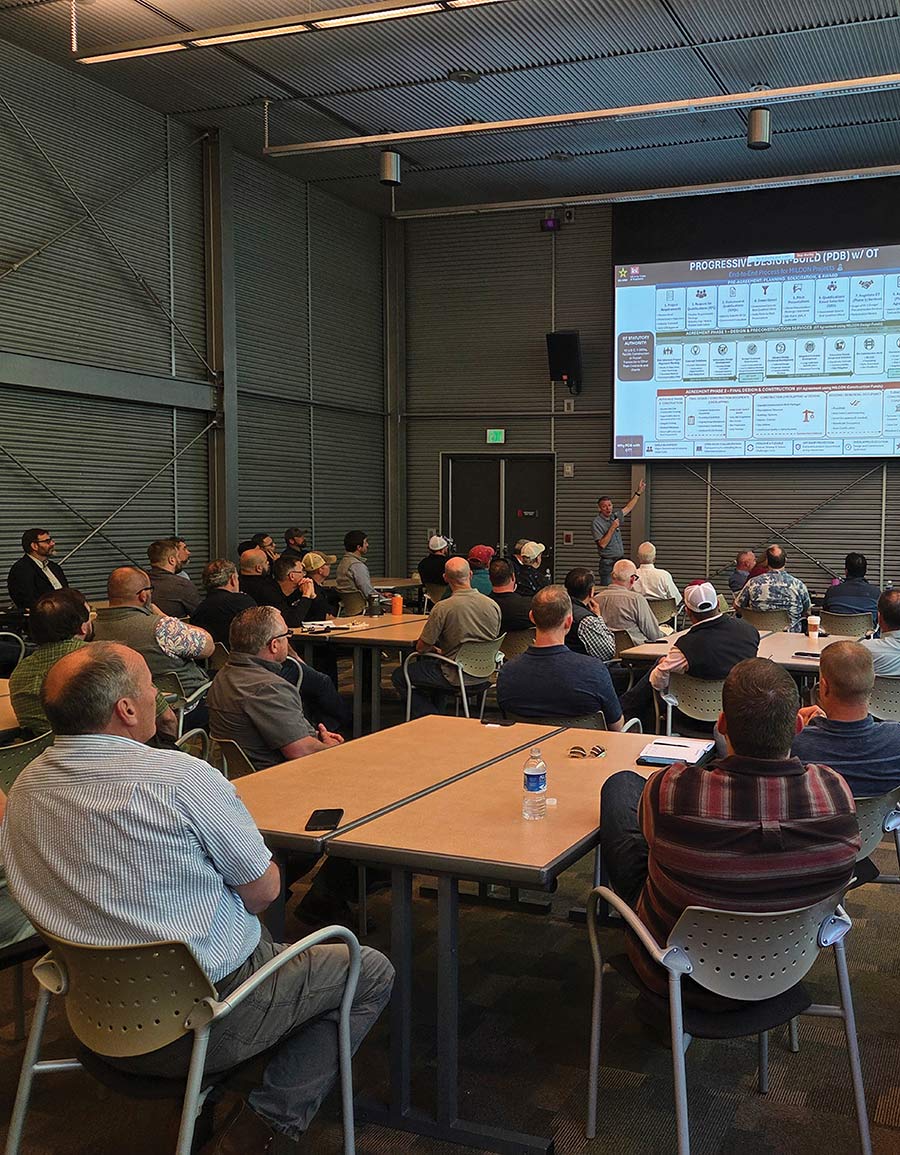
The US Department of War was authorized last year to procure and execute military projects using PDB. In the July meeting with AGC staff and members, USACE leadership clarified how local contractors can be competitive under the PDB method.
A separate meeting with FHWA gave AGC members an opportunity to engage with FHWA Administrator McMaster to discuss Alaska’s infrastructure potential. FHWA sought to better understand the constraints and logistics of delivering federal-aid transportation projects more effectively across the state.
“The power of a collective industry voice is a valuable benefit of AGC membership,” Olson says. “Individual companies may not always have the opportunity to engage directly on major policy and procurement issues, but together our members can help inform project owners about Alaska’s unique operating environment, challenges, and capabilities.”
AGC of Alaska

Carin Currier | Alaska Miners Association
Pacific Ocean Commission photos: AGC of Alaska
“AGC was able to quickly notify federal contractors in the membership of the opportunity to meet with GSA. Contractors were then able to prepare questions and have a meaningful discussion with GSA staff regarding how upcoming projects can be completed most efficiently,” Olson says.
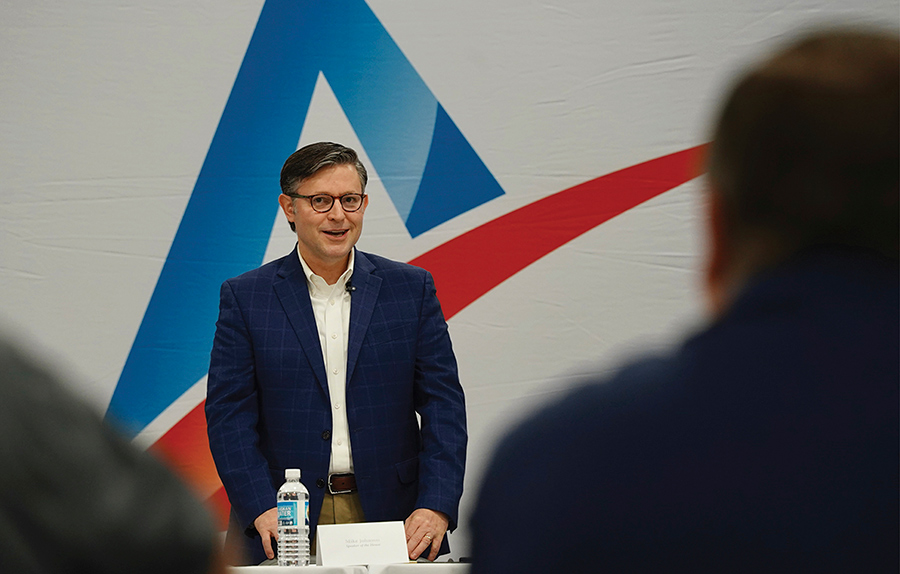
On August 7, AGC of Alaska Executive Director Alicia Kresl joined Alaska business leaders, Representative Nick Begich, US House Speaker Mike Johnson, and other federal representatives for an Alaska Business Roundtable focused on federal policies affecting Alaska employers. Kresl highlighted the importance of long-term federal infrastructure investment, emphasizing the critical role transportation funding plays in connecting Alaska communities and strengthening the state’s economy. She also reinforced the need for permitting reform to ensure that infrastructure projects can move from funding to construction more efficiently.
Meetings like these are relatively unusual, but AGC maintains year-round relations with the Alaska DOT and regional USACE staff, hosting both a DOT steering committee and a USACE steering committee. AGC’s annual Legislative Fly-In is another crucial connection to local lawmakers the agency provides for its members, bringing them to Juneau each year to meet with legislators and to educate and advocate for AGC’s legislative priorities. Olson pointed out that these activities reflect AGC’s founding values and a major benefit of AGC membership: the ability for members to participate in conversations as a powerful collective, helping to shape the future of Alaska and its infrastructure.