


cross America, the construction industry is short on hands. Contractors are stretched. Crews are aging out. Closer to home, a generation of young Alaskans is hesitating at the door of the trades.
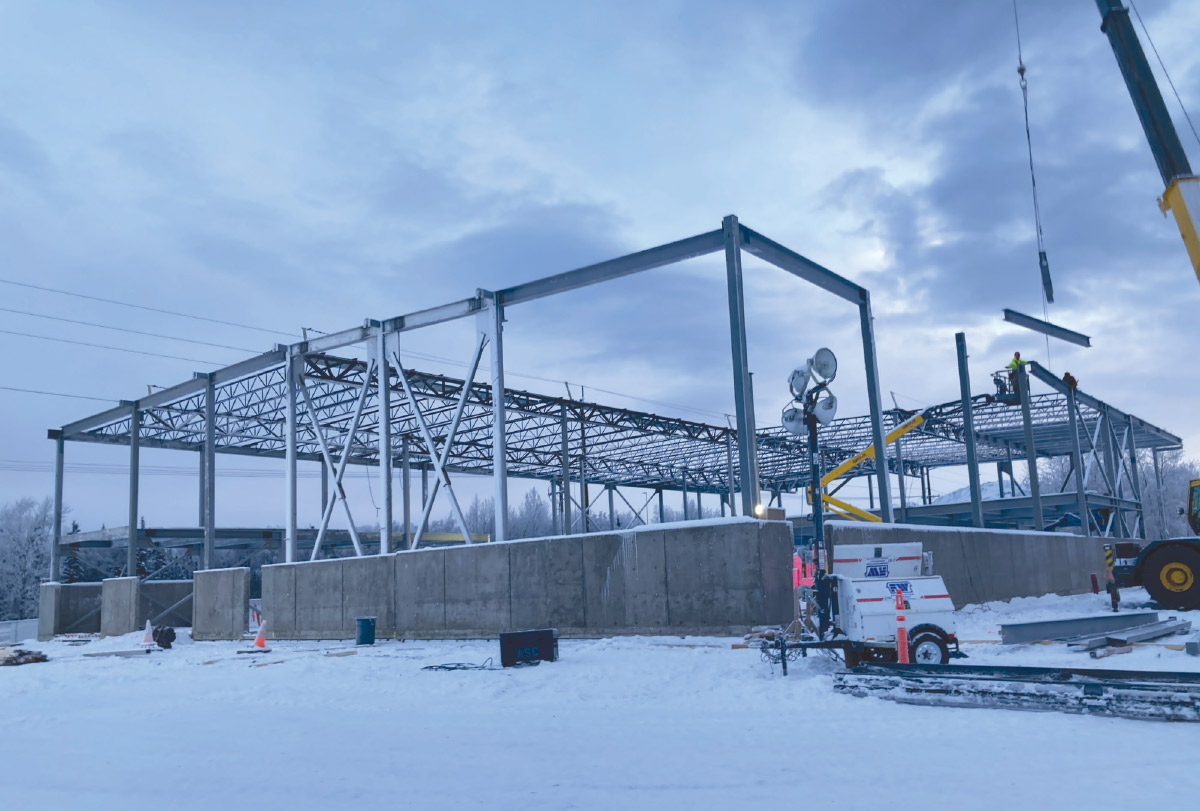
For the Carpenters Local 1281, an answer is rising on a high-visibility lot off the Glenn Highway just east of the Boniface Parkway exit, where a 20,000-square-foot training center is taking shape along Boundary Avenue.
“The training center is going to be a flagship piece for our organization in Alaska,” says Mario Martinez, regional manager for the Western States Regional Council of Carpenters. “It’s a message to the industry that says the Carpenters union is serious about training the best quality, skilled, productive carpenters in the construction industry. And it also sends a message that we want to be able to train and give opportunity to folks that otherwise wouldn’t have an opportunity for a good career with good pay and good benefits.”
The $20 million project, with F&W Construction Company Inc. as the general contractor, will replace the aging facility that Local 1281 has long outgrown. When the new facility opens this year, the union expects it to be a centerpiece of its recruitment and training pipeline in Alaska—a visible signal that the trade is still here, still hiring, and still investing in the next generation of carpenters and piledrivers.


“We definitely want to build to grow,” says Martinez. “What does that building look like if we have 2,000 members or 2,500 members? So we have to build to grow.”
The four-year apprenticeship remains tuition-free, says Martinez, and the union’s pitch to prospective carpenters is straightforward. “We like to have the students think of themselves as professionals,” says Martinez. “This isn’t just a job. It’s a career.”
Martinez says the new Anchorage training center mirrors a recent project in Boise, Idaho, where the union replaced a training center that dated to the ‘90s. Modern carpentry, he says, looks little like the trade of even a generation ago.
“Things have changed so much in the industry,” says Martinez. “It’s not like a hammer and nail so much anymore.”
Beyond hands-on training, the new facility will house computer-based software, multilingual classroom capability, and instruction in soft skills such as communication, accountability, and productivity, says Martinez.
Its location is no accident, either. It’s much more prominent than the current training center in South Anchorage.
“We don’t want to be the best-kept secret,” says Martinez. “We strategically put our training centers on very busy thoroughfares so that everybody can see that the Carpenters Union has got a training center and a presence in the community. We want to make sure that we’ve got high visibility, so folks know this is where you come if you want a pathway to a career.”
“We’re really proud, as a union contractor, to help make an impact and attract future workforce,” says Harris. “Just like everybody else, we’re struggling to find hands. We’re in an environment where a lot of young people don’t think to join the trades, and we’re hoping this creates more interest and curiosity for kids to consider a career in construction.”
“The project was awarded with the expectation to start ASAP,” says Luke Ciufo, the F&W project superintendent and project manager. “Our civil sub was able to accommodate this, got the lot cleared, and began the mass excavation.”
“It didn’t take long for the bumps in the road to begin showing up,” says Ciufo. “Unidentified and unknown underground obstacles, wells, septics, tanks, trash, and utilities.”


Saturated soils, freezing temperatures, and a tightening calendar forced one of the most consequential decisions of the project: hold off on pouring the first-floor slab until spring. That single call rippled across the entire schedule, says Ciufo, postponing nearly all interior work, including framing, electrical, plumbing, and mechanical.
Even so, crews kept moving. Structural steel went up. Exterior framing followed. The roof was installed in the heart of winter, allowing sheathing and a weather barrier to wrap the building. Once doors and windows were temporarily installed and heat applied, the second-floor slabs were poured.
“This is when the project finally opened up to all trades,” says Ciufo.
With the first-floor slab pouring in May, all trades transitioned their workflow from the second floor to the first floor and picked up speed heading into summer, says Ciufo.
Overhead powerlines run close to the building footprint, just far enough away for crews to safely perform their work but close enough to require constant vigilance. The challenge intensified in winter when crews built an 80-foot-by-125-foot plastic tent next to the high-voltage lines so the roof could be installed under temporary heat.
“Having a tent next to high voltage powerlines for six weeks was less than ideal,” says Ciufo, “requiring constant monitoring of the weather conditions and safety precautions to be maintained at all times.”
Underground, Chugach Electric Association high-voltage lines also crossed the building footprint. Coordinating their relocation became one of the more time-consuming delays of the mass excavation phase last summer, says Ciufo.
Soils have been a persistent challenge. The intent was to reuse much of the excavated material on site, but the wet fall, followed by spring breakup, has left certain areas oversaturated.
“It is extremely difficult to operate equipment in certain areas,” says Ciufo.
“This building is quite deceiving,” says Ciufo. “The farther into the details you get, the more precise everything needs to be.”
Despite the precision required and the moving target of a partial design-build approach, the project is tracking close to its aggressive schedule and budget. F&W is working with several Associated General Contractors of Alaska member subcontractors, including Fullford Electric Inc., AAA Fence, Inc., Rain Proof Roofing, Malone Construction LLC, and KC Corporation.
Harris credits the union itself with keeping the work on track.
“The Carpenters Union has made a really good partner to work with,” says Harris. “It’s a unique situation where, we get to work with an owner who understands construction, and specifically carpenters.”
The union is targeting a Labor Day grand opening, says Martinez, with a fallback window of fall 2026. For Martinez, the big picture is opening the doors to anyone who wants to train and ultimately don a carpenter’s tool belt.
“We want to make sure that we’re giving that opportunity out to anybody who would like to put on a set of bags,” says Martinez.