


Photo provided by Udelhoven Oilfield System Services, Inc.
Photo provided by Udelhoven Oilfield System Services, Inc.
ruise ship passengers traveling through the Port of Seward will now be greeted by stunning views, small-town charm, unpredictable weather—and a brand new, 748-foot-long, floating double-berth pier and a 69,000-square-foot passenger terminal.
With Associated General Contractors (AGC) of Alaska member Turnagain serving as general contractor, the entire project—from the date real estate development firm The Seward Company, the Alaska Railroad Corporation, and Royal Caribbean Group agreed to terms until the first cruise ship docked—took fewer than two years to complete. And it was done with minimal interruption to railroad or cruise ship operations.
“The Seward Company was up against a huge challenge, knowing that we were trying to get this done in a single winter season,” says Mickey Richardson, CEO and Founder of The Seward Company. “We timed construction with the cruise ship season and structured the project in such a way to take full advantage of the changes in the weather conditions during marine construction. This dance was the most difficult part of our accelerated timeline.”
The $137 million project not only modernizes the port’s aging infrastructure but promises to expand economic opportunities for Alaska Railroad, Royal Caribbean, the City of Seward, and the Alaska visitor industry.
Yet, despite the urgent need for replacement, several attempts to get the project underway were unsuccessful—until The Seward Company approached the railroad in January 2024 with a bold plan. The unsolicited proposal was backed by Royal Caribbean and included a 30-year Pier Use Agreement (PUA) with the cruise line and its guarantee of, at minimum, 140,000 passengers per year. The three entities agreed to terms in July 2024. Within the agreement, Turnagain was pre-named as the team’s design-build partner.
“Turnagain is heavily invested in the development process,” Richardson says. “As a design-build firm with a lot of experience around Alaska and in Resurrection Bay, they gave us a leg up. Turnagain is great to work with, as always.”
The agreement required project completion for the 2026 cruise ship season, so working on an accelerated timeline required open communication and collaboration between all parties. Turnagain stepped up on all fronts.
Cole Petersen, owner of AGC member company Metco Alaska, says having Turnagain at the helm minimized delays.
“Turnagain’s design team was great,” he says. “If we ran into any issues, it was redesigned and back to us the next day. That was really nice.”
“HPM has done an amazing job and been 100 percent on schedule,” he says. “They really under-promised and overdelivered on all terms of the project. The building is beautiful.”
HPM came on board in August 2024 and immediately set to work helping design and price the terminal.
“We worked with them during the design phase to get the cost down so that the terminal could fall under the overall funding limit of the job,” Wilhelm says. “That included the site work and the dock work.”
HPM began construction on the terminal, which is 75 percent larger than the previous terminal, in April 2025. Designed to meet the cruise ship industry’s needs and enhance the passenger experience, the terminal consists of a 41,500-square-foot indoor passenger terminal and a 27,500-square-foot covered outdoor space, with covered walkways and larger awnings to protect passengers, luggage, and vehicles from the elements. The terminal was moved from the dock to the adjacent uplands area, part of the Alaska Railroad’s 328-acre land reserve.

Photo provided by The Seward Company

Photo provided by HPM, Inc.

Photo provided by Udelhoven Oilfield System Services, Inc.
The terminal, a pre-engineered metal building (PEMB) that sits atop a polished concrete slab, is “a realistic and efficient building solution for Alaska,” Wilhelm says. The decision to go the prefabricated route was equal parts necessity and practicality.
“For a fast-track design like the one we had, PEMB presents a more streamlined opportunity; it’s a simplified fabrication process and it’s easier to ship,” Wilhelm explains. “It’s just another means that tends to be a little bit more cost effective.”
Metco Alaska began excavating the terminal site on January 1, 2025, removing 12,000 to 15,000 yards of material and filling it back in with 12,000 to 14,000 yards of material from its Seward gravel pit, Petersen says. All that material, combined with almost 2,000 feet of underground utility piping and demolition of inground structures, made it one of the largest jobs in Metco’s history.
“Seward’s a pretty small place, so 10,000 or 15,000 yards of material on a single job, that’s a lot for us,” Petersen says. “Most Seward jobs take 1,000 yards, and it’s done. For my six or eight employees who worked on this project day in and day out, we were able to accomplish some really big tasks for a small team.”
AGC of Alaska member Udelhoven Oilfield Systems Services, Inc., installed roughly 40,000 feet of tubing to support the terminal’s in-floor radiant heating system, says Karlo Buitrago, Udelhoven’s on-site superintendent and foreman.
“There was a large amount of work done on our mechanical side between mid-December and May,” he says. “We roughed in all domestic water piping, waste and vents, and the entire heat system in a very compact schedule. Everything went smoothly, and all the trades worked great together to get this completed in such a short window.”

Photo provided by Metco Alaska

Photo provided by The Seward Company
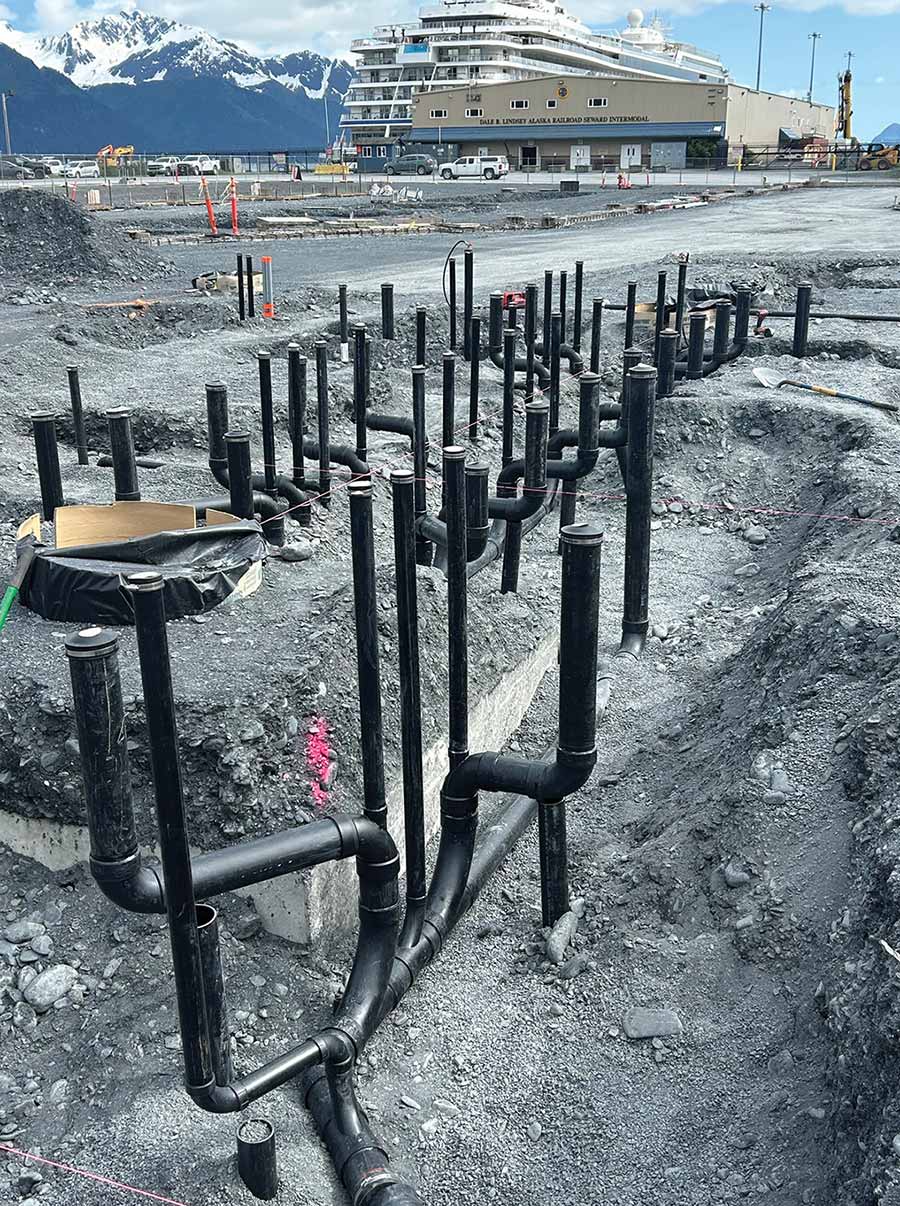
Photo provided by Udelhoven Oilfield System Services, Inc.

Photo provided by Metco AlaskaSystem Services, Inc.
High winds and cold temperatures created some hiccups on the terminal side as well. HPM intermittently paused work when the wind created safety issues.
“Then it’s just a juggling act, and you’re watching the weather, so when you have a window, you take advantage of it and keep going until Mother Nature decides to have other plans, and then you pivot,” Wilhelm says.
“Water in the building was tough in the winter months,” Buitrago adds. “The underground plumbing encountered some hurdles with steel and concrete designs, but we came up with a solution, and everything worked out great.”
The original facility’s age, combined with ‘60s construction methods, also created unexpected challenges. The original batter piles were solid concrete poured inside steel casings, rather than strengthened with rebar, which is standard today, Richardson says. Over time, the sheeting rusted, leaving the concrete piles fragile.
The Port was also designed to accommodate larger classes of ships, eliminating the potential that it will repeat the error of the original facility, which saw potential user groups outgrow its capacity.
“I expect the new facility, with the new building materials and techniques, will last just as long, if not longer than, the original port,” Richardson says.
The terminal will also be available for community rentals during the off-season. That’s a benefit Petersen, a Seward resident, is looking forward to.
“During construction, the terminal wasn’t available to the community,” he says. “I’m excited, the community’s excited to have this building back in town. It’s going to be really nice.”