



Associated General
Contractors of Alaska

8005 Schoon St.
Anchorage, AK 99518
907-561-5354
Fax: 907-562-6118
www.agcak.org
Associated General Contractors of Alaska
Jenith Ziegler
ChemTrack Alaska, Inc.
Pearl-Grace Pantaleone
HDR Alaska Inc.
Alicia Kresl
Associated General Contractors of Alaska
Christine A. White
R&M Consultants, Inc.
Heather Sottosanti
Big State Mechanical, LLC
Carrie Jokiel
ChemTrack Alaska, Inc.
Johnathon Storter
Meridian Management, Inc.
Tasha Anderson
Managing Editor
Rindi White
Editor
Monica Sterchi-Lowman
Art Director
Fulvia Lowe
Art Production
James K Brown
Graphic Designer
BUSINESS STAFF
Charles Bell
VP Sales & Marketing
907-257-2909 cbell@akbizmag.com
Chelsea Diggs
Account Manager
907-257-2917 chelsea@akbizmag.com
Weston Giliam
Account Manager
907-257-2911 wgiliam@akbizmag.com
Tiffany Whited
Marketing & Sales Specialist
907-257-2910 tiffany@akbizmag.com
501 W. Northern LIghts Blvd., Ste 100
Anchorage, AK 99503
The Alaska Contractor is published by Alaska Business Publishing Co. Inc. for the Associated General Contractors of Alaska. Contents of the magazine are not necessarily endorsed by AGC of Alaska or Alaska Business Publishing Co. All rights reserved. Copyright 2026 by the Associated General Contractors of Alaska. For information about articles in this edition or for permission to reproduce any portion of it, contact Alaska Business Publishing Co.
Design by: James K Brown
8005 Schoon St.
Anchorage, AK 99518
907-561-5354
Fax: 907-562-6118
www.agcak.org
Associated General Contractors of Alaska
Jenith Ziegler
ChemTrack Alaska, Inc.
Pearl-Grace Pantaleone
HDR Alaska Inc.
Alicia Kresl
Associated General Contractors of Alaska
Christine A. White
R&M Consultants, Inc.
Heather Sottosanti
Big State Mechanical, LLC
Carrie Jokiel
ChemTrack Alaska, Inc.
Johnathon Storter
Meridian Management, Inc.
Tasha Anderson
Managing Editor
Rindi White
Editor
Monica Sterchi-Lowman
Art Director
Fulvia Lowe
Art Production
James K Brown
Graphic Designer
BUSINESS STAFF
Charles Bell
VP Sales & Marketing
907-257-2909 cbell@akbizmag.com
Chelsea Diggs
Account Manager
907-257-2917 chelsea@akbizmag.com
Weston Giliam
Account Manager
907-257-2911 wgiliam@akbizmag.com
Tiffany Whited
Marketing & Sales Specialist
907-257-2910 tiffany@akbizmag.com
501 W. Northern LIghts Blvd., Ste 100
Anchorage, AK 99503
The Alaska Contractor is published by Alaska Business Publishing Co. Inc. for the Associated General Contractors of Alaska. Contents of the magazine are not necessarily endorsed by AGC of Alaska or Alaska Business Publishing Co. All rights reserved. Copyright 2026 by the Associated General Contractors of Alaska. For information about articles in this edition or for permission to reproduce any portion of it, contact Alaska Business Publishing Co.
Design by: James K Brown



 AGC MEMBER
 Brice Incorporated
$36,888,681
Fall 2025–Spring 2028 Community Winter Access Trails – Utqiagvik, Atqasuk, Wainwright, Drill Site 2P or alternative site, Galbraith Lake and Anaktuvuk Pass
Eskimos, Inc.
$14,100,000
Northern Region ADA Improvements – Nome: Steadman St.
Knik Construction Co Inc
$4,376,344
GAOA – Alaska Peninsula NWR Float Plane Dock Replacement
STG, Inc.
$2,634,300
Northern Region Surface Preservation Maintenance FFY2025
Jolt Construction & Traffic Maintenance, Inc.
$1,679,000
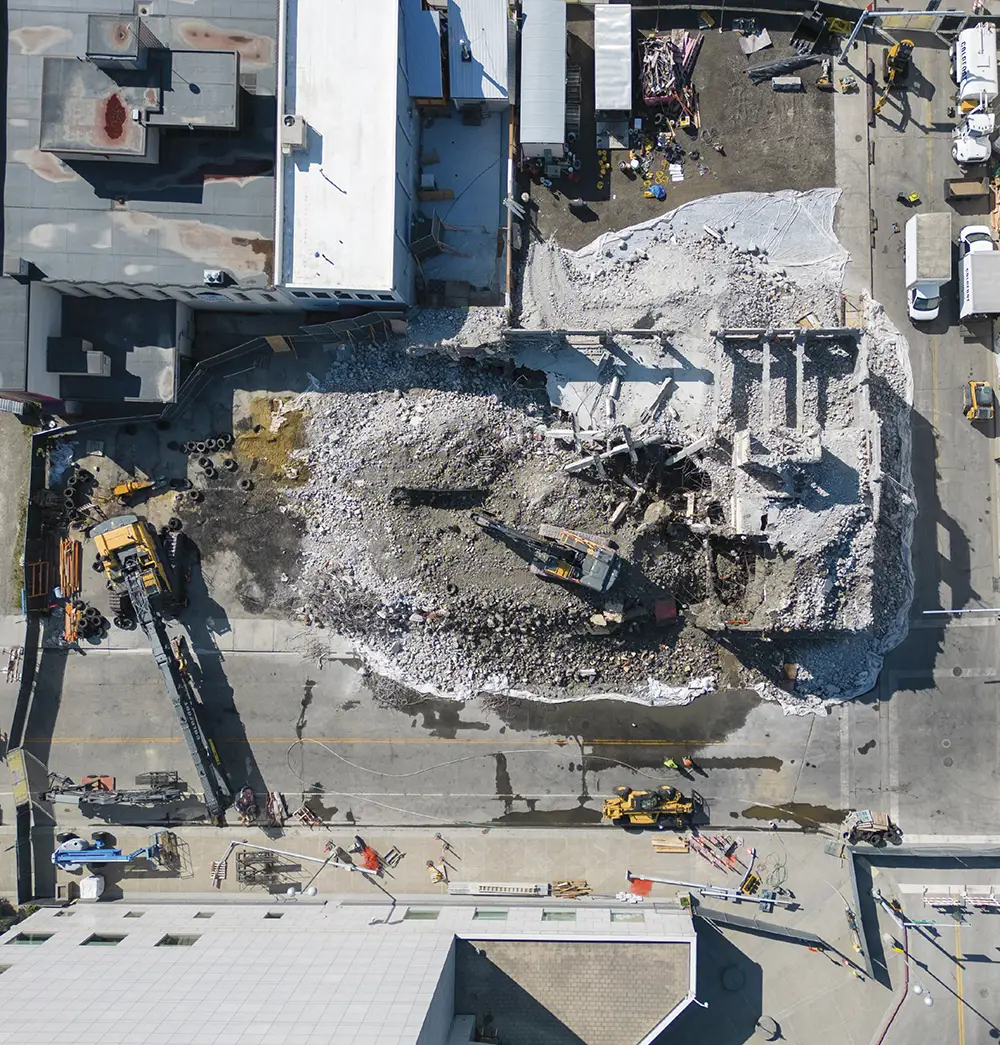
Soap & Suds and Old Pharmacy Bldg. Remediation and Demolition
Alaska Demolition, LLC
$759,525
Utqiagvik Courthouse Upgrades
R Squared Contracting, Inc.
$372,553
Northern Region Airport Electrical Maintenance 2025
Alcan Electrical & Engineering, Inc.
$333,450
Residential Well & Septic System Installation – Dillingham
Northern Contractors and Consulting LLC
$174,209
 HC Contractors LLC
$5,329,076
University Avenue South Bicycle/Pedestrian Facility (CMAQ)
Great Northwest, Inc.
$1,996,791
Appliance Maintenance Services – Fort Wainwright
Appliance Service Co, Inc.
$979,104
Parks Highway Nenana River Bridge at Moody #1143 Preventive Maintenance
Granite Construction Co.
$808,500
Delta Junction Panoramic Field Berm Removal
Midstate Equipment, Inc.
$224,375
FIA South Cargo Apron Emergency Repairs
Exclusive Paving
$197,111
Construct a New Septic System for the Eagle Village Health Clinic
Alaska Rural Construction Services LLC
$176,000
ARRC Nenana Front Street Crossing Upgrade
Granite Construction Co.
$167,500
Centennial Center Column Repairs
Callahan Construction Company
$156,400
Jones Road Service Area – Road Repair
Groundhogs LLC
$132,191
Tok Junction Surface Maintenance Preservation FFY2025
Specialized Pavement Marking, Inc
$123,331
Fairbanks Building Parking Lot Improvements
Great Northwest, Inc.
$100,366

Western Dock & Bridge
$978,000
7-Mile Shop Heavy Equipment Storage Shed
Dawson Construction, Inc.
$901,864
Scow Bay Generator #2 Design Build Construction Project
Dawson Construction, Inc.
$768,330
Last Chance Basin Wells 4 & 5 Replacement
Dawson Construction, Inc.
$713,989
2025 Road Surfacing Improvements
Colaska, Inc. dba SECON
$484,333
2025 Lemon Creek Pit Asphalt Processing
Secon-Aggpro
$465,000
Eaglecrest Gondola Mid-Station Access Road
GR Cheeseman Construction
$456,000
2025 Romine and Roosevelt Drive Water Main Replacement Project
Copper Ridge LLC
$440,500
35 Mi. Off Road Vehicle Beginner Trail
Southeast Trucking LLC
$259,303
Pederson Hill Paving
Secon-Aggpro
$226,600
Lily Lake Road Repair
SouthEast Road Builders
$146,723
Alaska State Capitol Complex Snow Removal Services
Cutting Edge Development
$122,375
 QAP
QAP$29,667,552
Construct Emergency Services Facility 3-9
H5 Construction, LLC
$14,083,785
Construct Taxiway Kilo
AHTNA Construction & Primary Products Company
$8,243,859
Don Young Port of Alaska SDS001 and SDS002 Rehabilitation
Granite Construction Co.
$5,778,179
Kachemak Drive MP 0-3.5 Pavement Preservation Project
Southcentral Construction, Inc.
$3,734,539
E 64th Ave & Meadow St Drain Improvements
Bristol Prime Contractors LLC
$2,745,369
MOA Alaska Center for Treatment
Orion Construction Inc
$2,404,369
Anchor Point Road MP 0-1.3 Pavement Preservation Project
East Road Services, Inc.
$2,396,149
Bowman Elementary School Playground 2025 Upgrades
Roger Hickel Contracting, Inc.
$1,605,200
Seward Highway, McHugh Creek Turn Lane
Granite Construction Co.
$1,572,333
Southcentral Construction, Inc.$1,431,485
Klatt Elementary School Loading Dock Awning
HPM Contracting, Inc.
$1,067,969
Truck Mounted Drill Rig
Geoprobe Systems
$616,797
Highland Drive Culvert Replacement Project
East Road Services, Inc.
$587,990
Architectural/Engineering Services for 2nd Ave & Nelchina St Area Storm Drain Improvements – Phase II
Stephl Engineering, LLC
$498,523
UAA EM1 Boiler Addition
Alaska Mechanical, Inc.
$347,600
Furnish Washed Sand Aggregate to the Municipality of Anchorage, Maintenance & Operations Street Maintenance
Anchorage Sand & Gravel Co., Inc.
$328,070
Kachemak Selo Exploratory Water Supply Well
Sullivan Water Wells
$279,000
Campbell Tract Hazardous Fuel Reduction
Absolute Forestry LLC
$265,000
Design-Build O&M Covered Storage
Steppers Construction Inc.
$264,975
Sturgeon Electric Co., Inc$227,316
Provide Birch Tree/Elmore Limited Road Service Area Road Maintenance
Western Construction & Equipment LLC
$217,000
Finger Lake Elementary School Boiler Replacement
Mechanical Specialist Inc
$199,863
Architectural/Engineering Services for Condition Assessment & Load Rating of POL2 Dock
Moffatt & Nichol
$184,220
Plant Materials Center–Seed House Addition
Summit Builders Incorporated
$183,950
Plant Materials Center–Seed House Heating System
JGH Plumbing & Heating
$162,070
AMYA Warehouse Roof and Siding Repairs
JRF Enterprises LLC
$146,870
KBC Young’s Building Demolition
Alaska Demolition, LLC
$141,794
Maud Road Station Fill Site Clearing
Tutka, LLC
$131,750
1,700 TPH Snow Blowers Supply
Snow 49, LLC
$126,538
Furnish Rabbit Creek View/Heights Limited Road Service Area Road Maintenance
Northern Gravel & Trucking LLC
$105,300




s I step into the role of president for Associated General Contractors of Alaska, I find myself reflecting on the people, places, and experiences that shaped my path into this industry. Like many of you, my story is woven into Alaska itself, its history, its challenges, and its unwavering strength.
I am the daughter of an immigrant.
My father, Sig Jokiel, left the industrial pulse of Düsseldorf in 1960 to study at the University of Alaska, where he met my mother, who was raised across rural Alaska as the daughter of Bureau of Indian Affairs teachers. My childhood in the ‘80s and ‘90s was full of lessons shaped by a struggling economy, bank failures, and the Exxon Valdez oil spill. I was raised with an entrepreneurial spirit and grew up watching my parents navigate the economies of those decades. While friends asked for bedtime stories, I asked for business stories and my parents would read chapters from books by Lee Iacocca and Zig Ziglar.
I grew up on job sites, in ice rinks, in the back of a Cessna 185, and around people whose grit and determination defined what it means to be Alaskan. I am—and always will be—the proud daughter of a construction-working hockey player.
Those early experiences formed the foundation for the leadership attitude I carry today: the Northern Attitude.
We don’t wait for perfect conditions.
We don’t turn around when the work gets tough.
The Northern Attitude is quiet grit.
It’s showing up when it’s dark.
It’s building when it’s cold.
It’s sharing the common experience of isolation and lending a hand regardless.
It is the fierce belief that progress is always possible—because we show up, dig deep, and get it built.
This mindset runs through our contractors, apprentices, labor partners, engineers, operators, and every community our work touches. It is what has always set Alaska apart.
The next generation is watching us closely. We must ensure the doors of this industry remain open, accessible, and full of possibility.
Leadership today must include empathy. It must include willingness to talk about mental health, to normalize conversations that were once taboo. Even small actions—like beginning meetings with “box breathing” or other cortisol reducers—can create safer, healthier environments. Compassion is not separate from construction; it is a core competency that keeps our teams whole.
- 40 communities impacted
- 15 contractors mobilized
- 55 work authorizations issued
- $65 million in recovery
- 2 million pounds of material moved within days
What stands out is not the devastation, it’s the determination. Alaskans get up, gear up, and get it done. That’s who we are.
The math is clear: 90% federal. 10% Alaska. 100% smart.
Meeting the match means stronger communities, safer roads, improved ports, resilient energy systems, and opportunities for every contractor in this state. When Alaska meets the match, Alaska moves forward.



Photo provided by Brandon Harker
PO Box 1773, Seward, AK 99664
907-406-0099
Gryph@gryphonmarine.com
Gryphonmarine.com
7532 E. Heavenly Cir., Wasilla, AK 99654
907-746-8895
jgcinc@mtaonline.net
johnsgeneralcontractinginc.com
845 S. Grantham Rd., Wasilla, AK 99654
907-290-0601
admin@pyramidmm.com
pyramidmaintenancemanagement.com
34718 Sterling Hwy., Sterling, AK 99672
907-398-6346
alaskaalloy@gmail.com
alaskaalloy.com
12243 Center St., Eagle River, AK 99577
907-346-7867
customerservice@akqualityseptic.com
akqualityseptic.com
3244 E. 144th Avenue, Anchorage, AK 99516
907-268-5221
chiser@squarehconstruction.com
squarehconstruction.com
8005 Schoon St., Suite A, Anchorage, AK 99518
907-202-8935
info@stillwatermarineservice.com
stillwatermarineservice.com
3909 W. Arctic Blvd., Anchorage, AK 99503
907-529-5268
dhunter@afognak.com
acg.afognak.com
6301 Rosewood St., Anchorage, AK 99518
907-273-2736
ap@akwaste.com
akwaste.com
8055 E. Bogard Rd., Palmer, AK 99645
907-745-4044
info@centralgravelproducts.com
centralgravelproducts.com
601 Union St., Suite 1601, Seattle, WA 98101
206-302-9254
david.tran@cnasurety.com
cnasurety.com
714 Fourth Ave., Suite 100, Fairbanks, AK 99701
907-455-1500
vsupanick@doyonutilities.com
doyonutilities.com
13925 Interurban Avenue South, Suite 100, Seattle, WA 98168
907-982-5045
3705 Arctic Blvd. #2053, Anchorage, AK 99503
907-302-5674
nelson@finishedgrade.com
1198 S. Crown Rd., Fairbanks, AK 99709
907-479-6201
info@goldennorthinn.com
goldennorthinn.com
1070 Sandy Hill Rd., Irwin, PA 15642
724-863-0550
neil.simpson@imi-critical.com
pbmvalve.com
4272 Chelsea Way, Anchorage, AK 99504
907-250-9038
patrick.lemay@lemayengineering.com
7941 Sandlewood Place, Suite 100, Anchorage, AK 99507
907-272-4732
jrabe@stratus-services.com
stratus-services.com
418 Dark Star Court, Fairbanks, AK 99709
907-590-5009
seth@tundrakitchensolutions.com
tundrakitchensolutions.com

hen the remnants of Typhoon Halong ripped through western Alaska in October, the storm left behind more than broken boardwalks and scattered debris. It disrupted daily life in communities already operating with limited infrastructure and few methods of access. Roads and airports washed out, coastal areas eroded, fuel and water systems were damaged, and many homes were deemed unsafe for families to move back into after the waters receded. We all watched the images online with feelings of despair and helplessness.
In moments like these, Associated General Contractors (AGC) of Alaska members step into roles that are both deeply technical and deeply human. Their work is not only about construction—it is about helping communities regain stability after a terrifying night that changed everything.
One important part of this story is the rapid statewide mobilization led by the Alaska Department of Transportation and Public Facilities (DOT&PF). Department staff reached out to AGC almost immediately after the storm, making clear that any contractor able to mobilize in western Alaska was needed. In several cases, DOT&PF staff were on the phone with contractors at 6:30 a.m. on a Sunday morning or meeting them at hangars to sort through contract details and determine how to get equipment and crews into affected communities as fast as possible. Their urgency and coordination helped accelerate the entire recovery effort.
In some communities, crews are repairing boardwalks that serve as primary travel routes. In others, workers are leveling houses, repairing exterior walls and roofs, rebuilding entryways, and reconnecting fuel systems so families can safely return home. The work varies by community but the intention is the same: restore what the storm damaged so residents can get back on their feet.
The logistics behind this work are just as challenging. One heavy-lift operator has transported nearly 500,000 pounds of lumber, insulation, generators, and other materials from Bethel to coastal areas in only a few weeks. Every delivery helps keep ground crews productive in remote areas where all supplies must be flown in.
When AGC members work in remote regions, they bring the experience, equipment, and determination needed to respond quickly when disaster strikes. Their work stabilizes communities during moments of uncertainty and establishes the groundwork for repairs that will continue well into next season. The pride in this effort is shared across the AGC membership. This work is hard, but also meaningful, and reflects an industry that knows how to solve problems under pressure.
AGC of Alaska is proud of the dedication and skill our members bring to communities in need. Thank you for the work you are doing. And sincere best wishes to our neighbors and friends in western Alaska as recovery continues.

- Alaska Native Tribal Health Consortium
- Brice Environmental Services Corporation
- Brice, Inc.
- Brice Services, LLC
- Cruz Construction, Inc.
- Drake Construction, Inc.
- Equipment Source, Inc.
- Everts Air Cargo
- Fullford Electric, Inc.
- GHEMM Company
- Great Northwest, Inc.
- Knik Construction Company, Inc.
- Lynden
- Mass Excavation, Inc.
- Northern Air Cargo
- Qayaq Construction, LLC
- Quality Asphalt Paving/Aggpro
- ROTAK Helicopter Services
- STG, Inc.
- UIC Government Construction, LLC
- Trygg Air Alaska
- Tumet Industries, LLC
- Yukon Equipment, Inc.

he 2025 Associated General Contractors (AGC) of Alaska annual conference may be wrapped up, but the lessons, connections, and advancements AGC members made throughout the week will linger into the future.
At the conference, held November 12 through 15 at the Hotel Captain Cook, AGC members learned about upcoming bid opportunities through the Alaska Department of Transportation and Public Facilities and the US Army Corps of Engineers, along with how to incorporate changes to the federal and state contracting process. Members with strong records of safety, or who had overcome challenges to build a unique project with the deck stacked against them, received awards for their efforts. Up-and-coming contractors had a chance to talk with seasoned contractors at the Construction Leadership Committee reception. Contractors spoke frankly about lessons they learned from their most difficult projects. Industry leaders who specialize in working in remote communities shared their strategies for working in logistically challenged regions. Lawyers, Small Business Administration officials, and financial advisors shared information about navigating labor agreements, unlocking small business funding when it’s time to expand, and how to prepare for a meaningful retirement. Through it all, there were networking opportunities, meaningful conversations, and a sense of camaraderie and celebration of a productive year. With full hearts and new ideas to consider in 2026, members donned floral shirts and blossom-laden finery to close out the conference with the annual Dinner Dance, themed Met Gala: A Floral Affair. After entering to the dulcet tones of a string quartet and being entertained by the talented members of Alaska Dance Promotions, newly elected AGC Board President Carrie Jokiel introduced the incoming Executive Board and encouraged AGC members to go strong into the new year: “We are the people who work with little light and big ambition. We build when it’s dark, we lead when it’s hard, and we show up—period.”


- Marsh McLennan Agency
- IMA
- ChemTrack Alaska
- ConocoPhillips Alaska
- Davis Block & Concrete
- Fullford Electric
- F&W Construction
- First National Bank Alaska
- Northrim Bank
- STG Pacific
Gold Sponsors
- Colaska, Inc.
- Cruz Construction, Inc.
- Davis Constructors & Engineers
- JD Steel Co., Inc.
- N C Machinery
- Spenard Builders Supply
Platinum Sponsors
- Construction Machinery Industrial, LLC (CMI)
Silver Sponsors
- Anchorage Sand & Gravel Co., Inc.
- Denali Drilling
- Granite Construction Company
- Great Northwest, Inc.
Bronze Sponsors
- Craig Taylor Equipment
- GHEMM Company, LLC
- KLEBS Mechanical
- Lynden
- Qayaq Construction
- BDO USA
- Knik Construction Co., Inc.
- Loken Construction LLC
- Loken Crane, Rigging & Transport LLC
- North Star Equipment Services
- Olson Creek LLC
- PND Engineers, Inc.
- Stantec
- Yukon Equipment
Dedicated Item/Event Sponsors
- Afognak Commercial Group
- AIDEA (Alaska Industrial Development and Export Authority)
- Bagoy’s Florists
- The Brandon Skinner Group, P.C.
- Denali Industrial Supply, Inc.
- Drake Construction
- DWELL In Alaska
- Fullford Electric
- KUNA Engineering
- Republic Services
- STG, Inc.
- Spenard Builders Supply
- Surveyor’s Exchange
- Swalling General Contractors
- TOTE Maritime Alaska, Inc.
- Zurich Surety

Photo provided by Bagoy’s Florist & Home
Photo provided by Bagoy’s Florist & Home
agoy’s Florist & Home has consecutively been voted best florist in the state since 1922, which is a little ironic considering that the florist opened shop while Alaska was still a US territory. The family-owned business, which recently celebrated its 100th anniversary, is going strong under the management of Adam Baxter and his wife, Kristen Keifer.
The couple bought the business three years ago when Baxter was looking for a change from his career in commercial banking. He says the experience has been deeply rewarding.
“I believe that our phenomenal design staff, who are extraordinary in what they do and the product they present, sets us apart from other florists,” Baxter says, noting that lead designer Maria Calzada has been with the company for thirty-one years. “We also try and source the best product, handle it with care, and take great pride in our customer service. We want our clients to be happy.”
Celine Kaplan, acting executive director and marketing and public relations director of Anchorage Senior Activity Center, has been a Bagoy’s client for six years. The florist provides flowers for the senior center’s fundraising gala each summer, as well as for the facility’s day-to-day needs, like birthdays and sympathy arrangements.
“We chose Bagoy’s because of their design skills—we are always looking for something special and elegant for our gala,” explains Kaplan. “Every year we have a different theme, and we work closely with their designers to achieve the look we’ve envisioned.
“They are always welcoming of our ideas, and they offer great ideas themselves,” she adds. “Because the gala is so unique—under a tent outside in Alaska—it requires really special arrangements and décor.”
“I learned quickly when I got here that, while flowers are the final product, the business itself is largely logistics,” says Baxter. “It’s quite an accomplishment to get flowers to the store, delivered to customers locally, or shipped out to other communities.”
Store manager Julie Wilson says Bagoy’s customers range from large corporations and oil companies to individuals purchasing their first flowers. The company has even provided arrangements for US presidents.
“Customers remember buying their first prom corsage here, or buying flowers after asking a girl out,” says Wilson. “From galas in Anchorage to funerals in Barrow, we’ve been a part of people’s lives for a very long time.”
Wilson, who has been with the company for seventeen years, is especially proud of the floral 727 jet that the company created for the funeral of an Anchorage doctor, who was also a pilot, and of the giant floral diorama Bagoy’s design department created depicting a Bush airplane flying through the mountains.
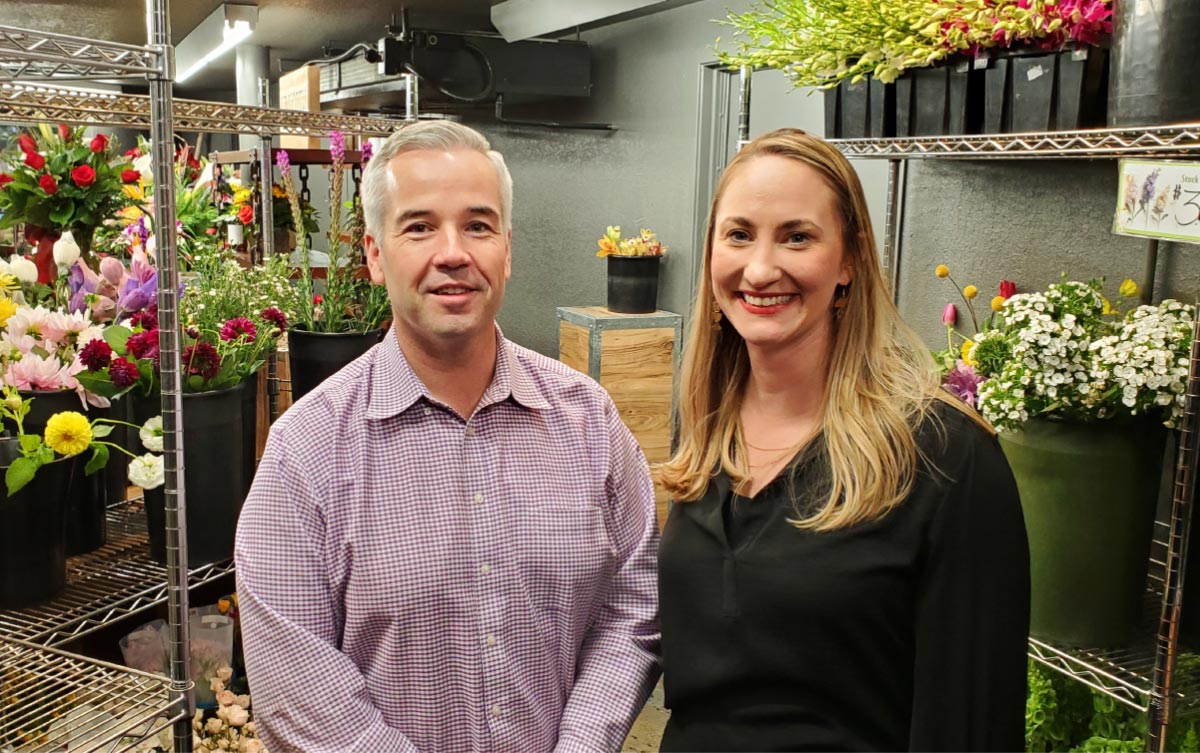
Photo by Scott Rhode | Alaska Business
“Getting a package license was a feat in itself, as was getting the delivery endorsement, shipping endorsement, packaging endorsement, and more,” says Baxter. “Now we can deliver wine, champagne, and bottles of bourbon—it’s just like ordering from DoorDash or Uber Eats.”
The option of sending a boozy bouquet or gift is quite popular; last year, the company sold more than 700 corporate gift boxes that included an alcohol component.
“We keep current with the latest technology, and social media is another component to staying relevant,” says Baxter. “We are also extremely committed to the community and give back through our Helping Hands initiative, school and military discounts, and sharing costs with nonprofit events.”
Baxter is also very involved with AGC, which he joined while working at the bank.
“When I resigned from the bank, a few contractor friends told me that I didn’t have to quit AGC; I could just make Bagoy’s a member,” he says. “And why not? Most members are our customers in one way or another, and I like supporting the construction industry. And they like supporting me.”
Luke Blomfield, AGC member and president and co-owner of Davis Constructors & Engineers, Inc., is one of those customers.
“I’ve worked with Bagoy’s since I was a teenager in charge of sending out flowers for my dad’s company,” he says. “They have a terrific track record; they are always there when you need them and offer a fair price. And they are a very established Alaska company.
“Since they’ve gone through new ownership, they haven’t skipped a beat,” he adds. “The other day I needed flowers within a few hours, and they delivered $1,000 worth of flowers 40 miles away in the Valley with no issue. They’re just that good.”



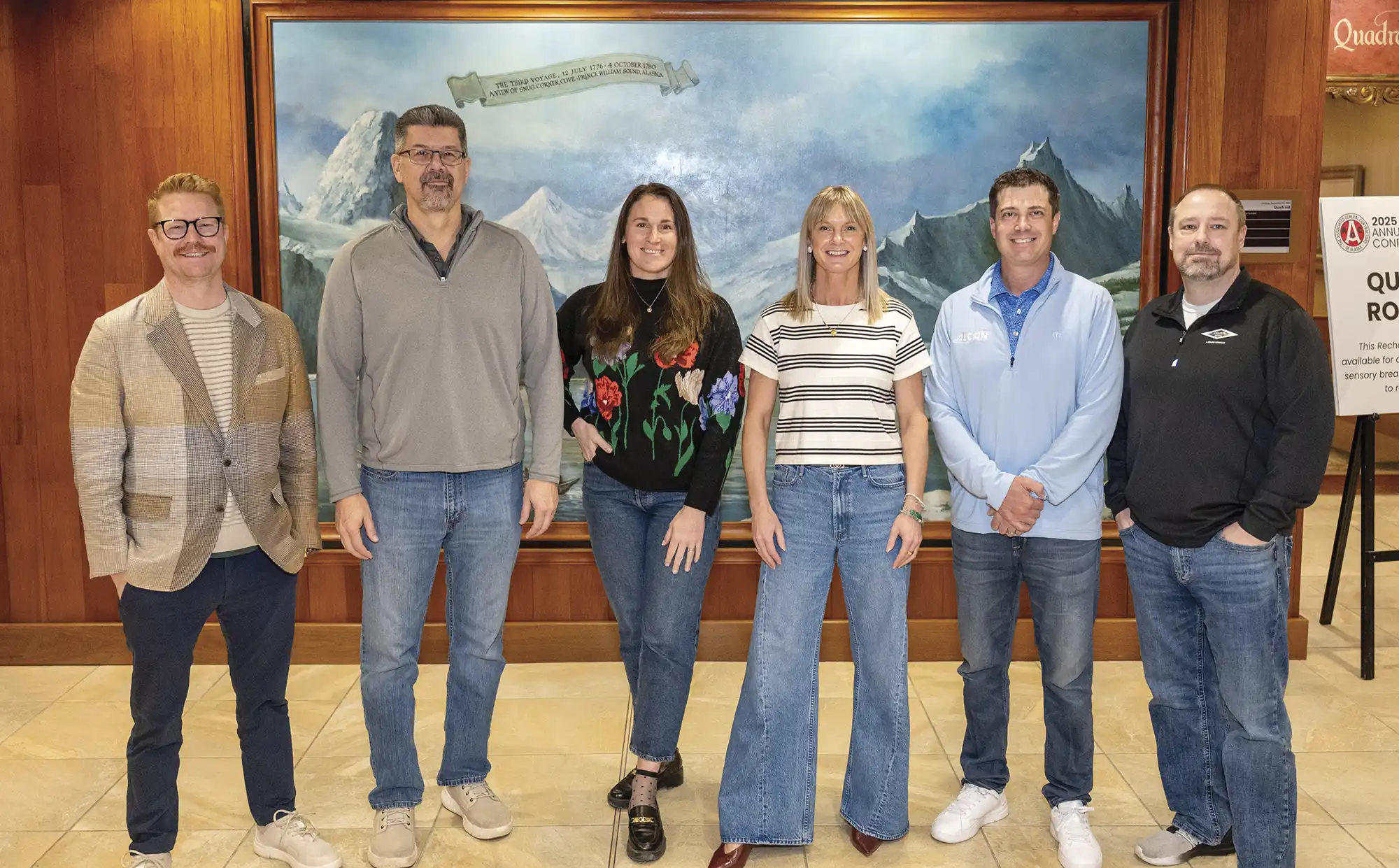
Photos by Photo Emporium Alaska unless otherwise noted.
n her tenure as 2024-2025 President of the Associated General Contractors (AGC) of Alaska, Saigen Harris diligently encouraged AGC members to jump in and make their voice heard. In her outgoing speech as president before AGC members gathered at the Dinner Dance Gala November 15, Harris reiterated her challenge to members, to “take a step forward and participate in this organization, to make sure that this industry remains competitive.”
The perspective of each member, whether a project manager at a large contracting company or the sole owner of a one-person bookkeeping firm serving construction industry clients, has value in shaping policy, directing advocacy efforts, and ultimately helping AGC better serve its members.
Where are those perspectives shared? Mostly around committee tables, where AGC leaders work together to tackle issues of import to members. AGC board members bring their own experience, as well as input gleaned from other industry leaders, to the table when discussing issues that matter in their day-to-day operations. AGC of Alaska would like to welcome the 2025/2026 executive board and all the members of its board of directors as we embark on a new year of service.

President
Jokiel attended the University of New Hampshire on an ice hockey scholarship. During her time there she received a Bachelor of Science in Kinesiology, won a national championship, and captained her team her junior and senior year. After graduating she worked for NBC Sports in New York City and was hired to work the 2002 Winter Olympics in Salt Lake City. Upon returning home to Anchorage, she worked at the local sports arena and finished her MBA from UAA. She then began working at ChemTrack and finished her masters of science in project management, also from UAA.
Jokiel is active on the AGC Board of Directors. She is a mentor for the Women’s Power League of Alaska, a new nonprofit seeking to champion future and existing leaders in the 49th State through mentorship, professional development, and community building. Jokiel was a board member of the YWCA Alaska where she served as board president for two years. She is also a member of Women Impacting Public Policy, or WIPP, the Society of American Military Engineers, the National Contract Management Association, and is an ambassador for Women’s Ice Hockey in the Fast and Female International Program. In 2018, Jokiel was awarded the Enterprising Women of the Year award for her company’s revenue category. In 2016, she was inducted into the Sports Hall of Fame at the University of New Hampshire and in 2014 was named one of Alaska Journal of Commerce’s Top Forty Under 40.
Jokiel was born and raised in Anchorage and is still active in the hockey community, playing and coaching. She enjoys spending as much time as possible in Girdwood skiing, running, and enjoying the mountain town lifestyle. Most importantly she is the proud mom of a little lady named Will, named for her incredibly strong German Oma, Wilhelmina.

Vice President
During his professional career, Blomfield has achieved a few noteworthy accomplishments. He is married to a wonderful woman and has two stellar children; he was invited to speak at the Project Management Institute Global Congress presenting his master’s thesis; he was named one of Alaska Journal of Commerce’s Top Forty Under 40; he sits on the UAA Construction Management Department Advisory Committee; and he is a member of the Anchorage Museum Board of Directors.

Secretary
Drake and his wife, Amber, have three daughters: Callan, Teigan, and Mairyn. Drake, a Doyon shareholder, serves on the Alaska Technical Center Advisory Board in Kotzebue as well as AGC’s Department of Transportation Committee and its Sustainable Budget Task Force. In his spare time, he enjoys outdoor activities such as fat tire biking, snowmachining, and golf.

Treasurer
Recognizing his potential, Alcan’s leadership provided him with further development opportunities, which included leadership courses through the National Electrical Contractors Association and training through Firestone Consultants’ Leadership Academy. Armed with an Electrical Administrator’s license, Fleming stepped into project management roles and soon became indispensable to Alcan’s operations. His accomplishments include managing major projects such as the Solid Waste Services Central Transfer Station in Anchorage and the Long-Range Discrimination Radar at Clear, both of which required meticulous planning and coordination with top partners such as Lockheed Martin and Davis Constructors & Engineers.
Fleming’s dedication and vision eventually led him to partner with Jesse Hale and Sage Bringmann to acquire Alcan, where he now serves as president. Under his leadership, Alcan has successfully delivered some of Alaska’s largest and most complex electrical projects. Known for his focus on company culture, Fleming emphasizes teamwork and employee recognition as core values within the organization.
Beyond his professional achievements, Fleming is a proud Alaskan who enjoys spending time with his family, supporting his kids in their sports, and exploring the outdoors during Alaska’s vibrant summers. His dedication to his team, community, and industry makes him a respected leader in Alaska’s construction landscape.

Contractor-At-Large
Jensen began his construction journey with a small civil earthwork company in 1998 and held various positions from estimator to vice president. Jensen has worked for Granite Construction, QAP, and is currently the General Manager for Exclusive Paving & University Redi-Mix in Fairbanks. Jensen has a strong passion for training and development and hopes his efforts will help shape the industry’s future workforce.
Jensen has volunteered as an adjunct professor in UAA’s construction management program since 2017 and has served since 2015 as a member of the UAA Construction Management Advisory Board. Jensen coaches and leads UAA CM students in the Associated Schools of Construction Student Competition, competing in the Heavy Civil Division. Jensen is also a Co-Chair of the AGC Workforce Development Committee, where his efforts helped him achieve the AGC of Alaska Stan Smith Volunteer of the Year Award in 2024.
Jensen and his wife, Kelly, have three children: Tyler, Aiden, and Hailee. They enjoy spending time together as a family exploring all Alaska has to offer. Kris enjoys sports, especially traveling around the country watching his daughter play volleyball—he is a proud volleyball dad.

Associate Member
Russell joined Northrim Bank in 2014 and has since held several roles, including lead teller, universal banker, loan servicer, credit analyst, commercial loan officer, and most recently, assistant vice president, business development strategist. While working at Northrim, she completed a BBA in accounting in 2020 and graduated from the Northrim Bank Management Academy in 2023.
Russell serves on the AGC Board of Directors and volunteers her time on the Construction Leadership Committee, Finance Committee, Board Development Committee, Legislative Affairs Committee, and Conference Committee. She received the Stan Smith Volunteer of the Year Award in 2021 and has remained actively involved in AGC initiatives at both the local and national levels.
She is also the treasurer of the Anchorage Wolverines Booster Club. Outside of her professional and volunteer commitments, she enjoys golfing during the summer and spending time in her second home, Maui, during the winter.

Immediate Past President
Harris’ involvement with AGC began in high school, participating in AGC National scholarship opportunities and conferences. This involvement sparked her desire to form the AGC of Alaska Construction Leadership Council (CLC) in 2014. Since the formation of Alaska’s CLC, Harris has participated as a steering committee member for the AGC National Construction Leadership Council.
Harris enjoys spending time in the mountains with her husband Nathan, daughters Magnolia and Marigold, and their dog, Marshall.
President
Luke Blomfield, Davis Constructors & Engineers
Vice President
Toby Drake, Drake Construction, Inc.
Secretary
Chrys Fleming, Alcan Electrical & Engineering
Treasurer
Kris Jensen, Colaska, Inc.
Contractor-At-Large
Kiersten Russell, Northrim Bank
Associate Member
Saigen Harris, F&W Construction Co. Inc.
Immediate Past President
Nathaniel Barnett, Brice, Inc.
Matt Chacho, GHEMM Company, LLC
Robert Champion, Brice Pacific, LLC.
Amy Cook, TOTE Maritime Alaska, Inc.
Jason Crist, Spenard Builders Supply
Kirk Currey, CMI, LLC
Aaron Finney, Shoreside Petroleum, Inc.
Terri Froese, TDL Staffing
Mike T. Gould, Excel Construction, Inc.
Troy Gray, Knik Construction Co., Inc.
Sean Hickel, Roger Hickel Contracting, Inc.
Randee Johnson, SafeLogic Alaska, LLC
Matt Ketchum, K & H Civil Constructors, LLC
Mike Klebs, KLEBS Mechanical, Inc.
Sarah Klebs, CGC Services, LLC
Dax Lauwers, Marsh McLennan Agency
Tyler Loken, Loken Construction, LLC
Travis Malin, HC Contractors, LLC
Jeff Miller, Cruz Construction, Inc.
Jose Owens, American Marine Corporation
Ron Pichler, Denali Drilling, Inc.
Jenni Quakenbush, Great Northwest, Inc.
Steve Rowe, St. Charles Corporation
Jennifer Schrage, Signature Land Services
Heather Sottosanti, Big State Mechanical, LLC
Chase Swalling, STG Pacific, LLC
Paul Swalling, Swalling General Contractors
Matt Thon, Parker, Smith & Feek, LLC
Marty Thurman, Granite Construction Company
Marcus Trivette, Brice, Inc.
Scott Vierra, North Star Equipment Services
Brennan Walsh, STG, Inc.




ining and construction are not merely adjacent industries in Alaska, they are fundamentally intertwined. From permitting and design to logistics and infrastructure to reclamation at the end of a mine’s life, construction contractors are present at every stage.
“We could not do what we do without the construction industry,” says Deantha Skibinski, executive director of Alaska Miners Association. “Mines have people with specific skill sets, but especially in Alaska’s unique conditions, we rely on construction companies to bring the expertise needed to build and maintain operations. We have a reliance and a partnership with the construction industry that is really special.”
The permitting process for any large mine in Alaska requires a level of design detail that only experienced contractors can provide. Mine operators submit detailed plans describing how roads will be built, where mill buildings will be placed, how maintenance shops will operate, and how tailings, water, and waste rock will be managed safely.
That means construction contractors factor into permitting from the very beginning.
“Companies identify the contractors with the right expertise—road builders experienced in arctic conditions, underground contractors who create the portals, engineers familiar with pit-wall design,” Skibinski explains. “Their input shapes the mine plan that regulators review.”
“When you’re doing an investment like that, you have to have a lot of caution, and navigating that space doesn’t happen quickly,” she says.
These long lead times mean that contractors don’t just execute the work, they serve as long-term partners and subject-matter experts. Their involvement ensures the plans that go to state and federal agencies are realistic, buildable, and compliant.
It also means they are poised to mobilize quickly when permits are approved.
Construction doesn’t end when the mine is commissioned. Contractors are there for the life of the mine, providing trucking services and reclamation, working on facility upgrades, and doing infrastructure repairs.
The presence of a mine can boost the local economy, says Meadow Riedel, external affairs manager for Kinross Gold Corporation.
Contractors continue to play leading roles as mines expand. After Coeur Alaska amended its plan of operation to expand tailings-waste storage at Kensington Mine, companies such as Alaska Aggregate Products (AAP) and AGGPRO, Alaska’s largest commercial gravel mining operation, were tapped to perform a dam raise and build a treatment facility.
Coeur’s External Affairs Manager Rochelle Lindley says Coeur called on these trusted Alaska contractors not just because they’re local but because they’re specialized, experienced, and used to working in remote terrain.
Since its founding in 2009, Associated General Contractors (AGC) of Alaska member AAP has specialized in remote earthworks: roads, dams, leach pads, lined ponds, and high-density polyethylene (HDPE) piping systems. The contractor has completed mine reclamation, including pit closure and soil treatment, large earthmoving rehabilitation projects, and building demolition. AAP’s expertise has supported mines across Alaska, performing a dam raise and bridge replacement for Kensington Mine and reclamation and heap leach construction for Fort Knox.
This year, the Alaska Industrial Development and Export Authority (AIDEA) Board of Directors committed $50 million for permitting, geotechnical work, and construction-planning activities, with plans to begin geotechnical work soon.
Representatives of Ambler Metals, the company leading exploration of the Ambler Mining District, say if the project goes ahead, the company will need to find ways to deal with the effects of permafrost along Ambler Road. Ambler Metals may lean on local expertise to preserve frozen ground and engineer the road for thaw settlement, lateral movement, and drainage changes.
For many in the construction industry, Ambler Road represents not just a project but a generational opportunity. If built, the road would create significant contracting opportunities—not just for road building but for gravel pits, maintenance hubs, river crossings, and long-term infrastructure. A fact sheet produced by the White House following President Donald Trump’s October 6 decision directing his administration to authorize the Ambler Road Project estimates the construction project will support 2,730 jobs and that Alaska will receive more than $1.1 billion in revenue linked to mining in that area.
Every project, no matter how similar, brings its own challenges, says AAP President Kirk Zerkel. “Although the purpose is the same for all heap leaches, this does not mean that all footprints are the same, nor their terrain.”
Reclamation, in particular, is a continuous process, and it’s often handed over to contractors. As one portion of a mine is exhausted, contractors carry out the reclamation plan, resurfacing and returning the disturbed area back to a pre-mine condition, ensuring the site meets regulatory closure criteria.
When the mine closes, contractors are brought in for final reclamation: reshaping terrain and replanting vegetation. It’s not just cleanup; it’s restoration.
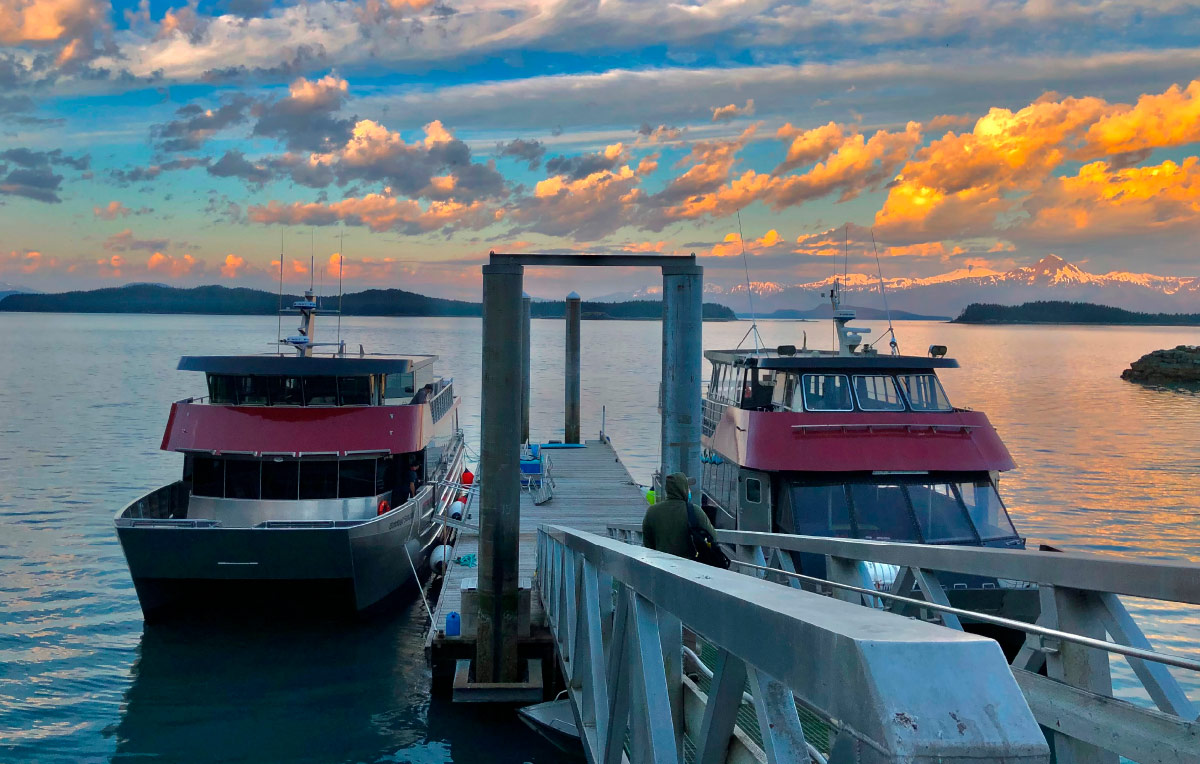
Coeur Alaska’s Kensington Mine is located 45 miles north-northwest of Juneau in the Berners Bay Mining District—off the road system and accessible only by air or water. That means Kensington employees are transported to the site twice daily by bus and boat, a task handled by Goldbelt Transportation, a subsidiary of Alaska Native Corporation Goldbelt, Inc. Meanwhile, AGC of Alaska member company Alaska Marine Lines provides barge services between the mine site and other ports, transporting food, equipment, supplies, and gold concentrate. It’s a critical supply chain, managed via contracts with companies with deep understanding of Alaska’s remote logistics.
At the Manh Choh project near Tok, Kinross Gold Corporation relies on Black Gold Transport, a division of AGC of Alaska member company Black Gold Express, Inc. created specifically to provide service for the mine. Black Gold Transport hauls ore about 240 miles to Fort Knox’s mill.
“We collaborated closely with [Black Gold Express] and the Alaska Department of Transportation to build the safety program and operation plan from day one,” explains Riedel.
Black Gold’s trucks travel 24 hours a day, seven days a week—logging 8 million miles in 2024, its first year of operations—bringing mine traffic onto public highways and into public view.

The remoteness of the Red Dog Mine, though, means “ore hauling hasn’t been right in front of our faces,” Skibinski points out. The Manh Choh project, on the other hand, “has shined a light on moving ore that we hadn’t seen before.”
With the Man Choh project, 90 percent of the route Black Gold Transport’s truckers take is on public highways, increasing interaction between the truck drivers hauling ore and the general public. The heightened contact has had surprising effects: Skibinski describes truckers pulling over for cars in distress along their route and taking time to jump batteries or radio for help.
“The drivers have the basic safety training to be able to assist until paramedics arrive when there’s an accident,” she says. “Black Gold Transport has been a wonderful contractor to work with and has really gotten very involved in the communities along that route.”
“When you get an AGC member that goes in there and says, ‘Look, I’m an Alaska construction company, I have seventy-eight employees and my entire business portfolio is doing services for mining industries,’ it means something,” Skibinski says. “AGC as an organization is constantly shining a light on the Alaska construction businesses that might be harmed or helped by decisions [around mining]. It’s made a huge difference.”
AGC and Alaska Miners Association have long collaborated, including partnering in the spring to host a networking event in Juneau that’s part of the AGC Legislative Fly-In.
Their voices illuminate an often-overlooked truth: when policy slows mining activity, it impacts not only mining companies but hundreds of construction jobs across dozens of Alaska businesses. In Alaska, partnership between the two industries isn’t optional; it’s the foundation on which the future of mining rests.


Contractor:
STG, Inc.
Project:
Tidal Network Wrangell Tower
Photos provided by STG, Inc.


Contractor:
STG, Inc.
Project:
Tidal Network Wrangell Tower
Photos provided by STG, Inc.


Contractor:
Cruz Construction
Project:
Spy Island Doyon 15 Rig Move
Photos provided by Cruz Construction
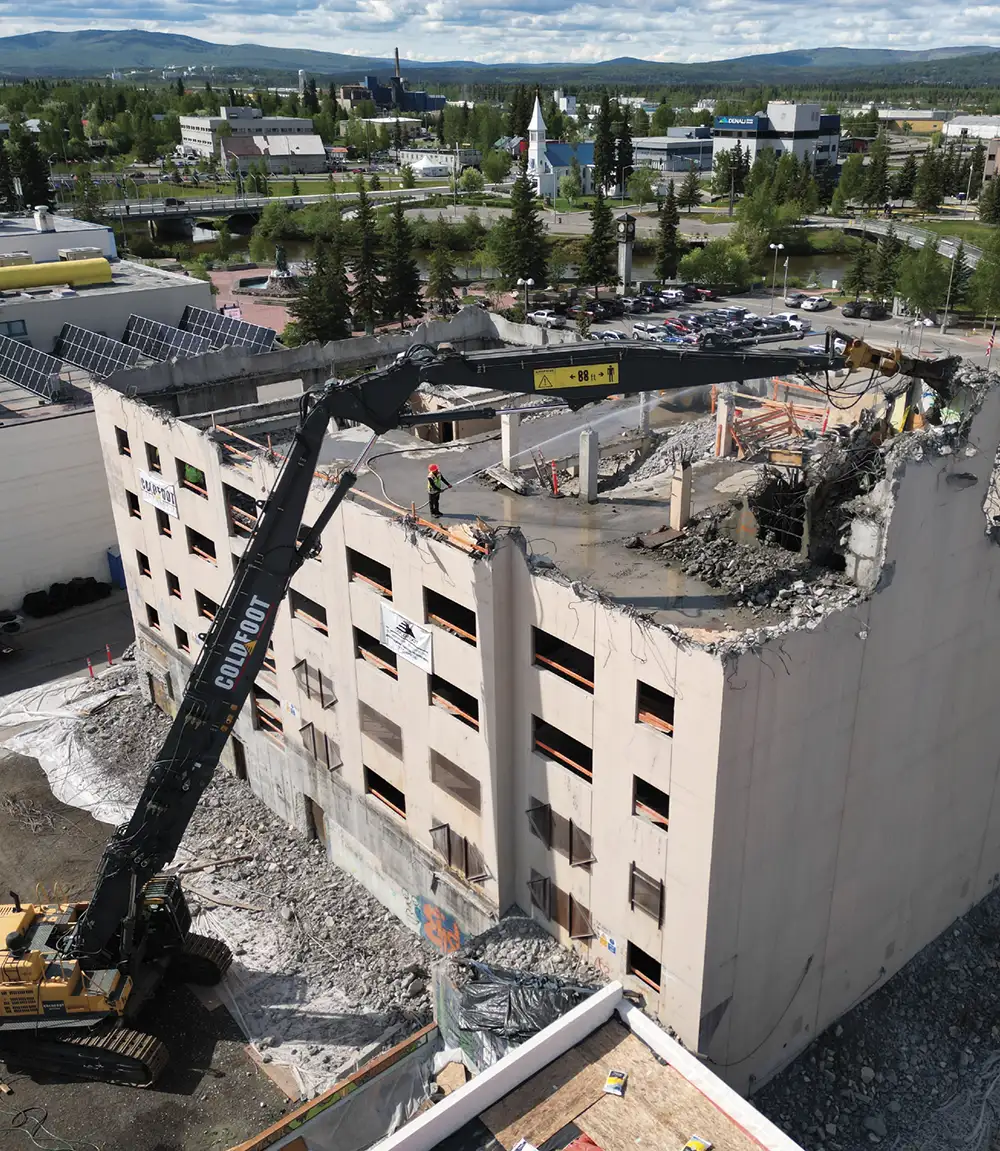
Contractor:
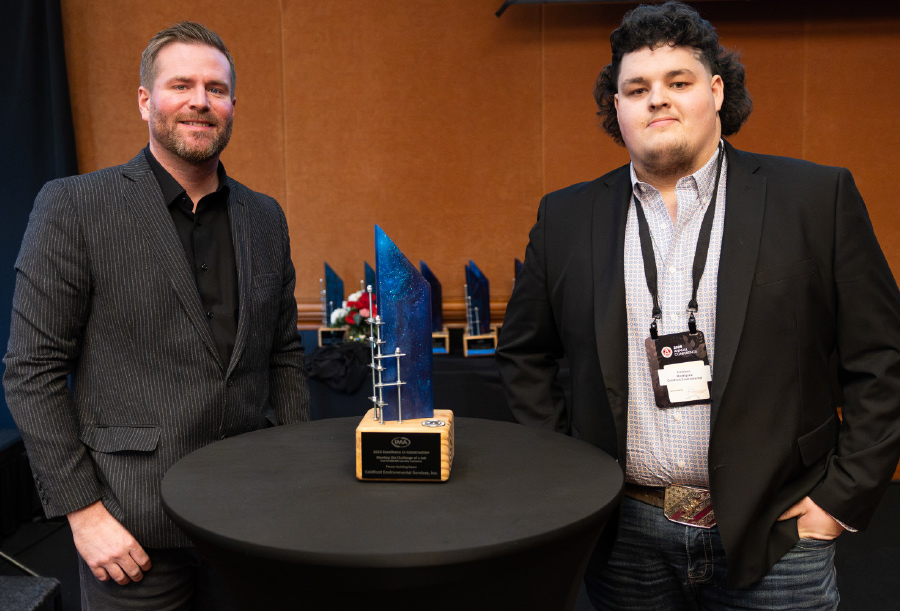
Coldfoot Environmental Services, Inc.
Project:
Polaris Building Demolition Project
Photos provided by Coldfoot Environmental Services, Inc

Contractor:
Davis Constructors & Engineers
Project:
Fort Greely Communications Center
Photos provided by Davis Constructors & Engineers

Contractor:
STG, Inc.
Project:
Tidal Network Wrangell Tower
Photos provided by STG, Inc.
Contractor:
Mass Excavation
Project:
Old Glenn Highway: Matanuska River Dike Emergency Repairs
Photo provided by Mass Excavation

Contractor:
Mass Excavation
Project:
Old Glenn Highway: Matanuska River Dike Emergency Repairs
Photo provided by Mass Excavation

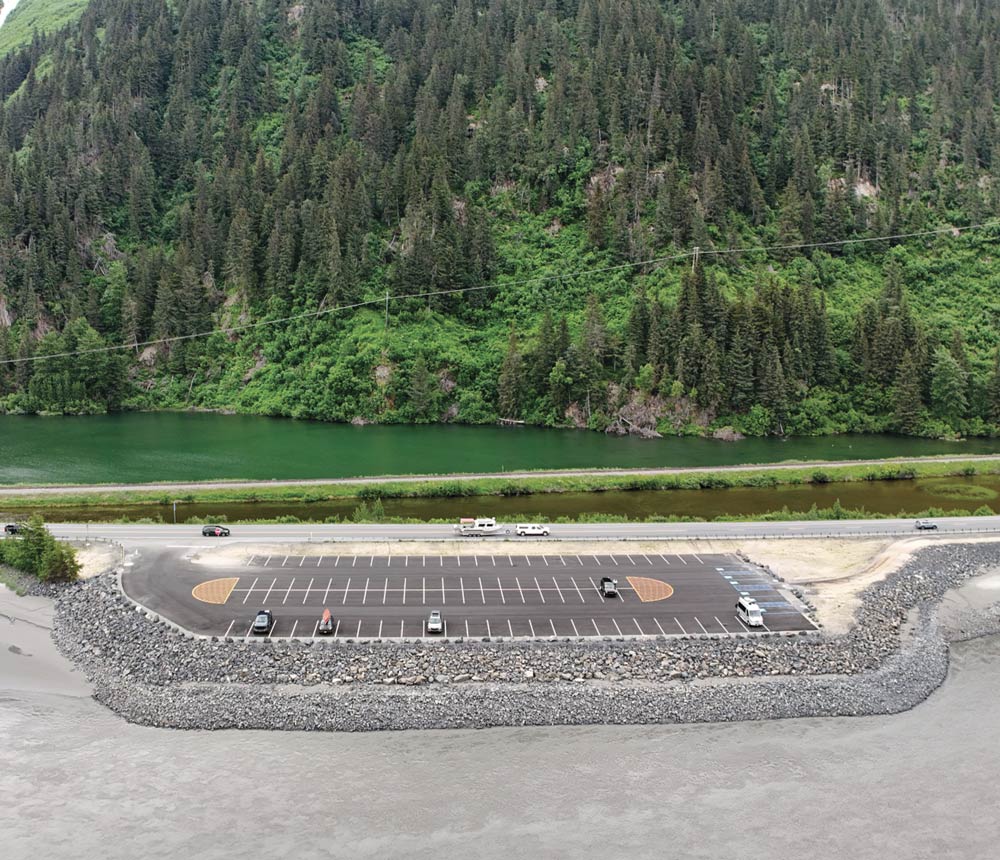
Contractor:
Granite Construction Company
Project:
Seward Highway Milepost 75 to 90, Phase III Project
Photos provided by Granite Construction Company
Contractor:
Colaska, Inc.
Project:
JNU Rehabilitate Part 121/135 Apron & RON Parking Apron
Photos provided by Colaska, Inc.

Contractor:
Colaska, Inc.
Project:
JNU Rehabilitate Part 121/135 Apron & RON Parking Apron
Photos provided by Colaska, Inc.

Contractor:
Davis Constructors and Engineers
Project:
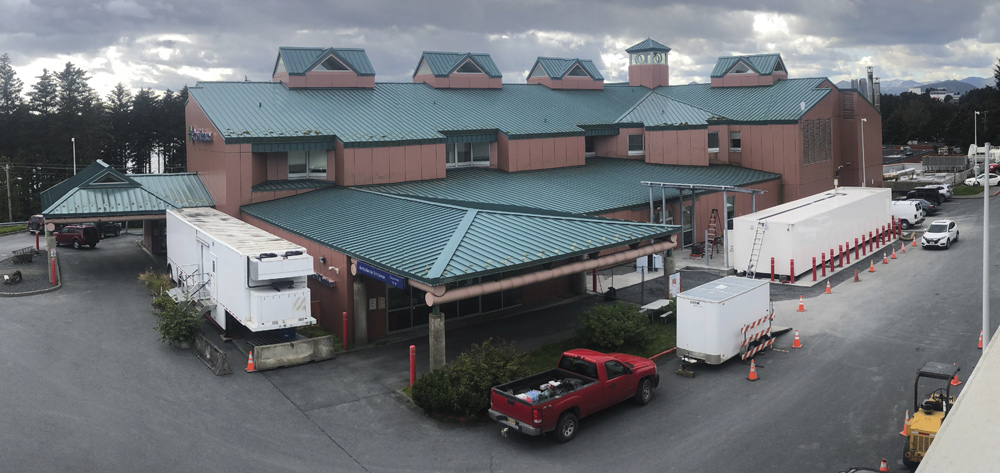
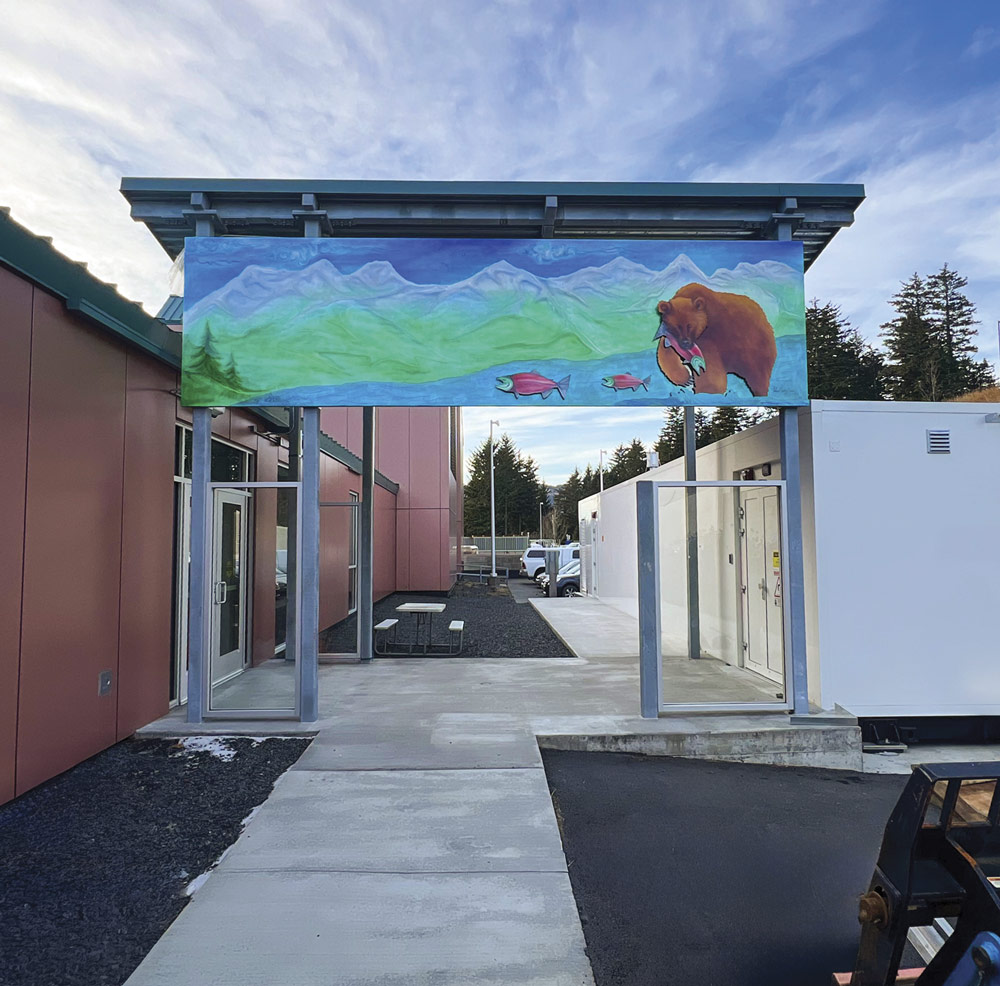
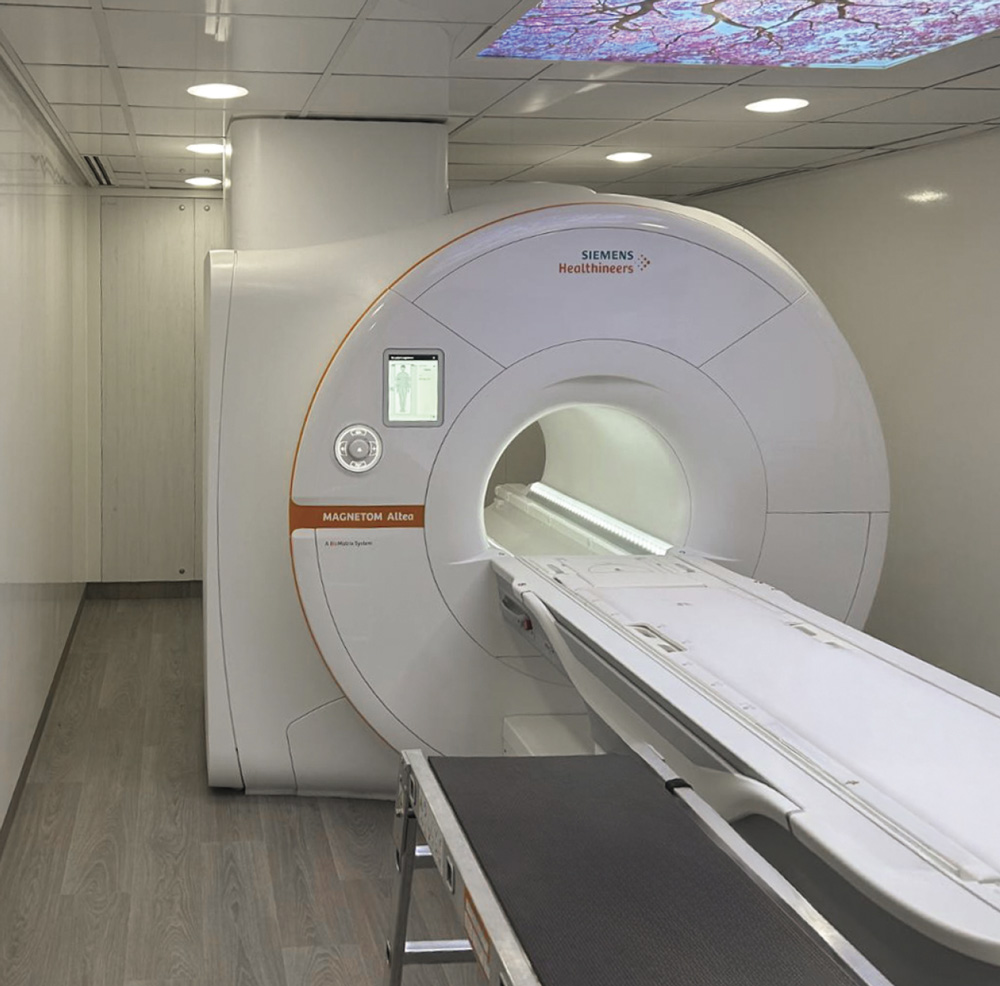
Providence Alaska Medical Center-Kodiak MRI Module
Photos provided by Davis Constructors & Engineers
Contractor:
Davis Constructors and Engineers
Project:
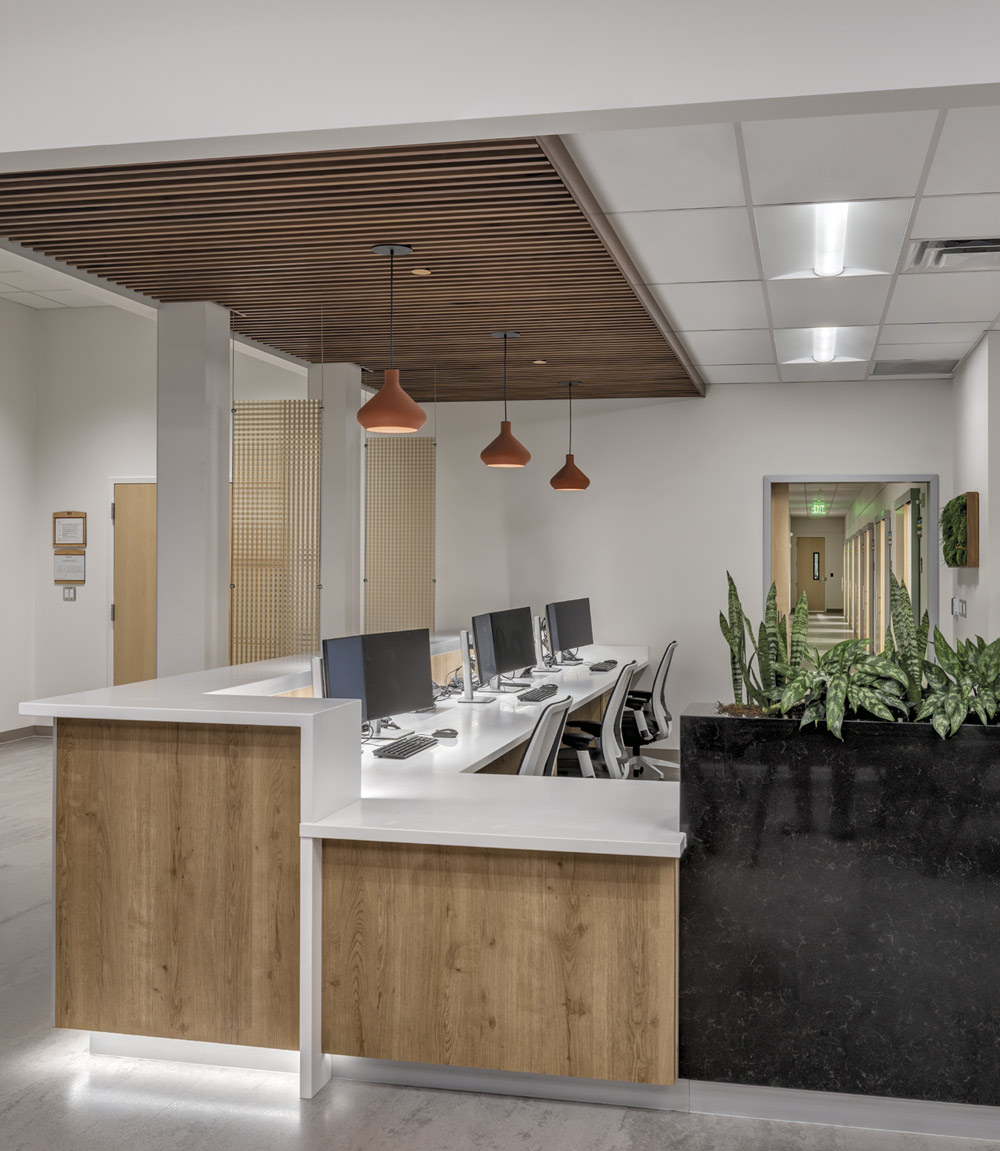
Providence Medical Group Eagle River Walk-In Clinic
Photos provided by Davis Constructors & Engineers

Contractor:
Roger Hickel Contracting
Project:
Chugachmiut Regional Health Center
Photos provided by Roger Hickel Contracting

Contractor:
Roger Hickel Contracting
Project:
Chugachmiut Regional Health Center
Photos provided by Roger Hickel Contracting


healthy building may start with a solid foundation, but it’s topped off with a robust roofing system. For Consolidated Enterprises, Inc., the roof isn’t the final touch to a commercial building project—it’s a component that should be planned for alongside every other aspect of building design. And given the vast differences across Alaskan regions, that design will need to be tailored to the building’s location.
As a general contractor, Consolidated Enterprises is well-versed in construction management. It’s also known as one of the best roofing companies in Alaska. This strategic blending of talents makes the company more competitive and also reflects its history.
Shortly after the 1974 incorporation of Consolidated Enterprises, the owners of Pacific Roofing and Interstate Construction Company ramped down their operations and began running new contracts under this singular entity. Consolidated Enterprises has always been a part of President Destry Lind’s life. His father ran the roofing side of things in the ‘80s and ‘90s and was president until 2008. Lind helped on the jobsite during his youth, joined the company as a paid employee in 1985, and became its president in 2013. For the past twelve years, Lind has successfully guided the company through natural disasters, a pandemic, economic uncertainty, and now a workforce shortage.
“A roof is your first line of defense in harsh environments,” says Lind. “Alaskans experience up to 100-degree temperature swings. Once installed, a roof can last over thirty years with proper upkeep and maintenance.”
Unfortunately, Lind says he has seen many buildings go unmaintained to the point that roof problems begin to affect the integrity of the rest of the structure. By then, it will be too late to take immediate action, as most roofing companies in Alaska, including Consolidated Enterprises, are already booked for the upcoming year. With many members of the current workforce retiring, the struggle to recruit people into the trade has limited the number of projects that can be completed each year.

“We put the team back together and won almost every roofing project proposal we submitted that had some sort of structural component, code changes, or permit requirements,” says Lind.
Ray Amsden, former Facilities Director at the Anchorage School District (ASD), worked with Consolidated Enterprises for decades, stretching back to when Lind’s father still ran the company. He said Consolidated Enterprises was the general contractor on many ASD projects, including Alpenglow Elementary in Eagle River, built in 1982. The company also maintained and rebuilt a number of roofs for the school district.
“It was always a good experience working with them,” says Amsden. “They have always delivered a quality project, and everyone was cooperative and easy to work with. Every project was successful and to satisfaction.”
“They make sure people receive a wage that is livable for Alaskans,” says Lind. “It’s one reason I’m thankful for AGC.”
Lind says he plans to continue efforts to recruit the next generation of workers into the industry. He and his team frequent job fairs and find other opportunities to introduce people to the trades.
“There is a lot of work on the horizon,” says Lind. “The state is poised for a huge boom, and now is the time to get into the trades.”


hen ten Wasilla High School students qualified for the national SkillsUSA competition this year, the celebration was immediate—but so was the challenge. Raising money for attendance—$3,000 per student—on a tight deadline seemed impossible.
Associated General Contractors (AGC) of Alaska and several local businesses stepped in to make the team’s dream of competing nationally in Atlanta, Georgia, a reality.
“It was high-fives and continuous cheers,” she says of the students as they learned they placed first in numerous categories.
Student Zackary Kohler says he was excited about the prospect of competing nationally after hearing he won at the state competition in the pin design category.
“I was a new type of scared but happy for what it would bring,” Kohler says.
Student Rylee Crum attended nationals as a state delegate, representing Alaska’s student members in the SkillsUSA National House of Delegates, where the delegates discuss things such as organizational bylaws and elect national officers. Crum says she was “excited but very nervous” about competing in Atlanta.
Bella Winn, who competed in the video production category, says she didn’t have the highest expectations for her work since it was her first time submitting a video for competition. “It was very surprising to find out I had qualified for something national,” she says.
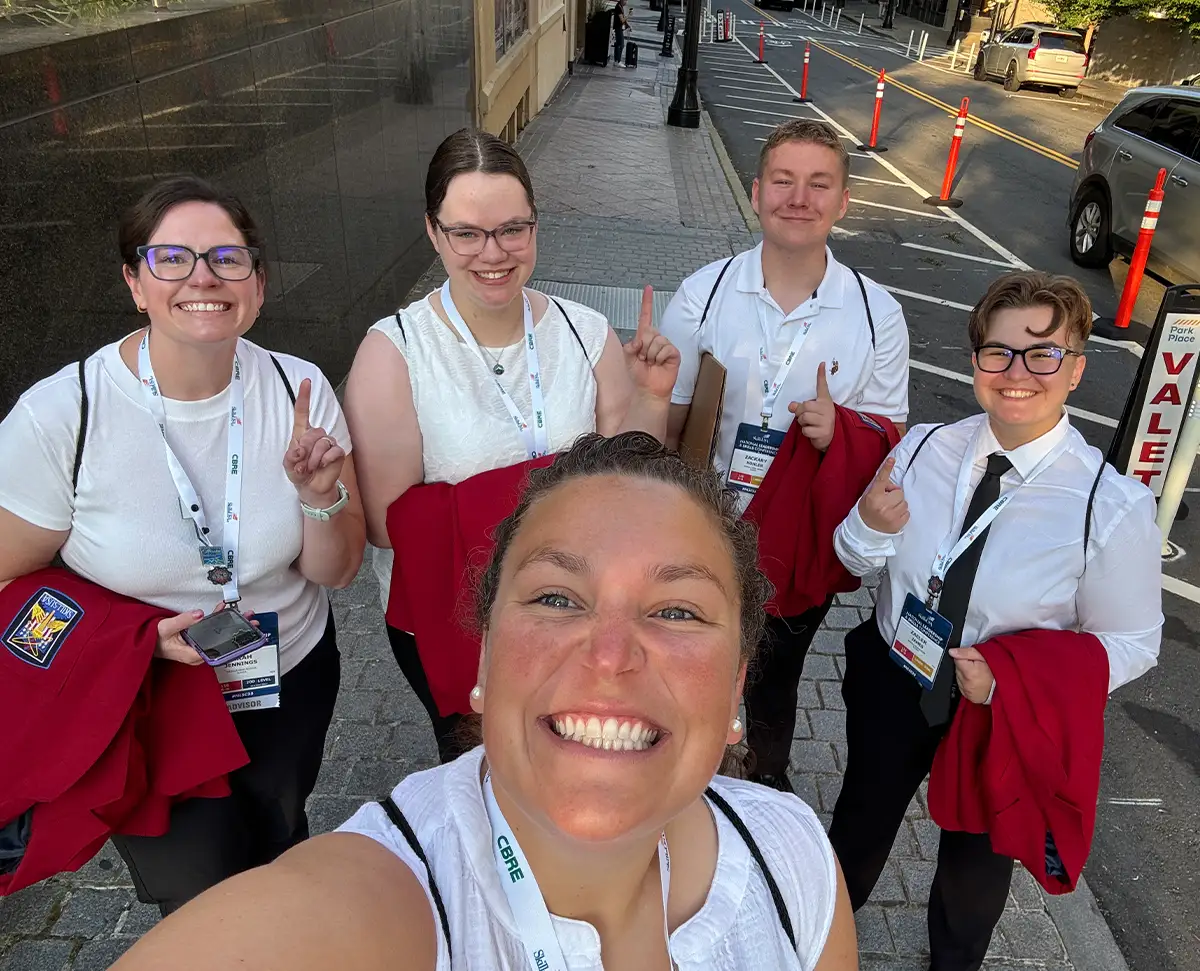


“We wouldn’t have been able to do this without Joey Crum and his support,” Lockwood says. “He reached out to a bunch of local businesses and said, ‘This is how much money we need to raise. I know these kids, and I know how much work they’ve put in.’”
The students were grateful for the donations and community support, which they say made going to nationals possible.
“Without the support from my school or the donations from AGC, I feel that it would have been a struggle to even get to state, let alone go to Georgia for nationals,” Rylee Crum says. “The support also made nationals a way better experience, filled with fun.”
Winn says the support made competing easier. “From the supplies we received to the donations me and my fellow competitors received, we were able to focus on the competition aspect so much more,” she says.
“The great donations helped us get to a big dream and goal for us students,” Kohler says. “We were scared that we couldn’t go, but AGC made everything come true for us kids. They are the reason why we got to experience a once-in-a-lifetime thing.”
The support of the community has been pivotal, allowing students not only to attend nationals but also to grow as leaders and advocates within the SkillsUSA program.
“I really see that they’re taking pride in the organization, and they want other students to join,” Lockwood says.
“We pour our heart and soul as advisors into making sure that we’re building a community of the skilled workforce,” Lockwood says.
Most SkillsUSA advisors are teachers who focus on career technical education (CTE), but Lockwood teaches digital media and Jennings teaches English. Even so, as an advisor and chaperone, Jennings’ expertise has been an asset for students in many of the competition’s categories, as well as the professionalism SkillsUSA emphasizes.
“It will be so helpful for a job interview and prepared speech and things like that,” Lockwood says. “With seventy-five kids, you need that. We are their biggest cheerleaders, their biggest fans, of course. And we hold them to a high standard and keep them moving towards the deadline.”
Jennings says she’s noticed students’ passion for the program has grown since going to nationals.
“Every state was represented, and there’s chapters that have 300-plus students in them,” Jennings says. “I think that they were able to see, ‘Oh, wow, we can actually have a huge chapter and do something with it.’ There’s an interest in it, and the spreading of what happened at nationals and their accomplishments is cool to see.”

“I learned how to improve on managing my time and meeting deadlines,” he says. “It has pointed me toward going to college and doing politics, which before [the competition] I had no clue.”
Crum also loved pin trading and getting to learn about other states’ chapters.
“I had to improve my social skills, like talking to and in front of a lot of people,” she says. “SkillsUSA made me possibly consider a future in certain CTE skills after I finish college. Before SkillsUSA, I was considering college, but I had no idea what to do after.”
Winn says she also loved getting to know competitors from other states.
“I loved exploring Atlanta and interacting with competitors from other states,” she says. “I especially enjoyed talking with other people about our passions for videography and design. I know that while I’m not planning on doing anything videography-related as a career, having that experience definitely broadened my perspective in that field. It’s always good to go on side quests in life.”
For Lockwood, Jennings, and their fellow advisors, the impact of SkillsUSA goes far beyond medals. They see it as a way to build student confidence, career readiness, and community—lessons that will stay with students long after graduation.


here’s a saying about safety: “Working safely may get old, but so do those who practice it.” It takes a little extra time for preparation, gear maintenance, thinking or talking through plans before acting, and even going through checklists, but a zero-incident rate is a green flag to prospective clients and potential employees.
Just ask the staff at the three companies and one individual who were selected as winners of the 2025 ConocoPhillips Excellence in Safety awards. Winners were announced at the November 13 luncheon presentation at Hotel Captain Cook as part of the Associated General Contractors (AGC) of Alaska annual convention. This year’s company winners are American Marine Corporation, Mass Excavation, and Cornerstone General Contractors. Brett Foster, construction manager with Brice Environmental Services, Inc., won the individual award.
American Marine Corporation operates at the intersection of commercial diving and marine construction, navigating some of the most hazardous environments on the planet. Divers contend with near-zero visibility below the surface, thirty-foot tidal fluctuations, and powerful currents and cross-currents—conditions that demand precision and discipline.
“This company has achieved something truly extraordinary: more than fifteen years of operation without a single OSHA [Occupational Safety and Health Administration] reported incident, without a single diving-related injury, and without a single lost-time accident. Fifteen years—and this, in one of the world’s most dangerous industries,” said Jason Charton, ConocoPhillips Alaska vice president of health, safety, and environment, when announcing that American Marine had won the 2025 Excellence in Safety—Specialty award.
For José Owens, Alaska operations manager, trust and leadership are central to sustaining this record. With two decades of experience, he emphasizes a philosophy that guides every dive: “There’s urgency involved, but it’s urgency in making sure that we’re doing things the right way.”
Every dive begins long before anyone enters the water. The process starts in the office with a job safety analysis. In the field, crews revisit the plan and adapt it to real-time conditions such as weather, site complications, or project changes. A dive supervisor reviews the plan once more, and then the team rehearses the dive step by step.
Sometimes divers even practice blindfolded, ensuring tools are positioned correctly, and motions are almost second nature. As Owens explains: “The reason we do that is to further ingrain in them what their motions are going to be, so when they get in the water, it’s been rehearsed, and the topside crew knows what to expect. We also discuss contingencies and emergency response if things do not go as planned.” In an environment where visibility is often nonexistent, details like body positioning, tool placement, and the line connecting diver to boat can make all the difference.
After each dive, divers log their experience in a notepad, noting whether everything went according to plan and documenting any irregularities. Issues are analyzed, discussed, and addressed openly. Owens stresses that every team member has the freedom to raise concerns—and the confidence that those concerns will be heard.
He reflects on the pride he takes in his crew: “What I’m really proud of is the fact that I get to work with guys and I know what they’re going through. They know that I know what they’re going through. And I love what I do—I’ve been in it for twenty years, and I’ve loved pretty much every facet of the business that I’ve been in, from being a diver tender all the way to where I’m at now. It’s exciting to get to give that experience to other young men. I’m big on professional development, so that’s an enjoyable aspect for me to see.”
Owens sees the award as validation of the company’s commitment to safety: “It backs up what I’m already trying to do. We’re doing it right—keep doing it.”
The most compelling evidence of that success? Every member of the crew completed the 2025 dive season without a recordable injury.
“The transition didn’t just happen, it was earned through discipline, preparation, and a companywide commitment to safety as a value and not just a requirement,” Charton noted. “When they took their operations north in 2022, they didn’t just adapt to the oil and gas industry standards, they exceeded them.”
Since the expansion, Charton adds, Mass X has maintained a perfect record of zero incidents.
“We’ve had a lot of growth in our company in the last five years,” says Justin Shields, general manager of Mass X. “A major driver of that success has been our focus on strengthening our safety culture. We’ve invested heavily in building out our safety program, supporting our field teams, and ensuring safety leadership is present on every job.”
As part of that effort, Mass X increased its safety crew from one person to four.
“Today, our expanded team provides a far greater presence in the field, ensuring safety is not just a program, but a daily, visible priority on every jobsite,” Mass X officials wrote in the company’s
award application.

Jason Charton, ConocoPhillips Alaska vice president of health, safety, and environment, poses with Mass Excavation general manager Justin Shields. Mass X won the ConocoPhillips Excellence in Safety—Highway award.

Cornerstone General Contractors Senior Project Manager David LaMont and SafeLogic President Randee Johnson accept the ConocoPhillips Excellence in Safety—Building award.
“We added a function that sends positive comments and notes about what the job site is doing correctly. This ensures the app is not solely focused on highlighting issues but also recognizes the positive aspects of the crews’ performance,” wrote Mass X Project Superintendent Dan Thibault.
The company upgraded PPE as well, moving to Studson hard hats that offer significantly better protection, including integrated face shields, wider brims, chin straps, and compatible hearing protection. These improvements reflect an ongoing commitment to providing the best equipment and safest work environment possible.
It all aims toward the goal, Shields says, which is to make Mass X the best company to work for. After winning the award November 13, he stopped by several job sites to show the crews the plaque, thank them for their hard work they put into earning it, and to let them know he plans to submit an application to AGC of America for a national award.
“At Mass X, we want to set the standard in our industry. I want every skilled worker in Alaska to see Mass X as the company they want to be part of,” Shields says. “After all—who doesn’t want to work for a company that cares deeply about its people and makes sure they go home safe every day?”
“This company’s safety philosophy begins with a simple truth: People come first. Every policy, every system, every milestone flows from the belief that where people are empowered and valued, excellence flows naturally,” Charton said when announcing that Cornerstone General Contractors had won the Excellence in Safety award for vertical construction.
Charton noted that Cornerstone was the first contractor in Alaska to achieve Alaska Occupational Safety and Health (AKOSH) CHASE FLAG status.
CHASE stands for Construction Health and Safety Excellence. The program is unique to Alaska and was created to provide a partnership between Alaska contractors and AKOSH to proactively reduce injuries, illnesses, and fatalities within the state’s construction industry. The program includes three levels of participation: AK-BLUE, representing initial acceptance into the partnership; AK-GOLD, which requires an employee or representative to administer the AKOSH program within the company and sets out several requirements for safety training, illness/injury reduction over time, documented employee review of the program and its goals, and development and maintenance of a substance abuse program; and AK-FLAG, which requires a company to have met all the BLUE and GOLD requirements in addition to requiring more training, effectiveness tracking for several program goals, passing an on-site visit by an AKOSH representative, and that the company have no “willful” and no repeat AKOSH violations in the preceding three years, as well as having no fatalities or catastrophes that resulted in serious or willful citations.
Cornerstone didn’t achieve FLAG status on its own; Randee Johnson, owner of SafeLogic and a consultant with Cornerstone, assisted with the multi-year process—she joined Cornerstone Senior Project Manager David LaMont in accepting the award at the luncheon.
LaMont says the other primary influence, who drove Cornerstone winning the Excellence in Safety award and also its achieving CHASE FLAG status, is company president, Joe Jolley.
“It starts at the very top,” LaMont says. “He wants his company to be the safest company in the state. And he wants our clients to recognize that we’re the safest contractor we can be on their behalf. So, it really starts at that level.”
With safety as a foundational belief from the top, LaMont says, Cornerstone has buy-in from all employees. And everyone on the management team is part of the safety team.
As part of Cornerstone’s growth and commitment to safety, company leaders recently selected long-time carpenter Aaron Combs to transition into the role of full-time safety manager. Cornerstone officials say his expertise and field experience will provide the synergy and supplementary boots on the ground approach to ensure that its safety momentum continues to evolve.
Cornerstone also incorporates a Breakthrough program, encouraging employees to “take smart risks and drive innovation.” Employees design their own Breakthrough project, often relating to safety, health, or the well-being of the corporate team. One such Breakthrough project created a pre-apprenticeship training program the company continues to use. Apprentices receive hands-on instruction from experienced journeymen in hazard recognition, personal protective equipment use, fall protection, and safe tool handling, “reinforcing that productivity never comes before safety, and instill[ing] the habit of speaking up and protecting peers,” Cornerstone leaders wrote in the safety award application.
Another program that encourages buy-in is the Safety Stand-Out Recognition Program through which Cornerstone employees can nominate team members who excel in regard to safety. The Stand-Outs are discussed at quarterly Safety Stand-Up meetings, where employees celebrate wins, discuss and learn from mistakes, and recognize the Stand-Out team members with benefits such as paid time off and public commendation.
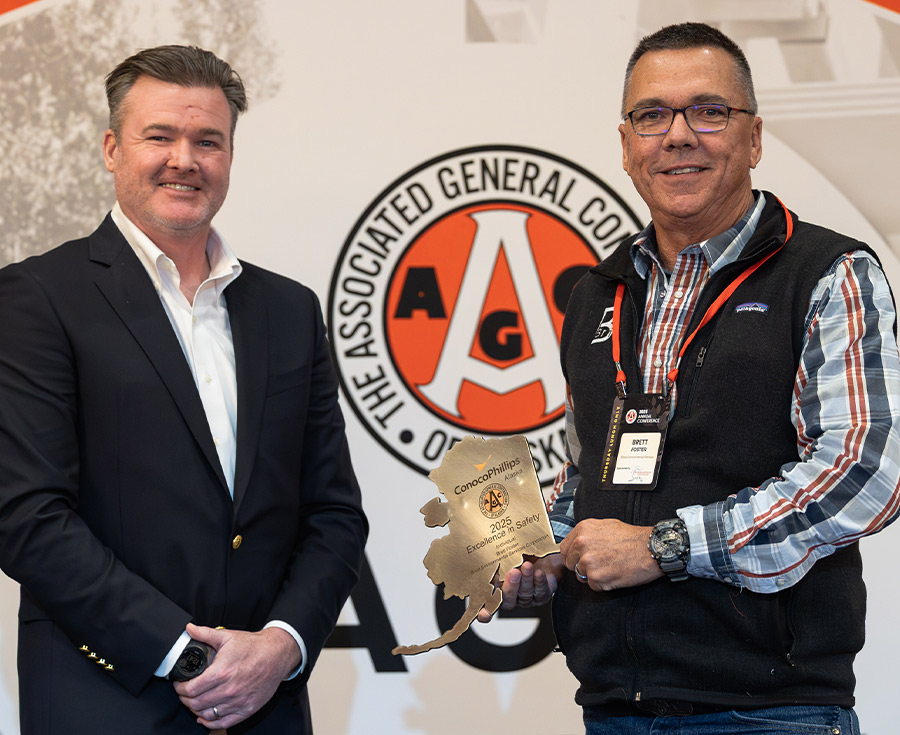
“I’m thankful that I work for a company that has the kind of safety culture that they have, that has that kind of leadership in safety, and that they advocate everybody to be safe on the jobsite,” LaMont says.
“You just take out as much risk as possible through inspections and diligence,” he says.
When he was a young man working in the oil drilling field, OSHA didn’t exist. But a friend in the drilling industry gave him some wise counsel: “If you want to work, you’re going to be safe.” So, he began looking for ways to complete the work ahead of him safely—and that translated to helping others be safe on the jobsite as well.
Brice Environmental Services, where Foster is a senior construction manager, nominated him for the award. Foster has served as a site superintendent and site safety and health officer on seven federal and military projects totaling around $44 million over the past five years.Company leaders say Foster “achieved zero OSHA recordable incidents across all projects, with five earning ‘exceptional’ safety ratings.”
Company leaders added that Foster directly improved the company’s safety metrics, “contributing to Brice’s EMR [Experience Modification Rate] drop from 0.67 (2022) to 0.55 (2025).” A company’s EMR is an insurance rating that reflects its workers’ compensation claim history, compared with industry averages. Lower EMR rates indicate a better safety rating and can lead to lower insurance premiums.
Brice Environmental officials say Foster lowered those numbers through a combination of efforts: daily inspections, Active Hazard Analysis reviews, crew-level check-ins, and initiatives such as a “Stretch and Flex” program that helps workers limber up before beginning work.
Company managers selected Foster to represent Brice at the 2025 AGC National Safety Conference, where his involvement helped Brice earn a third-place national ranking in the AGC Construction Safety Excellence Awards—Specialty Contractor category.
“Brett Foster exemplifies safety leadership through innovation, consistency, and crew-centered communication. With seventeen years in safety leadership roles, he applies a pragmatic, field-first approach to risk management—leveraging crane safety systems and operator simulators while grounded in fundamentals. He builds trust and accountability through daily engagement, one-on-one training, and real-time coaching. Brett’s impact is seen in his track record: zero recordables across complex projects and consistently high safety ratings. His leadership has driven company-wide improvements and instilled a culture where safety is second nature,” Brice Environmental officials stated in their application for the award.
Foster says he doesn’t shoulder the whole load when it comes to safety at Brice Environmental.
“This whole group works very diligently at their safety,” he says. “I’m one of the tips of the spear, but it’s not just me… this is a lot of teamwork.”
As for the Excellence in Safety award, he says it adds assurance that the company is moving in the right direction.




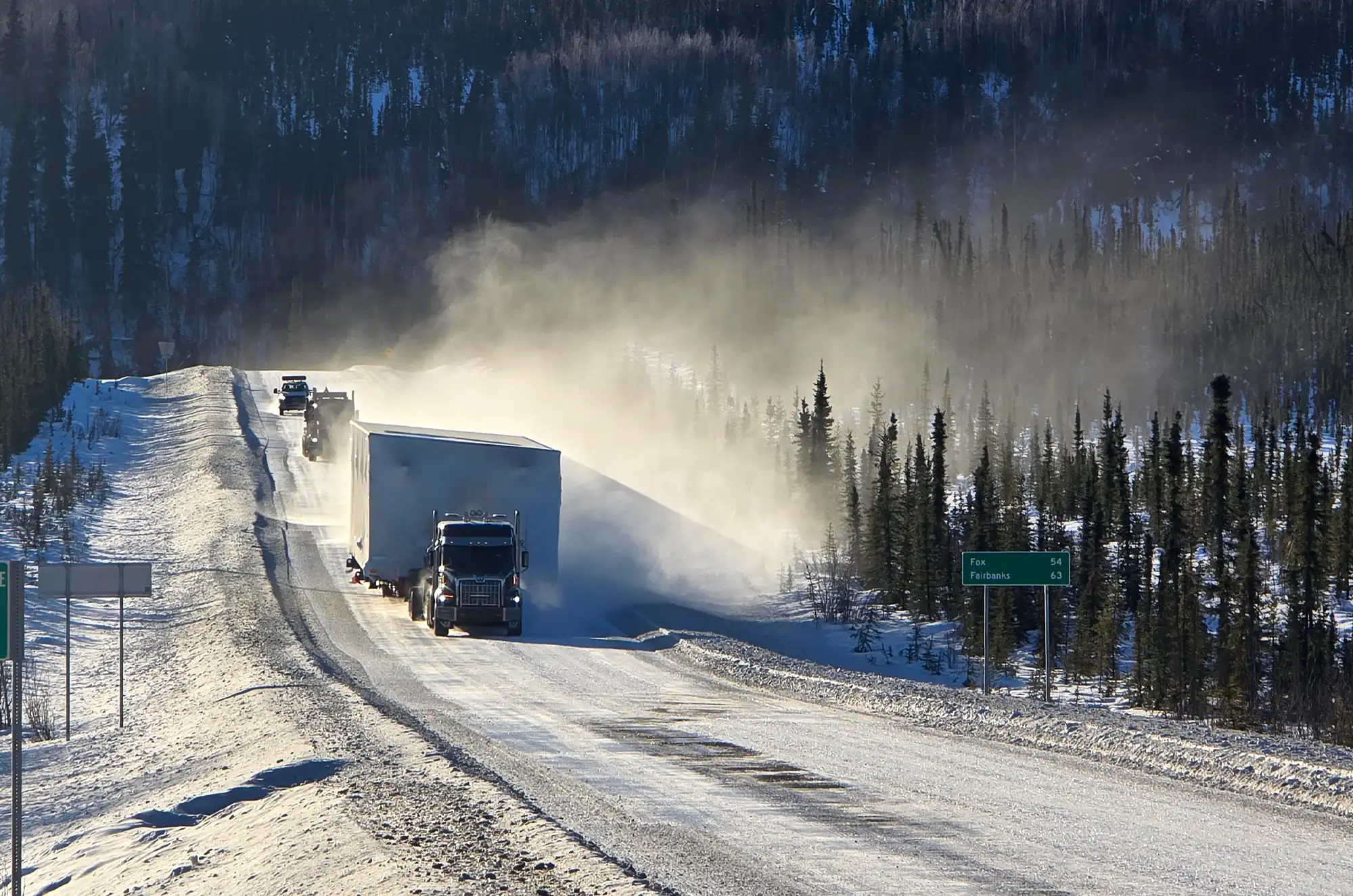
A Specialized Transport & Rigging truck transports a 76-ton oil field module at Mile 57 of the Elliott Highway, bound for Prudhoe Bay.
eing a freight hauler in Alaska is no small job. Winter places heavy demands on drivers. Snow and ice, nature’s Zamboni, turn roads into rinks; brutal subzero mercury readings push engines and vehicle parts to their limits; and the long, dark nights limit visibility.
All of this takes place on the state’s long, lonely highways, which offer ever fewer roadside services as one travels north. Aid-providing waysides all but disappear once trucks reach the Dalton Highway, which leads to the Prudhoe Bay oil fields. Road conditions vary from fair to difficult, no matter the time of year, as permafrost, flooding, and other natural forces add potholes and frost heaves to the mix. And then there’s the blinding, low-lying sun that skims the horizon at windshield level, especially in the Arctic.
For Curtis Spencer, president of Specialized Transport & Rigging based in Big Lake, there’s only one way to describe it all: “It’s extremely challenging. Period.”
STR loads its trucks with “a lot of equipment, a lot of cranes,” Spencer says, adding that other large items are also pulled by the company’s fleet of semis. “Tanks, to modules, to pipe racks. Things like that. Big loads. Twenty [foot] wide stuff, mostly. That’s what we do the best.”
STR was founded in 2014. Spencer had been a minority owner of Carlile Transportation until 2013, when that company was sold to Seattle, Washington-based Saltchuk. At that point, he began looking for a new venture.
“I was working on projects for the North Slope in Seattle,” he recalls. “And I came back and just decided, ‘I want to do something different.’”

Spencer drew on his extensive experience in freight hauling and a lifetime in Alaska as a springboard for fulfilling his vision, he says. “I’ve been in the industry for forty-five years, born and raised in Fairbanks. And it was a pretty simple thing to get it rolling.”
There was only one hurdle he needed to clear, however. “We didn’t have trucks. I was using friends that had trucks. We were using owner-operators.”
To build a fleet and work out other major details, Spencer found help from his friend Dave Cruz, owner of Cruz Construction. “We got trucks ordered and Mr. Cruz helped us out with getting other things in place,” he says, adding that “the company actually owes a debt to Mr. Cruz for all the help that he gave us.”
A decade later, STR has eighty trucks, with some based in the Lower 48, bringing loads across the country from the East Coast, Oklahoma, Texas, and elsewhere. The freight is either driven through Canada or brought to Seattle where the containers are shipped north on a barge.
“Typically, Valdez for the super-load stuff,” Spencer says, explaining how the largest items are brought to Alaska. “Truckload stuff comes up via TOTE and Matson.”
STR has developed strong relationships with clients all over the state. Among them is North Star Equipment Services in Anchorage, which Spencer describes as “a good partner,” adding, “we move a lot of their cranes around for them. Great folks.”
Brad Robertson, president of North Star, agrees. Citing STR’s experienced staff, many of them longtime acquaintances of his, he described the company as “very easy to work with, reliable, and accommodating to whatever our various needs are.”
For Spencer, this cuts to the heart of the matter. Providing the best service possible, he says, is what drives him and his crew.
“One thing that we, the team, say is, we like to be successful and complete what we say we’re going to complete on time. And we’ll stay true to our focus.”



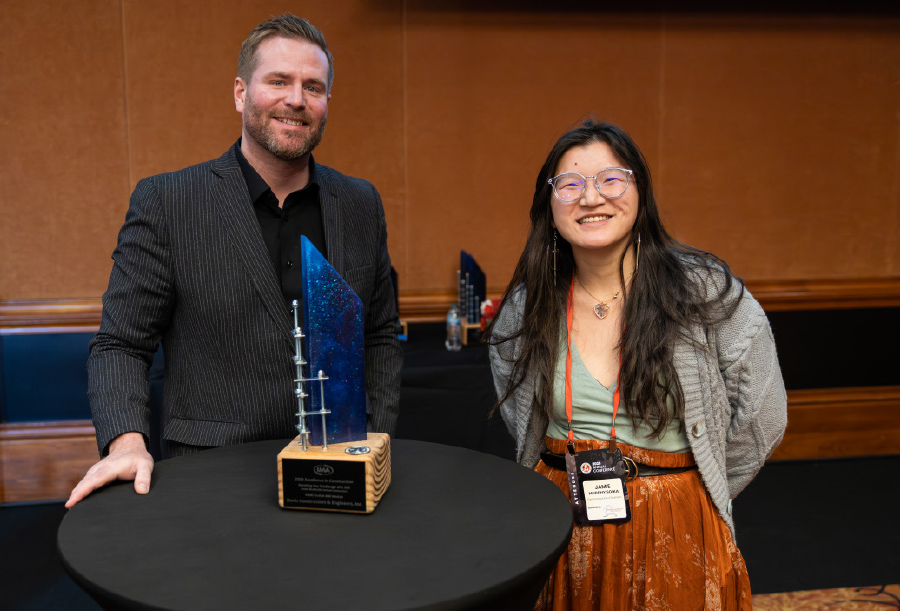
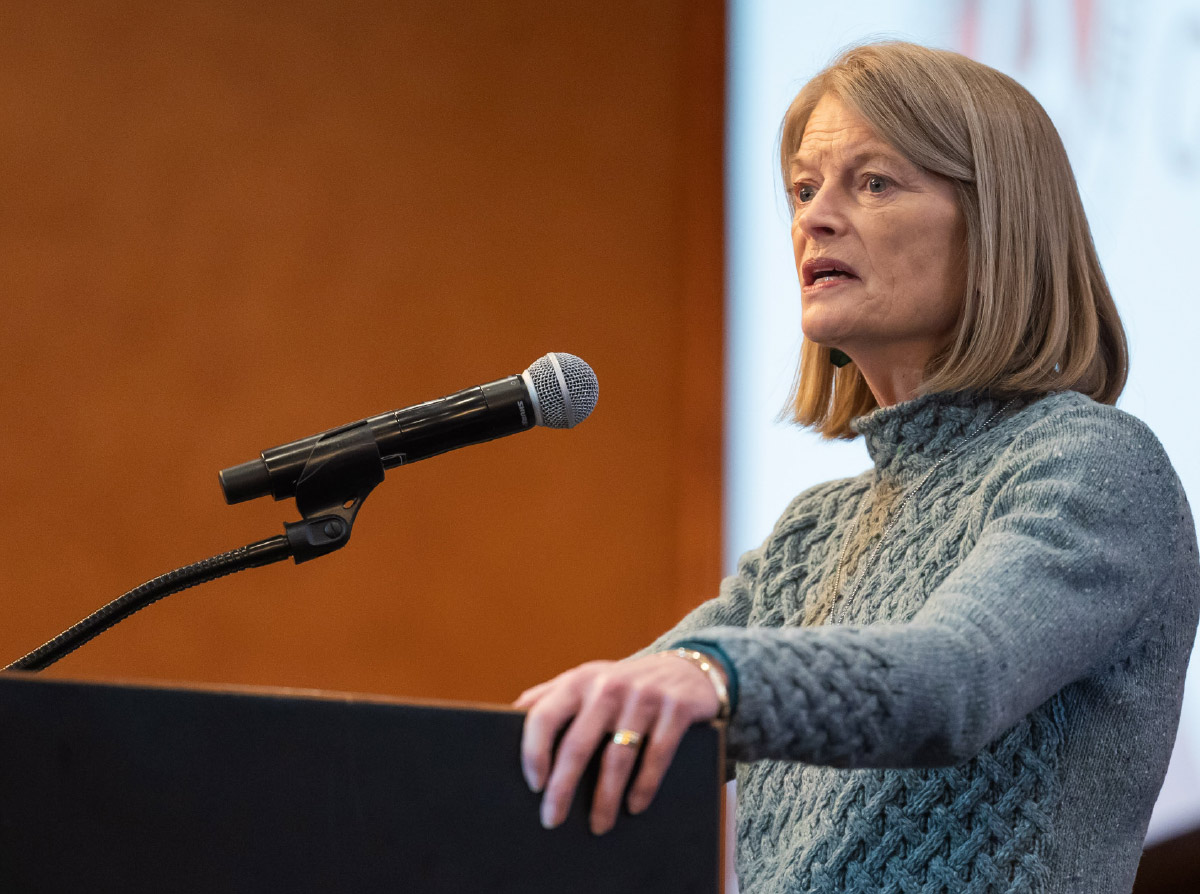
ssociated General Contractors (AGC) of America President Todd Roberts commended the Alaska contractors gathered at the November 14 luncheon at the Hotel Captain Cook, where the winners of the IMA Excellence in Construction awards were announced. Roberts, the president of a successful heavy and civil construction company based in Jackson, Mississippi, said he was impressed by Alaska contractors’ ability to surmount challenges that aren’t generally seen elsewhere in the nation.
“Congratulations to all the Excellence in Construction award winners that are going to be announced today. The projects you build up here are inspiring—especially when you think about the many logistical and weather challenges you face. I know it’s a different kind of construction up here, and it’s very rewarding to see what you all do and how you do it,” Roberts said.
Davis won two awards in the Vertical Construction category: Vertical Construction Under $5 million for its Providence Kodiak Medical Center Magnetic Resonance Imaging (MRI) Module project, and Vertical Construction Between $5 and $15 million for its Providence Medical Group Eagle River Walk-In Clinic project. The company also won the Sustainability in Construction award for its Fort Greely Communications Center project.
“One of our favorite aspects of receiving these awards is that they showcase the hard work of our project teams, acknowledge a job well done, and provide them with a source of pride when the project is done,” Davis officials say. “Winning the AGC Excellence in Construction awards highlights the skill, dedication, and collaboration of our onsite field teams as well as our office-based project management staff. These awards highlight our reputation among future clients, employees, and community partners.”


It wasn’t smooth sailing once the MRI unit had reached Kodiak, however. Midway through installation, a valve failure caused the MRI’s magnet to lose a majority of its helium gas due to a sudden “quench” event. If the magnet warmed, it would ruin the multi-million-dollar system. Davis crews learned of the quench at 7 a.m. and procured helium from various locations on the island—fish processing plants, refrigeration contractors, and the unused amount that was going to be shipped on the Matson steamship, which was in the process of casting off for its Seattle voyage.
“The team’s resourcefulness provided just enough helium to stabilize the system, avert catastrophe, and keep the project on track. Without immediate action by the Davis team, the multi-million-dollar unit would have been a total loss,” Davis officials wrote.
The renovation added fourteen exam rooms, five bathrooms, two offices, a blood draw room, a lab room, and a conference and team area and was completed under a compressed schedule, with completion scheduled in seven months from the start and a requirement by the client that the space be usable before completion.
“Even though our team was on track to finish within the tight deadline, our crews made even more of a push to open up a selection of the building early. Opening up the building while construction was still going on meant our teams’ safety protocols were tightened, along with working after work hours to ensure there were no disruptions to the staff or patients,” Davis officials wrote in the award application.
Although additional information was provided to judges for their consideration for this award, due to concerns about national security, more information about the project is not able to be published at this time.
The health center is a 26,000-square-foot new construction medical facility, built to provide care for Chugachmiut, an Alaska Native nonprofit agency serving the seven tribes in the Chugach region. The facility is Leadership in Energy and Environmental Design (LEED) Silver-certified and includes space for primary care, behavioral health, visiting psychiatry, dental and vision, community health aides, pharmacy, and lab services.
“It’s an incredible honor for RHC to be awarded with the Excellence in Construction award for Chugachmiut Regional Health Center,” says RHC President Sean Hickel. “This recognition affirms the exceptional workmanship, collaboration, and attention to detail our team brought to this project. Delivering this facility for the Seward community was a meaningful accomplishment on its own, and being acknowledged by our peers makes it even more rewarding. Most importantly, it reflects the dedication of our employees and partners, and it will continue to inspire our team as we look ahead to the work still to come.”
The project presented significant challenges, including a three-month delay caused by early design changes, but the team rallied to deliver it on schedule—and even returned over $1 million in unused contingency to the owner. Being a LEED Silver-certified facility meant many materials used to build the facility were special-order projects that require more lead time and careful handling to ensure compliance with sustainability standards.
“Despite these complexities, the team’s commitment to meticulous planning, collaboration, and innovative problem-solving allowed the project to be completed on time, meeting strict federal funding deadlines and allowing staff to begin operations as planned. The result is not just a building but a landmark facility that demonstrates what can be achieved when vision, skill, and dedication are combined with a trusted contractor like Roger Hickel Contracting,” Hickel says.
Coldfoot Environmental is a demolition, remediation, and hazardous materials removal company with work experience across Alaska. The company began work demolishing the Polaris Building, the Golden Heart City’s tallest building, in 2023. After twenty years standing vacant, it was an attractive nuisance in the city, not to mention that it contained asbestos, lead, mold, and other dangerous materials.
“Today, with the Polaris Tower coming down, Fairbanks has gained more than a cleared site—it has gained renewed hope. What was once the city’s tallest eyesore is now an opportunity for growth, safety, and revitalization. The demolition has not only eliminated a long-standing hazard but has also opened the door to reimagining the heart of downtown Fairbanks,” Coldfoot officials wrote in the award application.
The demolition was a step-by-step process; first Coldfoot demolished the Annex restaurant attached to the building, then came abatement, when material containing asbestos and other harmful or hazardous material was removed. Finally, the company brought in the largest high-reach demolition excavator in Alaska, a Volvo EC700CHR, to bring down the building itself—with plenty of local and media attention while it happened.
And Emiliano Rodriguez, on his first big job with Coldfoot, was at the controls of the excavator. He says it was a little stressful.
“At the start, it was definitely a learning curve,” he says.
Through it all, Coldfoot crews focused on safety. Three daily safety meetings were held to reinforce safe work methods, allow for immediate hazard identification, and give workers a chance to raise concerns or suggest improvements. The work was completed with zero accidents or injuries.
“There’s definitely a lot of hard work on projects like these; it’s nice to get an award for it,” Rodriguez says.
“Winning this award reinforces the quality of the work our teams deliver every day. It’s a recognition of the craftsmanship, planning, and problem-solving that our crews bring to every project. It also helps us communicate that commitment to future clients, partners, and employees. Awards like this validate our methods, strengthen our reputation, and open the door to new opportunities,” says Matt Jones, north slope operations manager for Cruz.

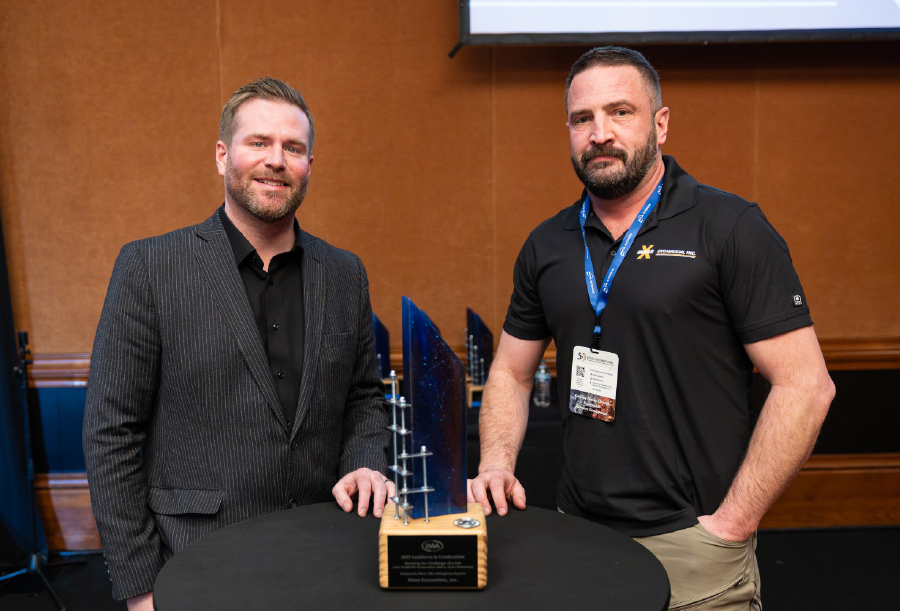


“The move required tight coordination, including the use of three tugboats and a spud barge to stabilize the vessel as the self-propelled rig advanced at roughly 1 mph onto the 630-foot barge before traveling 60 nautical miles to Point Thomson,” Jones says. “Extensive pre-planning, daily meetings, and staged backup crews and equipment allowed us to navigate weather and logistical challenges while maintaining efficiency. The project was completed with zero incidents, and all temporary materials were removed afterward, leaving no environmental footprint.”
“We’re extremely proud of our team and grateful for the recognition. Awards like this highlight the dedication of everyone involved—from our field crews to our project managers to our support staff. We appreciate the partnership and trust of our clients, and we look forward to continuing to deliver work that reflects the values of Cruz Construction,” Jones says.
But as with many projects in Alaska, it wasn’t as straightforward as it appeared on paper. The challenges STG, Inc. overcame to build the tower on time and on budget despite the obstacles it faced netted the company a clear win for Excellence in Construction—Specialty Job Under $1 million.
“STG’s client for this project is in the early stages of implementing their network. Because they are still fine tuning the needs of each tower site, it is a challenge for STG to be in tune with how their needs might be changing and to offer solutions as things develop,” says project manager Wesley Burgess.
“A major logistical challenge arose when the Wrangell barge landing’s reduced load capacity prevented offloading the crane needed for tower erection,” STG, Inc. officials wrote in the award application. “With the tower too tall for local boom trucks, STG pivoted to a helicopter-assisted construction strategy, employing an A-Star B3 helicopter to lift preassembled tower sections into place.”
Pivoting was relatively easy, Burgess says, because STG has done the groundwork.
“My team and I had to rely on our past experience and strong industry partnerships to execute the solution on very short notice. Being very familiar with the helicopter work being performed, and with trusted pilots and tower crews, we were able to pivot so quickly to an entirely new workplan and avoid any schedule delays,” Burgess says.
Burgess adds that he and his team are honored to be recognized by AGC.
The flooding, caused by several days of warm weather and increased water flow due to glacial melt, had caused the road to be closed for nearly two miles near Maud Road, stranding residents. Water rose roughly six inches every half hour. Residents had filled hundreds of sand bags to try to create barricades to protect property in the area, and Governor Mike Dunleavy declared the flooding a state disaster.
“There were several utility poles that had been compromised and were falling over. They were really depending on us to get out there and get it under control so they could get the power back on,” says Mass X General Manager Justin Shields.
Mass X, already working in the area, responded immediately, creating an access road and placing riprap to stabilize and rebuild the bank. Crews worked around the clock, returning multiple times as the currents of the braided river shifted, ultimately stopping the erosion and protecting the road and nearby properties.
“Within three days we had it back where the utility companies were able to get back in there and get the power and utilities on, and we continued to improve it for the next three weeks,” Shields says.
He adds that the crew appreciated being able to help residents have power and access restored.
“For us, to win the award, it’s huge—we not only work in these communities but we live in them as well, so for us to be able to step in and help our neighbors is important to us,” Shields says.

“Doing night work plus tide work is a really challenging project,” Thurman says.
“It involved a lot of tide work, rock work, dyke shift, because it’s during the summertime when you can’t restrict traffic on the Seward Highway other than nighttime, so there were a lot of challenging situations,” he adds.
More than 73,000 tons of borrow was used to widen the shoreline and build the parking lot and 38,000 cubic yards of riprap in layers along the shoreline and parking area to protect and stabilize them.
Despite the technical, high-risk, and high-exposure nature of the project, Granite completed all major scopes of work a year ahead of schedule. Thurman says winning the award for this job is meaningful.
“We were very thankful and appreciative of being selected for the award. It’s been quite some time since Granite has won an award like this from the AGC, and it’s just great to be back winning the award again,” Thurman says.
The project was to rehabilitate the 121 and 135 aprons and add a Remain Over Night (RON) hardstand area east of the terminal building for airplanes staying at the field. In the course of the project, SECON officials realized there were a number of ponds or puddles on the aprons, which don’t drain properly and make it more difficult to maintain. SECON management discussed the issue with stakeholders and all agreed to use a new form of pavement cold planing based on 3D design models. The asphalt mill communicates with two total stations, or high-precision surveying instruments, to change the depth of the cold planing while in motion, resulting in a consistently smooth surface. The company also used a similar grade control for the grader and dozer used on the project.
In addition to the technical tools used to achieve a better end result, SECON used innovative phasing and logistics to minimize airport disruption, meet Federal Aviation Administration regulations, and bring the project to a close early.
“We are proud to receive this award. It wouldn’t have been possible without our skilled team and stakeholders. It reflects our dedication and skill in the industry,” says SECON Project Engineer Jared Mackey. “Winning this award affirms our team’s commitment to quality and innovation. It strengthens SECON’s reputation and helps us build trust for future projects throughout Southeast Alaska.”
AGC would like to acknowledge some oversights in this year’s Excellence in Construction Awards review process. Two Cornerstone General Contractors submissions were unintentionally left out of the judging packets, and one Cruz Construction project was reviewed in the incorrect category. We sincerely regret these errors. AGC is taking added steps to strengthen our review process and ensure accuracy moving forward.




Photo by Rod Cummings
Photo by Rod Cummings
fter years of rapid growth across the Matanuska-Susitna Borough, the two-lane Seward Meridian Parkway could no longer keep pace.
Traffic volumes climbed. Medical offices filled in along the route. Parents jockeyed for space at school drop-off zones. Left turns from side streets grew risky. Fenders met. Sirens followed.
What had once been a quiet road now felt like a bottleneck in the heart of Alaska’s fastest growing region. Phase 2 of the Seward Meridian Parkway project—the final stretch of a two-phase plan—aims to fix that.
Led by the Alaska Department of Transportation and Public Facilities (DOT&PF), with Mass Excavation, Inc. as general contractor, the $44 million project will fully connect the corridor, widen the majority of it to four lanes, join the last gaps between three primary east-west routes, and layer in safety features that reduce crash risk while improving day-to-day reliability for students, parents, patients, and other drivers.
At roughly two miles long, the Seward Meridian corridor runs north-south though a densely developed part of the Mat-Su. The growth along the corridor has been striking, says Tague. A medical plaza has sprung up with clinics, various medical providers, a surgery center, and a 67-bed skilled nursing facility. Hundreds of families use the road daily to reach one of the four schools along the corridor. Recreation traffic on the weekend can also include paddlers who head for the area’s chain of lakes.
More than 13,000 vehicles travel the corridor per day, according to state traffic data. Before Phase 2, a missing link between east-west connectors Bogard and Seldon roads forced drivers heading from Wasilla to Mat-Su Career and Technical High School or Teeland Middle School to detour along a previously quiet residential street.
As volumes increased, Tague says side-street turns became riskier.
“People start taking chances,” says Tague. “That’s when you see crashes.”
A separated multi-use path now runs the length of the project on the west side of the corridor, a deliberate choice because three out of four schools along the route are located on that side of the road. Students walking or biking will now have a protected route that stretches from Seldon south to Walmart at the Parks Highway.

Photo by Rod Cummings
In the past, boaters had to either portage across Seward Meridian Parkway or take their chances paddling through the narrow culvert.
“There were a couple things that led to building the bridge,” Tague says. “We raised the elevation of the road by about 14 feet in that location, so if we had gone back with a culvert, the fill would have been much wider and impacted much more stream channel. Also, from the Fish and Game side, a bridge is far more desirable for salmon passage.”
DOT&PF salvaged natural streambed material to keep the channel looking and functioning like a creek. Beneath the top layer sits a stable base of riprap that’s designed to hold firm during flood events.
Cody Troseth, project manager for Mass X, says the transformation at Cottonwood Creek was dramatic.
“The old crossing was just a 10-foot culvert, half-buried, clogged with rocks, timbers, and even trees,” he says. “We cleared everything out and replaced it with an open channel under a 120-foot long, 90-foot-wide bridge. Now it looks and functions like a real stream.”
“We cut through the hill and punched the corridor all the way to Seldon,” Troseth says.
The dirt, however, didn’t always cooperate.
“We hit hardpan in the cut, which wasn’t anticipated,” Troseth says. “You couldn’t just excavate it up.”
Mass X switched to ripping it with a claw, then excavating. At Cottonwood Creek, crews encountered a fine, silty material that turns to goo when wet. Operators had to over-excavate to reach firm ground, dewater constantly, and backfill in a controlled way while working up to 30 feet deep in some places.
“It was a big challenge,” Troseth says.
Throughout the project, the corridor had to remain usable. Aside from two weekend closures to set temporary culverts and do critical creek work, Seward Meridian has stayed open.
Managing traffic on a corridor carrying more than 13,000 vehicles a day was a logistical puzzle. Mass X and DOT&PF coordinated closely with subcontractor and AGC member Jolt Construction & Traffic Maintenance, Inc. to keep traffic moving safely.
“The most challenging part of the job is dealing with traffic and the public,” Troseth says. “You’re building one side of the highway, moving traffic onto it, then building the other side. We ran day- and night-shifts. It’s the only way to stage a project like this without shutting down the corridor.”
Flaggers managed traffic at busy driveways and intersections throughout the corridor, particularly near medical offices and Cottonwood Elementary School, where side-road approaches were stripped to gravel before being rebuilt.
Despite the complexity, Troseth credits the teamwork with DOT&PF and Jolt Construction for keeping the project on track.
“It’s not easy keeping that much traffic moving,” says Troseth.
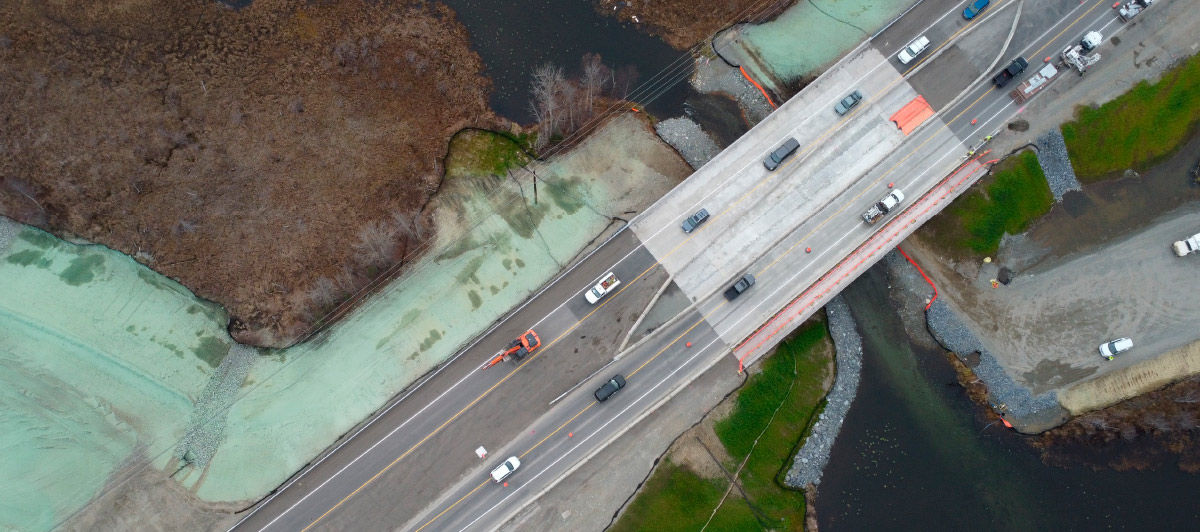
Photo provided by Mass Excavation Inc.
DOT&PF widened sight distance at intersections and used the median to manage turns in and out of driveways. Sidewalks and the new multi-use path unclutter the shoulders and offer predictable spaces for people who bike, walk and run.
The work is already paying off.
“We’ve already seen a drop in the number of accidents,” says Tague. “These are the kind of crashes that tend to happen on a congested two-lane road.”
Seward Meridian Phase 2 also came with a web of utilities to adjust. The project required extensive relocations for fiber and powerlines. Coordination with Enstar allowed for the installation of a high-pressure gas main within the project boundaries. This upgrade has helped alleviate low-pressure issues in the Hatcher Pass area, says Tague.
“Because of this new corridor being linked through, we were able to take advantage of some opportunities,” says Tague.
“This is our seventh bridge with Swalling,” says Troseth. “We’ve got a very good working relationship with them.”
Meanwhile, AGC of Alaska members Sturgeon Electric led the signal and lighting system and ASRC Earthworks, LLC handled the paving. Specialty striping and guardrail crews cycled in as phases opened. On a typical day, Troseth estimates, fifty people from Mass X, Swalling, and Sturgeon were active on site, with bigger surges during paving.
“We worked closely with our subs on everything,” says Troseth. “The collaboration has been good.”
Construction on Phase 2 kicked off in spring 2024, with crews taking advantage of winter work windows wherever possible, especially around the creek diversion and bridge.
“We thought colder ground might help,” says Troseth. “Last winter didn’t really cooperate, but the extra push still helped the schedule.”
Even though the project’s contract completion date is set for August 2026, both DOT&PF and Mass X expect to finish ahead of schedule. The remaining civil work centers on the Bogard Road intersection and the final electrical installations needed to complete the corridor’s new signal and lighting systems.
“Fall in Alaska isn’t the time to bite off more than you can chew,” says Tague. “We were right on the bubble for paving this year and made the call to hold Bogard for next season.”
In the meantime, the widened north and south ends of the corridor already deliver a vast improvement, says Tague.
When construction wraps up, ownership of the upgraded corridor will transfer to the Matanuska-Susitna Borough. And when the last barricades come down and the final signal flashes green, Seward Meridian Parkway will feel like what it has quietly become—a true north-south spine through a growing community that will be safer, steadier, and ready for the future.



nton “Tony” Johansen says it’s a good thing he’s a little gullible. There’s a long tradition at Associated General Contractors (AGC) of Alaska of keeping the recipient of each year’s Hard Hat award secret until the moment the recipient is announced at the Saturday evening Dinner Dance that caps each AGC Annual Convention.
Great Northwest Inc., the company Johansen jointly owns and where he works as vice president, frequently has a table at the AGC Dinner Dance. But this year, someone had the idea that the company should purchase a second table and invite college students to attend the festivities.
“That was all a ruse; there were no college students,” Johansen says.
And coincidentally, Johansen’s brother and two of his daughters, along with their significant others, also planned to attend the Dinner Dance this year.
“They all had plausible stories as to why they were going to be there,” Johansen says.
Alaska is, after all, a big village, and the construction industry is a smaller community within it. One person’s spouse works in the Brice family of companies; another works at Siemens—there were good reasons for a few more family members to be at the celebration than usual, and when the table set aside for college students suddenly opened up, Johansen says it seemed like a natural idea to move the family members to the Great Northwest tables.
So it was that they were all on hand to give Johansen a standing ovation—along with the rest of the audience at the Dinner Dance—when he was chosen as AGC of Alaska’s 2025 Hard Hat recipient.
In making the announcement, Robby Capps, a Hard Hat recipient himself, noted that Johansen, who grew up in Valdez and Fairbanks, had placed a priority on education both in his own life—having graduated magna cum laude with a bachelor’s degree in civil engineering from University of Alaska—and in the lives of those around him.
After working in the Alaska Department of Highways’ Engineer in Training program, Johansen returned to school and obtained a master’s degree in civil engineering with an emphasis in construction management from Stanford University. Johansen returned to Fairbanks and worked as a project manager for H & H Contractors, then served under then-Governor Tony Knowles’ administration as the Department of Transportation & Public Facilities (DOT&PF) Northern Region director. After five years in that role, Johansen returned to the private sector with Great Northwest, Inc., where he’s been since 2000.
“Tony understands the value of early entry into the construction industry as a career path, with his longtime position as trustee on the Operating Engineers Training Trust and past role as trustee for the Fairbanks Pipeline Training Center. He strongly supports the hiring and development of UAF engineering graduates in their business,” Capps said.
Johansen says three of Great Northwest’s professional engineers schooled at UAF. The company frequently employed graduates of UAA’s construction management program and graduates of the UAF Community and Technical College (formerly Northwest Community College), which offers an associate’s degree in construction management.
“That helps every contractor, actions like that,” Johansen says. “We see a lot of value for Great Northwest coming from Associated General Contractors.”
Johansen says education isn’t the only reason he appreciates AGC and wants to stay involved. AGC’s lobbying efforts, from advocating for more transportation funding to stepping in when a statute or regulation change makes doing business difficult, has been indispensable to the company.
“We work with AGC and its lobbyist to solve those problems,” Johansen says.
Capps noted that Johansen plays an active role in those lobbying efforts.
“Tony has attended several annual AGC legislative fly-in events and has participated in several AGC of America conferences. Tony’s voice is strong and his messaging clear when advocating for education, specifically STEM [science, technology, engineering and math] and the importance of these skills to the construction industry,” Capps said.
“Tony presents a loud and well-respected voice, based on his DOT and contractor knowledge, when participating in the AGC of Alaska DOT Committee. Additionally, Tony was appointed in 2016 to serve on the Governor’s Statewide Highway Advisory Committee where he had the opportunity to advise the governor regarding issues of design, construction, maintenance, and operation of our state highway system,” he added.
Woodrow Johansen, for whom the Johansen Expressway in Fairbanks is named, was an engineer for the Territory of Alaska Road Commission, then district engineer for the Interior District, carrying the title while the department shifted from federal control to state control when Alaska became a state. He eventually became Northern Region director, a job he held until 1980. Woodrow became a Hard Hat in 1979.
Tony Johansen says he attended his first national AGC conference in 1983. He served as AGC of Alaska Board President in 2012 and is both an AGC Life Director and an Emeritus Life Director. And now, thirteen years after serving as president, he holds AGC’s highest honor, the Hard Hat. It may look like a natural progression, but Johansen says it came as a complete surprise.
“It was very humbling to have all those people decide that I should get this award. I feel very honored,” he says.


onstruction Machinery Industrial (CMI) has kept Alaska’s industries “moving forward” since first opening its doors in 1985, and it’s been an Associated General Contractors (AGC) of Alaska member almost as long. The company prides itself on its reputation for exceptional service, for offering support solutions tailored to meet Alaska’s unique and demanding market, and its extensive inventory of equipment engineered to “get it done.”
CMI applies that same “get it done” mentality to its involvement with AGC, reliably sponsoring and participating in events, being part of committees, and sending members to Juneau to speak with legislators. It’s that unwavering commitment and steadfast support to AGC’s mission that led the AGC Executive Board to choose CMI as the Associate of the Year at its November annual conference.
“They have representation at just about every AGC event we host, both in attendance and sponsorship,” AGC Executive Director Alicia Kresl told attendees at the Dinner Dance, where the award was announced. “This company supports [AGC] through serving on our Board of Directors, our Membership Committee, our Legislative Affairs Committee, as well as the Construction Leadership Committee. They truly go above and beyond with their customer service, understanding the importance of collaboration within the industry, and take pride in going the extra mile for their clients.”
With locations in Anchorage, Fairbanks, Juneau, and Ketchikan, CMI delivers equipment from industry-leading brands for purchase or rent to AGC and non-AGC members in the construction, mining, and logging industries across Alaska. CMI’s signature “extra mile” service begins before a contract is signed and continues long after the sale is complete—its 112-person team is available every step of the way to ensure that the entire transaction, from financing to purchasing to ongoing maintenance, is as hassle-free as possible.
Last fall, CMI earned the thirtieth spot in Alaska Business magazine’s 2025 Top 49ers list for the second year in a row. The list ranks Alaskan-owned companies by annual gross revenue. Kirk Currey, sales representative for CMIs’ Anchorage branch, told Dinner Dance attendees that CMI and AGC will continue to grow together.
“Thank you very much,” he said when accepting the award on CMI’s behalf. “It’s been an honor to be a part of you for a long time. I look forward to seeing us prosper and continuing to move forward. I appreciate it very much.”


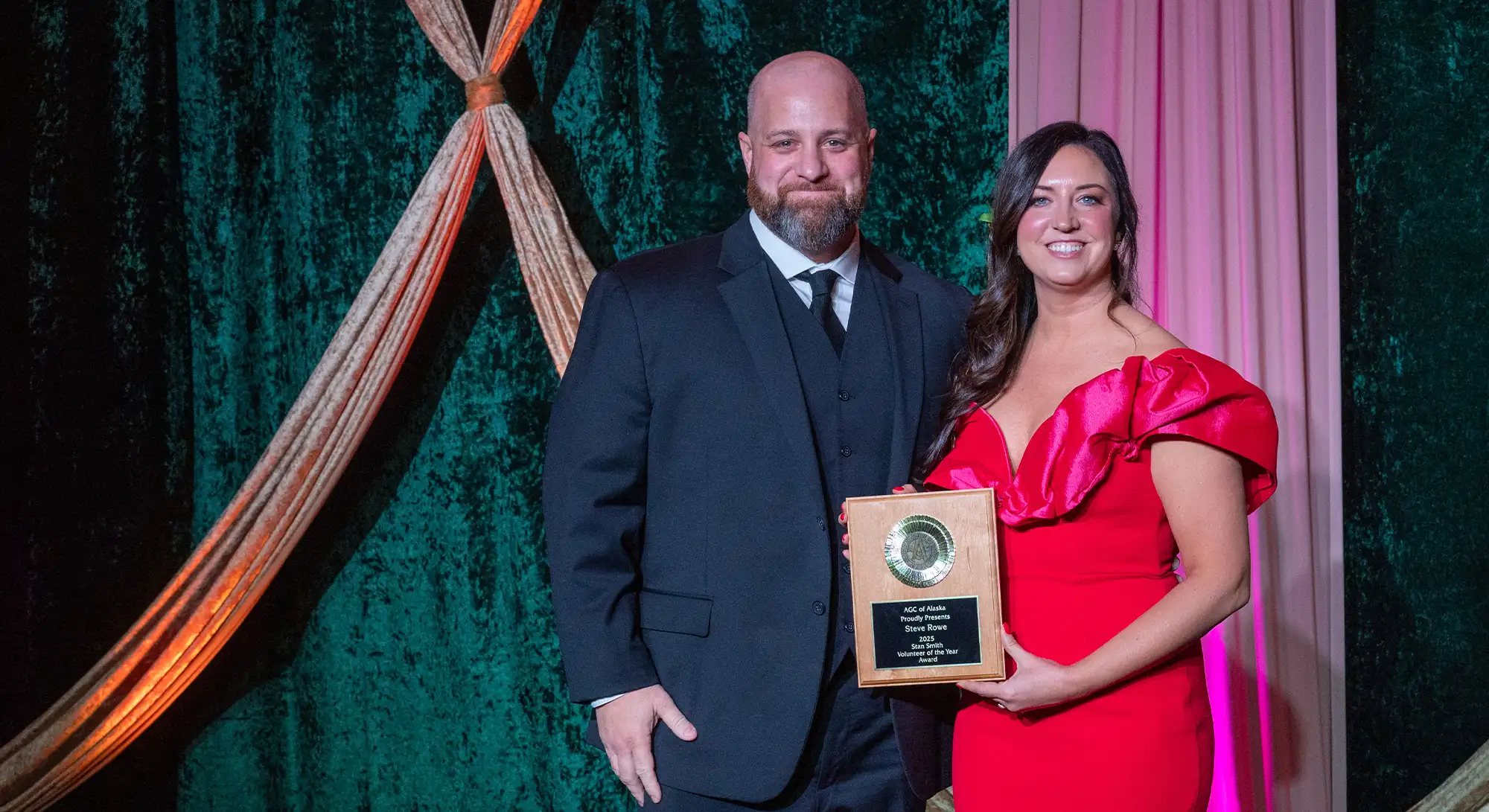
teve Rowe, co-owner of Swalling General Construction, says he was “blindsided” when Associated General Contractors (AGC) of Alaska Executive Director Alicia Kresl announced he was selected by AGC staff as the 2025 Stan Smith Volunteer of the Year at November’s Dinner Dance, the capstone event of AGC’s annual conference.
“It was awesome,” Rowe says. “There are so many members and companies and so many people doing great things in the state for AGC, and they only give one award out a year. So it’s truly an honor to even be considered for that, and then to win it is something really special.”
Kresl told Dinner Dance attendees that it is Rowe who brings something special to AGC.
“This person is always willing to lend a hand and will come into the office or give us a call with four simple—but very meaningful—words: ‘What do you need?’” she said in remarks preceding her announcement. “Not only do they participate in the committees and events that we already have on the books, but they come to AGC staff with additional ideas for not just helping our industries but also helping our community.”
Rowe’s been part of the industry for twenty-six years, starting when his mother, a construction accountant in Hawaii, got the “rambunctious” 18-year-old a job as a laborer. After four years building houses and running excavators, Rowe returned to Alaska, where he spent time at Watterson Construction. “They pretty much taught me just about everything,” he says. Rowe went on to work at SNC-Lavalin, Cornerstone General Contractors, and Swalling General Contractors.
“I worked all the way from a laborer to a carpenter foreman,” Rowe says.
When Rowe, Paul Swalling, and Brian Van Abel took over Swalling General Contractors in 2016, he traded his carpenter bags for a desk job and began handling the company’s operations. The transition, while bittersweet, meant Rowe could devote more time to AGC.
“I’d always wanted to get more involved, but I kind of had to be the ‘guy in the chair’ to become some of those things,” he says.
Rowe has become so involved that it takes him a beat to remember every AGC committee he’s involved in. He’s a member of the safety and legislative affairs committees, helps organize the annual Sporting Clays Shoot, and—his favorite—spearheads AGC’s Toys for Tots drive, encouraging members and member organizations to donate cash or toys to the efforts.
Rowe says working so closely with AGC has given him greater insight into the extent of the organization’s efforts to support Alaska’s construction industry and how “our voice becomes louder” when working together.
“There is this whole other side to AGC that people don’t see, and the things that they do,” he says. “We’re in Juneau every year, and Alicia is always making testimonies and statements, and we’re fighting for what makes the construction industry as a whole stronger. We need help on so many issues, and the more people we have that can join in and get our hands dirty, so to speak, helps.”


he Alaska Department of Transportation and Public Facilities (DOT&PF) had one important message for Associated General Contractors (AGC) of Alaska members at its presentation on the opening day of AGC’s annual conference in November: when projects are ready to deliver, DOT&PF wants to deliver them.
Transportation staff members repeated this message during individual presentations at the meeting as they gave their annual update on federal and state funding, statewide projects, regulations, and communications.
August Redistribution is unused spending authority provided back to the states. It allows states to access more of their statutory formula funds, funds that would otherwise simply carry forward to the next year and comes from unspent program funds—under-used grant programs, loans, and new Infrastructure Investment and Jobs Act programs for which allocated money has not been spent. The redistributed spending authority allows states to put that money into projects that meet eligibility requirements for funds they have remaining. If a state is unable to spend those funds through August Redistribution, those funds typically carry over to the next year.
“That was a record year,” Keith told AGC members. “We’ll continue to strive for that goal, but it does depend on the revenue [match] that we get from the state.”
DOT&PF Commissioner Ryan Anderson says many things contributed to the significant increase in the August redistribution. Over the past couple of years, DOT&PF has modernized systems by updating its processes with digital tools, streamlined its tentative advertising schedule, and advanced its project delivery plan. He says this has positioned the department to pursue multiple projects across diverse federal funding categories. Likewise, it increased DOT&PF’s ability to track costs and schedules in real time, enabling it to quickly adapt when challenges arise. This modernization has resulted in a more transparent system in which data entry occurs as work is being done, ensuring an accurate list of projects ready to be delivered when federal highway funds become available.
“When we have an FHWA project that meets the criteria, has right-of-way secured, and the environmental pieces in place, we certify it and obligate it with federal highway funds,” says Anderson. “We have to obligate the August distributions by the end of the federal fiscal year to projects that will be constructed over the next year or two.”
“Until then, we’re committed to continuing our work and ensuring every dollar—state and federal—is used responsibly to improve Alaska’s transportation system,” he says.

On the aviation side, DOT&PF expects $272 million this year. Keith clarified that fluctuations in aviation funding occur because the program is discretionary. Though they are not guaranteed funds, the state continues to submit requests and aim for an increase. She says the Federal Aviation Administration is heavily focused on safety right now, and DOT&PF is currently reviewing its airport program to identify projects that involve safety modifications, making them eligible for federal funding.
Finally, DOT&PF’s National Highway Performance Program provides an additional $360 million for main road corridors and $200 million for surface transportation block grant programs, allowing flexibility to work in rural parts of the state. Combined, DOT&PF has $1.98 billion in surface and air transportation projects planned for the coming year.
Anderson says DOT&PF is also working in the background to prepare for several large state projects on the horizon. The most notable is the proposed 807-mile Alaska Liquified Natural Gas line that will transport natural gas from the North Slope to Nikiski for export to international LNG markets. This complex project requires multiple connection points for in-state gas distribution and eight compressor stations. DOT&PF is coordinating with the Alaska Gasline Development Corporation to ensure that existing projects within the gasline corridor do not conflict with the construction of the treatment plant, pipeline, or the liquefied gas facility in Nikiski.
“This means that our needs as a state are greater than the amount of federal funding we get,” says Pannone. “[Advance construction] is the tool we use to deliver those projects.”
Without advance construction, Pannone says some projects would stall while they wait for the next year’s federal funding allocation. Over the next few years, DOT&PF will carry an advance construction balance representing roughly 87 percent of the federal highways program funding the state expects to receive each ear. The department will most likely continue to grow that balance until it grows to about a year of federal funding. However, if there is any period of project slowdown, DOT&PF can use the advance funds to pay down the balance.
Several external challenges have made advanced construction even more necessary. Highway construction inflation has risen over 100 percent since 2012. Inflation costs have risen by more than 60 percent in the last five years alone, starting with the pandemic. That has caused DOT&PF to reevaluate their project delivery timelines, project scopes, schedules, and estimates, and triggered a cascading refactoring of the entire program. This means relying on tools and technology to show potential projects for the next year.
For federal FY26, DOT&PF anticipates advertising approximately ninety projects statewide, valued between $670 million and $1.1 billion. Most are highway projects; about twenty are aviation projects. Pannone considers the count a healthy and sustainable workload across all three of Alaska regions.
“We haven’t slowed down on developing and having projects ready to go, simply because our match funding was reduced,” says Pannone. “Those projects are waiting for additional funding or a match from the legislature. We’ll continue to update these and ensure this is accurate information. Overall, this represents a continued effort to make sure we’re communicating with our partners and being transparent about what we can deliver and how we’re delivering that.”
Pannone adds that if DOT&PF doesn’t get the anticipated $70 million match from the legislature, department leaders will use the federal dollars to pay down the advanced construction balance instead of keeping the momentum with delivering projects. He says this will ensure the State of Alaska is not at risk of losing federal dollars, even if it affects how many projects the state can deliver.

Finally, the Disadvantaged Business Enterprise (DBE) Program is being modified. The US Transportation Department issued an interim final rule on October 3, stating that DBEs will no longer be presumed disadvantaged solely on the basis of race or gender. With this ruling, all DBEs were decertified and must reapply for certification. Acting Northern Region Director Lauren Little says it’s not yet clear how recertification will work; rules for the process are currently being created. However, she says the department still encourages large prime contractors to support smaller contractors when possible.






Vantage Consulting
ome of my best construction clients have doubled—and sometimes even tripled—their profitability without adding a single new project or even changing their bidding strategy.
How did they do this? They eliminated internal chaos.
For example, many government contractors operate with net margins of 4 to 6 percent. They can’t expand those margins in competitive bidding. But they can reclaim profit by stopping the internal chaos that quietly bleeds profit from every job. Addressing the chaos often moves them to margins of above 15 percent.
Global research by McKinsey & Company estimates that the construction industry loses up to $1.6 trillion annually to productivity gaps. Dodge Data & Analytics found that nearly a quarter of those inefficiencies come from poor communication and coordination.
Clear communication and structures reduce or eliminate confusion. This reduces conflict and feels more professional, which is what high performers prefer. In this labor market, that is a competitive advantage.
The tricky thing is that this is “comfortable chaos”: tolerated issues and problems that no one likes but which feel normal. The issues are excused by saying, “This is what construction is like.”
Maybe it is. But it could be better.
There are ten unnecessary costs that contractors frequently incur, but most of these costs are driven by only three causes.
Leading studies by construction industry research and analytics groups such as McKinsey, the Construction Industry Institute (CII), Dodge Data, and FMI consistently identify poor front-end planning, unclear authority, and broken communication as the primary and often overlapping sources of inefficiency, avoidable costs, and lost profits in construction firms.
When these are systematically addressed, firms commonly recapture 40 to 60 percent of their avoidable losses, based on impacts documented in multiple global and North American studies.
If that number appears ridiculously high, read the rest of the article. It’s pretty obvious once you see it.
This rush causes leaders to skip steps, which sets the stage for problems and encourages a costly “out of sight, out of mind” approach to project management.
The Chaos: Jobs start before all the details are nailed down. Procurement, logistics, and resources aren’t planned well. Schedules are often built on guesswork and assumptions of perfect conditions.
The Cost: CII found that the quality of front-end planning alone can account for 10 to 20 percent of the total project cost.
The Fix: Treat front-end planning as margin protection, not overhead. Require joint project manager/superintendent pre-mobilization meetings. Build a living pre-plan checklist that travels with the project.
CII’s research confirms what every veteran builder knows instinctively—an hour of planning can save a day of rework.
The Chaos: Overlapping authority between project managers, supers, and foremen. Decisions stall or conflict. Time is wasted trying to figure out who to talk to or get answers from. Clients are frustrated.
The Cost: According to FMI’s 2023 Labor Productivity Study, nearly 60 percent of contractors report that at least 11 percent of field labor costs are wasted or unproductive, and 79 percent believe they could improve labor productivity by 6 percent or more with better management, including greater emphasis on planning, communication, and collaboration.
The Fix: Define who decides, who executes, and who informs on every workflow. Post a simple organizational or a Responsible, Accountable, Consulted, and Informed (RACI) chart on-site. Reinforce in every kickoff: Clarity equals speed.
FMI’s data matches what I see weekly. Confusion can burn as much or more of your margin as mistakes.
The Chaos: What the client understands or thinks they communicated doesn’t always reach the field. Meetings become info dumps, not opportunities for clarification. Critical details are buried in email threads.
The Cost: Dodge Data & Analytics reports that up to 25 percent of project inefficiency can be traced back to poor information flow.
The Fix: Standardize your bid-to-build handoff. Create a checklist. Use one shared document or platform for all changes. Hold a brief “scope sync” before mobilization to align expectations. The best companies don’t have to communicate more. In fact, they often communicate less. But their communication is clear, complete, and understood.
All of these can be improved, if not entirely addressed, with clear structure and consistent process discipline.
Each of these issues chips away at profit. But clarity restores it.
Chaos is optional. Clarity pays.


By David A. James
or more than 70 years, GHEMM Company has been known for its outstanding work, first on road projects and, for the past half-century, on commercial structures in Fairbanks and Alaska’s Interior.
“We do big jobs, we do small jobs,” says Meg Nordale, GHEMM’s president. “We work for private people. We work for public entities. We do building remodels, new buildings, industrial work, office space, hospitals.”
GHEMM has worked on countless prominent projects in the Golden Heart City, including several local branches of Mt. McKinley Bank and the new bus and van garage at the Fairbanks Transit Station, as well as a major renovation of the Bartlett and Moore residence halls on the UAF campus.
Whether clients arrive with a design in hand or need help finding an architect before breaking ground, Nordale says, “We’ll help you through the process, and we’ll build it for you.”
GHEMM’s eighty employees range from engineers to project managers to laborers. Many have been with the company for decades.
“We keep a pretty steady crew of people all year round,” Nordale says. “We dig a hole in the ground in April or May. We get a building up. We get it enclosed. Get it nice and cozy and warm. And then we work through the winter.” She adds that, “When the snow melts, we do the landscaping and we go away.”
She says, “The message we always try to portray is, no job is ever too big, and we’re likely the right fit for anything that’s remotely complicated.”
From Building Bridges to Medical Center Mastery
It wasn’t by accident that GHEMM secured the medical construction contracts; it took focused effort. Company management, engineers, carpenters, and laborers keep abreast of the technological needs of the medical industry, often attending training classes in the Lower 48.
“As the sophistication level of medical facilities in Fairbanks grew, it just necessitated that we grow our knowledge as well,” Nordale explains.

Heflinger, a gold miner, shortly decided he wanted to return to his claims, and Con Frank came in to take his place. All five owners remained with the company through the ends of their lives.
Initially GHEMM focused on roadwork and trucking and built bridges on many Interior highways, most notably the E.L. Patton Yukon River Bridge spanning the third-longest river in North America.
Within a few years the company shifted away from highway projects and began to focus exclusively on vertical construction. In the decades since, it has earned a reputation for high-quality work.
GHEMM’s work ethic is what keeps clients coming back. “One thing that we pride ourselves in is we do repeat work for many, many people,” Nordale says. “We do a lot of work for Holland America. We do a lot of work for the hospital. We do a lot of work for the university, for Mount McKinley bank, for Tanana Chiefs Conference [TCC]. We have relationships with all of them.”
Tim Troppmann, facilities senior project manager at TCC, says that’s exactly what maintains the Alaska Native nonprofit corporation’s loyalty.
“I have worked hand in hand with GHEMM for over 20 years and would work with GHEMM anytime,” he says. “There are always challenges and issues to resolve with any project, regardless of size. GHEMM always takes the time and initiative to collaborate with the owner, design team, and others to find workable solutions that keep the schedule and cost in the forefront. As an owner, I have grown to trust GHEMM as a substantial value-added partner in TCC’s projects.”
GHEMM strives to accomplish this with every job. “Our reputation is, we tell you what it’s going to cost and we don’t charge you more,” Nordale concludes. “We tell you when we’re going to get done—we’re never late. And the quality is top-notch.”




HEALTH & SAFETY
n Alaska, safety isn’t just about compliance, it’s about people, community, and smart business. Every contractor knows how quickly conditions can change: weather, logistics, and remote operations can turn a routine task into a high-risk situation in seconds. But what’s often overlooked is the financial side of safety, the tangible, measurable return on investment (ROI) that comes from preventing accidents, building a strong culture, and protecting your workforce. Put simply: a safe jobsite is a profitable jobsite.
In a high-stakes environment like Alaska construction, where skilled labor is tight and project timelines are short, preventing even one serious injury can save hundreds of thousands of dollars and protect your company’s reputation.
The National Safety Council estimates the average direct cost of a serious workplace injury in Alaska, where medical costs and logistics are higher, is $75,000 to $90,000. Adding in the hidden expenses, the total cost of a single serious injury can easily exceed half a million dollars or more.
When we talk about the ROI of safety, these numbers tell the story. Even one serious accident can erase months of profit.
Large clients from federal agencies to oilfield clients use EMR and TRIR as key indicators of a company’s risk profile. Most set hard thresholds, requiring EMRs below 1.0 for prequalification. In that environment, one lost-time injury costs money today, but it can cost you the chance to compete tomorrow.
EMR reflects the previous three years of workers’ compensation losses compared to your industry’s average. It’s the number your insurance carrier uses to calculate your premium. A company with an EMR of 0.75 pays 25 percent less on premiums than average, while a company with a 1.25 EMR pays 25 percent more than average, a difference that could add up to hundreds of thousands of dollars on larger payrolls.
The impact doesn’t end with insurance. Large clients rely on pre-qualification systems such as ISNetworld, Avetta, and Ariba to screen out higher-risk contractors. Strong safety records, paired with disciplined approaches to claims management and return-to-work programs, can make the difference between being selected or sidelined.
When operations professionals and CFOs understand how closely safety performance ties to profitability, it changes the conversation.
In a reputation-driven market like Alaska, that organizational trust carries weight. Companies that care for their people attract and keep better talent. Investing in things like advanced survival training and preparedness goes a long way toward boosting morale and retaining talented employees.
Investing in total worker health, peer support programs, supervisor training, open-door policies, and simple check-ins pays real dividends. Strengthening trust reduces turnover and helps crews bring their best selves to work. When leadership shows genuine attentiveness to both the physical and mental well-being of employees, it builds the kind of loyalty and resilience that no insurance discount can buy. Taking care of your team’s mental well-being isn’t just compassionate—it’s smart business.
Alaska’s lucky to have resources like the Alaska Occupational Safety and Health Consultation and Training Section, the Construction Health and Safety Excellence (CHASE) Partnership Program, the Alaska Safety Alliance, and other for-profit organizations dedicated to making it easier and more cost effective for companies to succeed in the realm of safety.
Safety isn’t overhead, it’s a strategic competitive advantage. In Alaska’s demanding construction environment, where every worker—and every day—counts, the companies that prioritize safety don’t just protect their people, they protect their profit, their reputation, and their future.
Invest in safety. Track your metrics. Support your crews. It’s the smartest business decision you’ll ever make.



uilding a business is like raising a child. It’s exciting, terrifying, rewarding, and frustrating all at the same time. Your business is a reflection of you; no one cares about it more than you do, and your DNA is in your business—it’s a part of you. You’ve nurtured it, grown it, and weathered countless storms together.
However, at some point you know there will be a new season for you and your company as you pass the baton to someone else. That moment should be a culmination of a process, requiring much intentionality and planning. The months and years leading up to it will determine if that day is terrifying or exciting.
Unfortunately, too many business owners don’t do the succession planning and proactive work ahead of that transition and essentially end up giving the company away, or at least selling it for cents on the dollar—or worse, they may have to mothball the business altogether, letting it slowly erode.
Overcoming these issues requires time, so if you are selling your business on Tuesday, this may not be the article you need. But if you do have some runway ahead of you, let’s get to work!
When I sit down with business owners, very few have a date-specific goal for when they would realistically like to sell. They also may be unaware of the price they’ll need to fetch to close the gap between wealth from other investments and the overall financial position necessary to live comfortably for the rest of their lives. The selling price isn’t the only objective, but it’s a good starting point—it’s measurable and tangible.
Secondly, how much of your time is spent on doing what only you can do? To clarify, I am not asking about what you do better than others in your company, but doing what ONLY you can do. You might have a key employee who’s only 80 percent as effective in a role as you are, but if that is more than sufficient for them to be successful in those duties, should you still be hanging on to that role?
Many entrepreneurs and business owners are CEOs: Chief Everything Officers. They wear too many hats and have their hands in every facet of the business. How much is your time worth? $100 an hour? Maybe $500? Are you still doing tasks you could hire out for $75 an hour and getting frustrated because the work keeps piling up?
I challenge you to go beyond outsourcing and delegating and start thinking about making yourself unnecessary in the daily operations of your business—or at least redundant. Becoming unnecessary, at least for ground-level, day-to-day activities, should be a green flag when it comes to how you measure long-term success.
Will you find someone who is exactly like you to buy your business? Almost certainly not. But can you mentor someone now to gradually step into your role? They might not yet have all the skills and expertise, but you can start molding that person into an operator who can effectively run your company in your absence. That employee doesn’t have to be interested in being the successor of the business, but having that key operator means that whoever does purchase the business has an existing leader in place, making your company more turnkey and far more valuable.
You probably don’t plan to sell your company for far less than what it’s worth, but do you have a plan not to?
Let’s bring it back to parenting: no one knows the perfect decisions necessary to raise a child in the best way. But there are always simple, concrete choices at hand if we want to be intentional parents. It’s often not so important what you do first but that you do something. Make the important urgent—take action on your company’s succession strategy.


Photo provided by The Walsh Group
edEx is upgrading its infrastructure at Ted Stevens Anchorage International Airport (ANC), investing $200 million in an ongoing modernization project. As part of the project, FedEx is expanding its existing domestic operations center to increase capacity both domestically and internationally. It’s also building a new, 180,000-square-foot sorting facility and additional ramp parking for all feeder aircraft. FedEx plans to open the facility in September 2026.
The sweeping expansion marks a pivotal moment for both the airport and Alaska’s growing role in global logistics. Anchorage serves as a critical hub for FedEx’s global network due to its strategic location and operational capabilities. It also serves as a key gateway for trans-Pacific trade. Earlier this year, FedEx launched a new, non-stop flight from Anchorage to Singapore four times a week, deepening US-Asia connectivity.
“The Anchorage hub is the touchpoint for all packages that come to Alaska and plays multiple roles while remaining central to both local and international deliveries,” says Dale Shaw, FedEx Express Alaska managing director of operations. “It can sort up to 60,000 international packages and up to 20,000 domestic packages daily.”
Beyond these operational advantages, Anchorage’s location—just nine and a half hours from 90 percent of the world’s advanced economies—positions ANC as a cornerstone for global trade and a vital part of FedEx’s strategy to deliver the “Purple Promise” (“to make every FedEx experience outstanding”) worldwide.
Subcontractors working on FedEx expansion project include the following Associated General Contractors of Alaska companies:
- Alaska Concrete Sawing, Inc.
- Alcan Electric & Engineering
- ASRC Energy Services
- BrandSafway Services
- Commercial Contractors, Inc.
- Chugach Electric Association
- Crouse Environmental Compliance LLC
- Dama Industrial
- ENSTAR
- Excel Construction
- Finishing Edge Concrete Construction
- Johnson Controls
- Rain Proof Roofing
- Rent-a-Can Toilet Co. Inc.
- Shoreside Petroleum
- Square H Construction
- Summit Windows & Doors, Inc.
- United Rentals

Photo provided by Ted Stevens Anchorage International Airport
“Roger Hickel Contracting [RHC] is a ‘super sub’ on the project, providing all civil and foundation work, also known as ‘anchor bolts down,’” says Scott Dunlap, vice president of RHC. “We completed all interior foundation and slab-on-grade work this fall, per the original schedule. That work being completed on time allowed the project to reach the ‘dried in’ stage by late October of this year, allowing interior work to proceed throughout this winter.”
The expansion hasn’t been without difficulties, and innovative measures were necessary to keep the project on track.
“This site was particularly challenging, as it was constructed not only on a peat bog but also involved navigating environmental concerns related to soil at the site. As a result, none of the in-situ material could be removed from the site, so the traditional methodology of excavating the peat below the building and filling the footprint with gravel was not possible,” explains Dunlap. “A Geopier approach using Rammed Aggregate Piers was used instead. This methodology allowed this challenging site to be developed economically and in conformance with environmental considerations.”
As one of the few remaining large tracts of land at the airport, the project site had not been developed before due to the high costs associated with construction, including both peat and environmental contamination.
“RHC is very proud to state that we worked with the client, CRW Engineers, and regulators to develop a unique approach to this site that allowed the project to move forward while meeting budget and environmental requirements,” Dunlap says.
Numerous AGC member companies are also working on the expansion in various capacities. “We supplied around 3,000 yards of concrete for the building so far, and we’ll still need to supply concrete for the hard stands on the outside of the building,” says Dave Johnson, sales manager of Anchorage Sand & Gravel.

Photo provided by Ted Stevens Anchorage International Airport
“At the height of construction, hundreds of on-site workers were employed, the majority from local firms and union trades,” says Angie Spear, director of the Alaska International Airport System (AIAS). “In addition to skilled labor positions, the project has supported engineering, design, and logistics jobs that draw on expertise from across Alaska. Once operational, the expanded facility will sustain long-term jobs in aircraft maintenance, cargo handling, and ground support services, reinforcing Anchorage’s reputation as a year-round aviation employment hub.”
The economic and operational benefits ripple outward beyond Anchorage.
“With approximately 1,500 employees in Alaska, FedEx is one of the largest employers in the state. The ongoing facility renovation brings both economic and operational benefits to the airport and the local community,” explains Shaw. “Operationally, expanded ramp parking will provide additional spots for feeder aircraft, improving service to remote communities, and ensuring timely delivery of essential goods like medical supplies, pharmaceuticals, and infrastructure equipment.”
Currently, FedEx operates four daily feeder routes to Fairbanks, Kenai, Kodiak, and Homer. Strategically, expanding international capacity requires building out the domestic operations center, which further stimulates the local economy.
“Combined with Anchorage’s role as a critical logistics hub, this investment reinforces FedEx’s commitment to supporting both regional connectivity and global trade,” says Shaw.
Anchorage already ranks among the top four cargo airports in the world by volume, and this project further solidifies its position. The expansion positions FedEx for future growth in global air cargo by boosting capacity and efficiency at a strategic cargo hub.
“Anchorage’s location makes it a vital link for US–Asia trade,” says Shaw. “The modernization featuring a new sorting facility and expanded ramp parking will enable FedEx to manage rising global demand, support international routes like Anchorage–Singapore, and serve the unique Alaska landscape and economy. These upgrades enhance FedEx’s ability to connect remote Alaska communities and reinforce leadership in global air cargo.”





enerative AI is rapidly transforming the construction industry by reshaping project planning, management, and performance. AI also comes with legal risks for contractors. This article explores the advantages and legal challenges of AI use in construction and outlines strategies to mitigate liability.
Design professionals use AI to generate project design documents. Developmental AI systems could potentially analyze designs for compliance with applicable law. AI programs are used to create procurement plans. Some programs could be used to analyze market data and effectively time purchases, avoiding cost increases.
Additionally, onsite AI use is expanding. AI controlled drones and cameras are used to track progress and identify risks. AI automation can also remedy labor shortages. While uncommon, some contractors use AI driven machines to perform repetitive site tasks or certain types of construction in extreme climates.
While the potential benefits of AI grow, a limited understanding of AI’s drawbacks poses risks for contractors.
Contractors using AI risk breaching contractual confidentiality. Most AI systems are operated by third parties without confidentiality obligations. As such, a confidentiality breach can occur even where the contractor has a confidentiality agreement with the system operator. Contractors should review confidentiality and cybersecurity clauses before using AI systems for contract data.
Further, AI systems learn by obtaining information. Consequently, AI companies seek control over AI system input data, including project, design, or other protected information. This can cause intellectual property disputes over project information. First, inputting design documents into an AI system could be a breach of contract or of intellectual property rights. Second, AI-generated designs subject to intellectual property protections may result in litigation over ownership, licensing, and usage rights in the design.
As AI evolves, there are also product liability concerns. System defects can injure personnel or damage property. The risk of harm increases when a contractor inadequately tests AI systems before use or does not follow system guidelines. Strong quality control systems are essential to ensure that AI tools function properly and to avoid liability.
Moreover, AI systems produce outcomes via proprietary algorithms. Systems provided by third-party vendors can lack transparency in how decisions are made, obstruct system oversight, and limit troubleshooting capabilities. Simply put, it may be difficult for contractors to understand AI decision-making, identify errors, or fix defects without vendor assistance.
Contractors should also implement cybersecurity measures for sensitive data inputted into, or generated by AI systems. Such measures include encryption protections, access controls, and system breach response protocols. Contractors should also establish internal policies for data storage and handling protected information.
Most importantly, contractors must provide human oversight of AI systems. Human oversight can limit operational error risks, confirm AI decision-making, and manage efficiency. Oversight should also confirm that systems operate within applicable laws. The main issues surrounding AI use stem from failure to use quality control processes to ensure AI tools provide accurate information and function properly.
The integration of AI into construction projects presents transformative benefits. AI also comes with risks. Through identification and management of such risks, contractors can maximize industry innovation and avoid liability.


offman Engineers announced this fall that employee Eric Jones successfully earned his Cathodic Protection Specialist (CP4) certification, marking a significant milestone in his career. The CP4 certification is the highest level of certification awarded by the Association for Materials Protection and Performance.
ssociated General Contractors of Alaska member Veritas, an Anchorage-based financial management firm, hosts a podcast on which Veritas staff have interviewed clients, friends, and in some cases strangers who have been working in the trades and learned a few tricks about building wealth the slow and steady way. Veritas leaders say they’re looking for new voices—and stories—to share.
ssociated General Contractors (AGC) of Alaska Board President Carrie Jokiel slid into her board seat in November with a recent win under her belt: her company was awarded a 2025 Build America award by AGC of America and The Baldwin Group in October. The award recognizes projects that exemplify innovation, teamwork, safety, and community benefit.
he Alaska chapter of National Association of Women in Construction will celebrate Women in Construction Week from March 2 through March 6 with events in Anchorage, Kenai, and Fairbanks. The chapter will host a series of social events designed to strengthen industry networks, along with technical webinars supporting workforce development and emerging best practices.

- Alaska Industrial Development and Export Authority (AIDEA)
- Alaska Industrial Hardware
- Alaska Mechanical Contractors Association, Inc.
- Alaska Precast Solutions
- Alaska Quality Septic
- Alaska Railroad
- Alyeska Tire
- Anchorage Sand & Gravel
- Birch Horton Bittner & Cherot
- Bob’s Services, Inc.
- Chugach Electric Association Inc.
- Coffman Engineers
- Combs Insurance Agency, Inc.
- Construction Machinery Industrial
- Cornerstone General Contractors
- Craig Taylor Equipment
- Crowley Fuels
- Cruz Companies
- Davis Block & Concrete
- Davis Constructors & Engineers Inc.
- ENSTAR Natural Gas Co.
- Equipment Source, Inc.
- F&W Construction Company Inc.
- First National Bank Alaska
- Fountainhead Development
- Fullford Electric, Inc.
- GMG General, Inc.
- Hamilton Construction Alaska
- JD Steel Co. Inc.
- KLEBS Mechanical
- Loken Crane, Rigging and Transport
- Lynden
- Matson Inc.
- N C Machinery
- NECA Alaska Chapter
- Northern Air Cargo
- Northrim Bank
- Personnel Plus Employment Agency
- Petro Marine Services
- PND Engineers Inc.
- Port Mackenzie
- Rain for Rent
- Rain Proof Roofing
- Roger Hickel Contracting Inc.
- Rural Energy Enterprises
- Samson Tug & Barge
- Seatac Marine
- Sheet Metal Inc.
- Sourdough Express, Inc.
- Spenard Builders Supply
- Sullivan Water Wells
- Surveyors Exchange Co. Inc.
- Swalling General Contractors, LLC
- Systemcenter
- TOTE Maritime Alaska LLC
- Tutka, LLC
- Yukon Equipment Inc.
 Take note: